







Support justice-driven, accurate and transparent news — make a quick donation to Truthout today!
A glimmering 12-story building towers over the intersection where Delaware Avenue meets Chippewa Street in downtown Buffalo. The building is owned by Uniland Development, a major Buffalo real estate developer. Surrounded by coffee shops, luxury hotels, and boutique restaurants, the building’s facade is emblazoned with the corporate logo of its anchor tenant, Delaware North, one of the world’s largest concessions corporations, headquartered in Buffalo.
But amid the daily humdrum at 250 Delaware Avenue — paper shuffling inside, cars honking outside — is, to many Buffalonians, something more shocking: The building’s seventh floor serves as the operational hub of U.S. Immigration and Customs Enforcement’s (ICE) machinery of detention and deportation across much of New York State, and it is a “hold room” site used to detain immigrant neighbors, including children.
For years, ICE’s Buffalo field office has lived inside the Delaware North Building. Now, an escalating campaign, Evict ICE from 250 Delaware, is determined to pressure the building’s corporate owners — Uniland Development, owned by the Montantes, a prominent Buffalo area family — and its flagship renter — the Delaware North corporation, owned by the billionaire Jacobs family — to cut ties with ICE when its current lease expires on March 31, 2027.
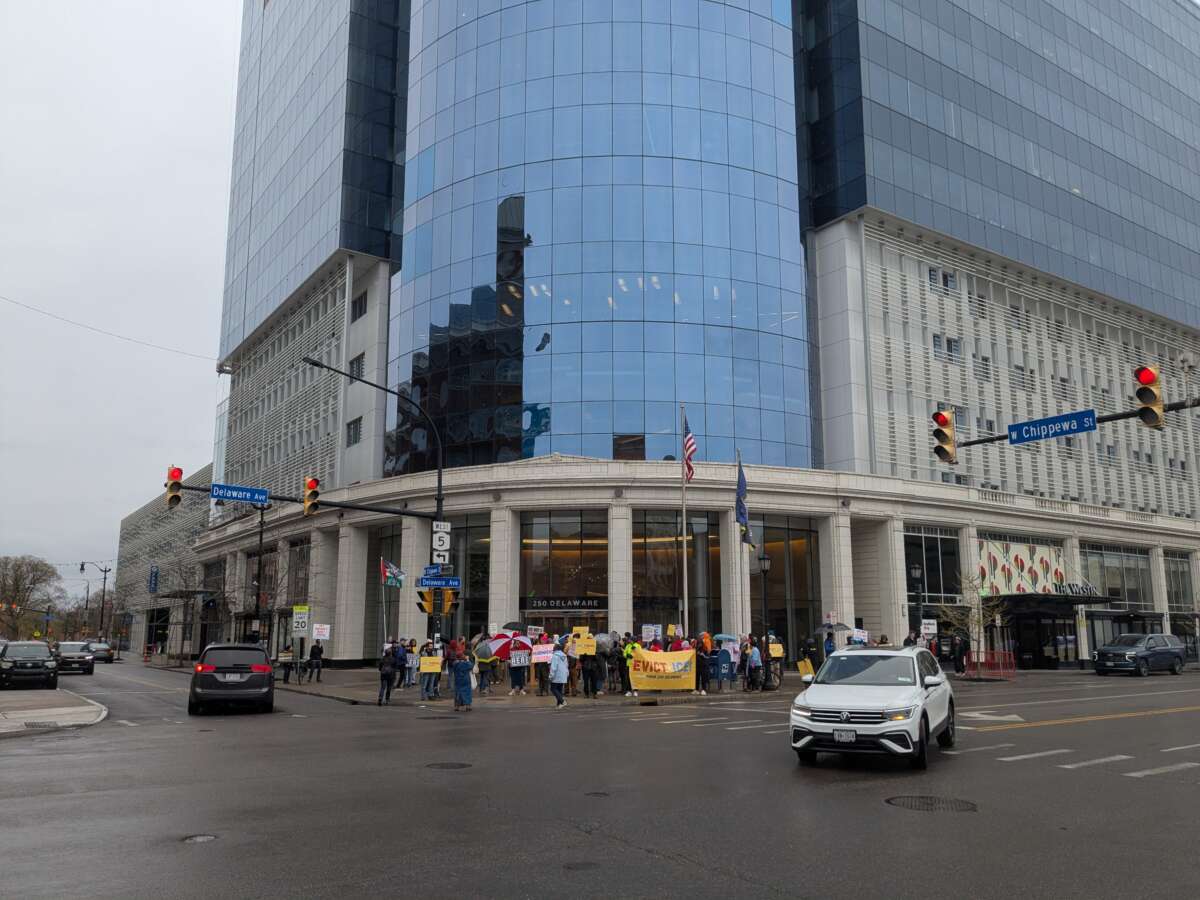
Backed by a broad coalition of community organizations and immigrant rights groups, and driven by dozens of volunteers, the campaign is working actively — canvassing and petitioning, protesting weekly, staging direct actions — to not only shame and compel Buffalo’s corporate class into evicting ICE from its properties, but also to use the campaign’s momentum to advance the more sweeping movement goals of kicking ICE out of Buffalo and abolishing the agency altogether.
On September 26, eight people were arrested as they sat down and occupied the intersection in front of 250 Delaware — which the campaign is now calling the “Montante Detention Center” — to protest “the Montante family’s continued profiteering from deportation,” according to a press release.
“The people of Buffalo will not allow mass deportation profiteers to hide any longer,” the arrestees said in a statement. “There can be no more business as usual at 250 Delaware Ave until the Montantes EVICT ICE.”
ICE’s Command Center
Buffalo is a border town — a city shaped by immigrants, past and present. The region is a focal point for Customs and Border Patrol (CBP) and Department of Homeland Security (DHS) operations, with raids, detentions, and deportations of immigrants a constant reality. Buffalo made national headlines in February after the death — ruled a homicide by the county medical examiner — of Nurul Amin Shah Alam, a blind Rohingya refugee who Border Patrol left at a downtown coffeeshop without notifying his family of his release.
The Evict ICE campaign describes ICE’s field office in 250 Delaware as the “command center” of the agency’s operations across most of New York State — essentially all areas upstate of New York City and its vicinity. Its purview also includes the nearby Batavia holding center, the state’s only ICE federal detention facility, which is expanding its capacity to hold detainees. In Buffalo, ICE arrests have soared over the past year.
“The masked men kidnapping people off the streets — that is orchestrated out of 250 Delaware,” Jennifer Connor, the executive director of Justice for Migrant Families, told Truthout.
Additionally, the building houses the Buffalo office for Homeland Security Investigations and Buffalo’s Office of the Principal Legal Advisor. Both are arms of DHS’s machinery across New York State.
The Evict ICE campaign and numerous sources say 250 Delaware contains more than piles of paperwork and ringing phones.
The campaign’s analysis of data from the Deportation Data Project found that 237 people were held at the “Buffalo Hold Room” on the 7th floor at 250 Delaware Avenue from February 2025 to March 2026, including 18 children under the age of 12. Many people were held for multiple days, exceeding ICE’s short-term holding policies, and in overcrowded conditions.
Connor says she’s spoken to multiple people who were held in 250 Delaware and that former detainees told her there are at least two holding cells in the building.
Truthout reached out to ICE’s Buffalo office for comment but did not receive a response.
For many Buffalonians, it is jarring to discover that the gleaming Delaware North Building is a place where immigrant neighbors, including children, are detained behind walls that are in plain view of passing drivers, latte sippers, and visiting tourists.
“At first I was like, ‘Oh, it’s just an office building,’” Lena Forti, an organizer with the Evict ICE campaign, told Truthout. “Now I understand that there’s so much power coming from this building. It’s directing all of ICE’s actions for New York State outside of New York City, and it’s holding people.”
Corporate Enablers of ICE
Local activists have been protesting ICE’s presence at 250 Delaware for nearly a decade. The current campaign began to take shape in 2025 among a core of local researchers and activists with mutual aid networks, immigrant rights groups, and progressive community organizations.
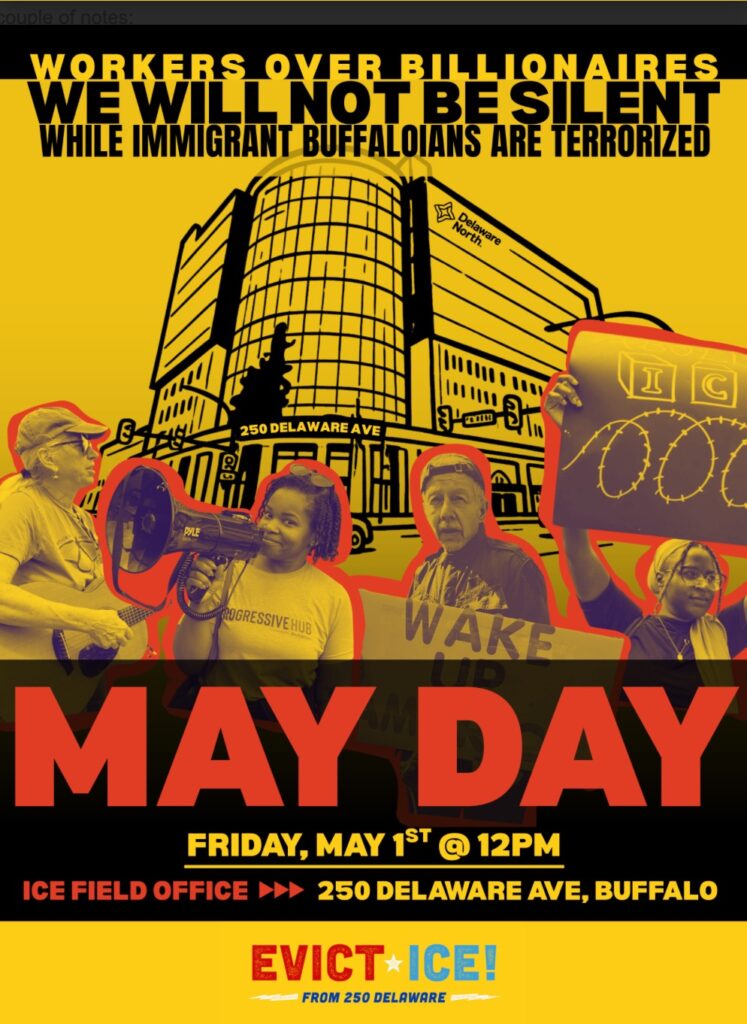
The Evict ICE campaign formally launched on May Day of 2026 with a rally in front of 250 Delaware Avenue. It has expanded to a coalition of nearly 60 organizations, small businesses, and elected officials, ranging from housing and environmental groups to labor unions and the Democratic Socialists of America, from bookstores and bike clubs to worker-owned bread co-ops.
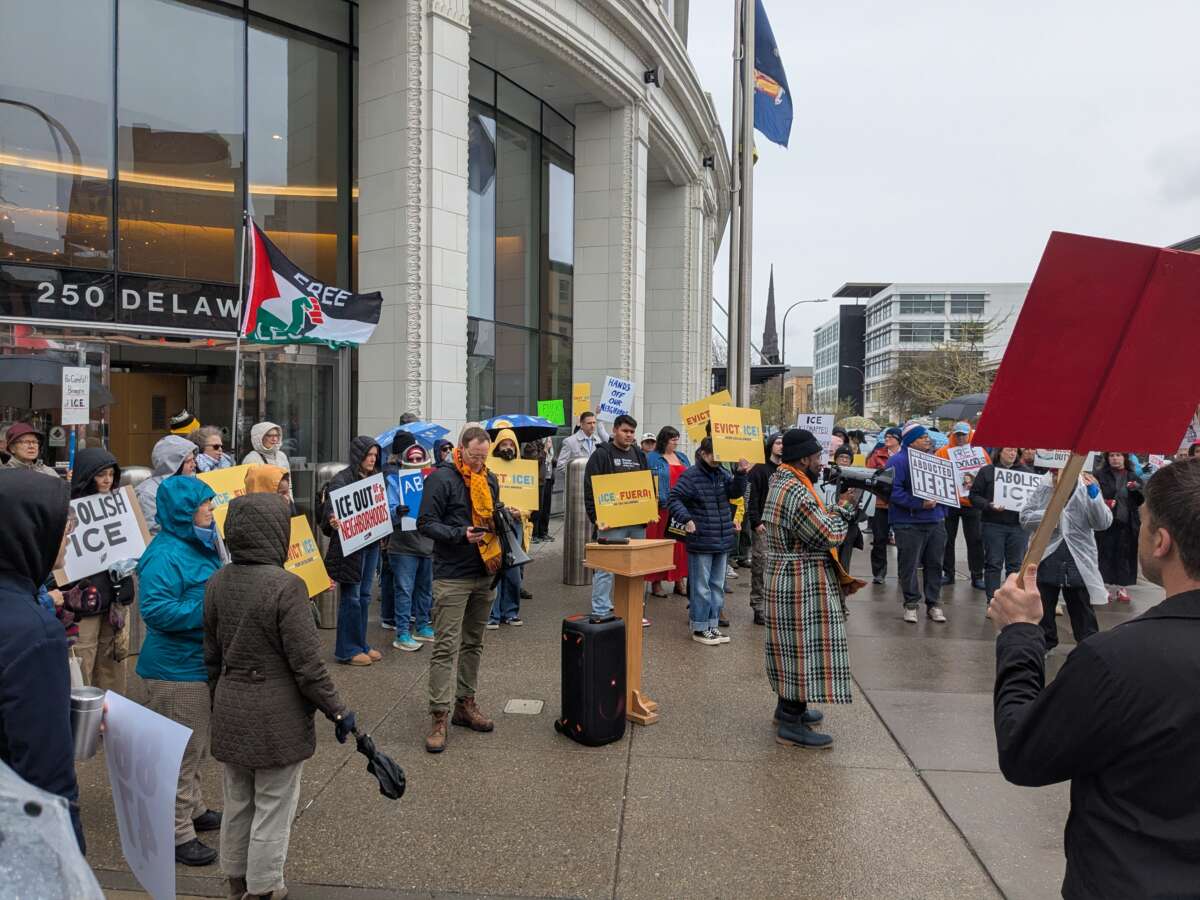
The Evict ICE campaign has a clear and immediate goal: pressuring Buffalo’s corporate enablers of ICE to not renew the agency’s lease at 250 Delaware Avenue.
Two corporations — tied to two prominent Buffalo-area families — are at the center of the campaign. The first is Uniland Development, the owner and developer of the building at 250 Delaware North. Uniland is owned by the Montante family, which has a wide presence across Buffalo’s corporate structure and network of educational and cultural institutions.
Uniland rakes in over $2 million annually by renting to ICE at 250 Delaware, in addition to around $850,000 by renting to CBP at two other locations, and it has enjoyed millions in public subsidies.
The second is Delaware North, one of the world’s largest concessions corporations, which is privately owned by the billionaire Jacobs family. Delaware North is the anchor tenant at 250 Delaware Avenue, the company’s global headquarters.
The Jacobs’ have their hands all over the Buffalo area, from universities to banks to art museums. The Jacobs family has donated to politicians from Donald Trump to Kathy Hochul, whose husband, Bill Hochul, was Delaware North’s general counsel and senior vice president until 2023. Delaware North has also raked in public subsidies.
“We have to hold the Montantes and the Jacobs accountable,” said Connor. “The types of violence we’re seeing at the hands of ICE can’t happen without the support of the existing power structures.”
Uniland and Delaware North are just two of the most prominent examples of how Buffalo’s power structure — some of the city’s traditional elite families and leading names in real estate — are profiting from the machinery of detention and deportation through lease agreements with federal agencies.
“It’s really important for us to name names of people who have a responsibility to do better in the Buffalo community,” added Connor.
“Evict ICE!”
Since its May Day launch, the Evict ICE campaign has organized a steady stream of activities and near-weekly demonstrations.
In May and June, the campaign placed billboards across from the building shaming Uniland and Delaware North and calling for ICE’s eviction. During Mother’s Day brunch, protesters held signs in front of the building’s restaurant with names of mothers who have been detained and deported. Jeremy M. Jacobs Sr. is the recent former chairman of the NHL’s Board of Governors and owner of the Boston Bruins, so protestors crashed the National Hockey League draft in June, which took place in Buffalo.
There were around 80 people at a protest and vigil at the building that I attended on July 25, organized to honor the lives and memories of those who have been killed by ICE and DHS. Labor activists, faith leaders, poets, and representatives from refugee organizations all spoke. Dozens marched around downtown Buffalo after the rally.
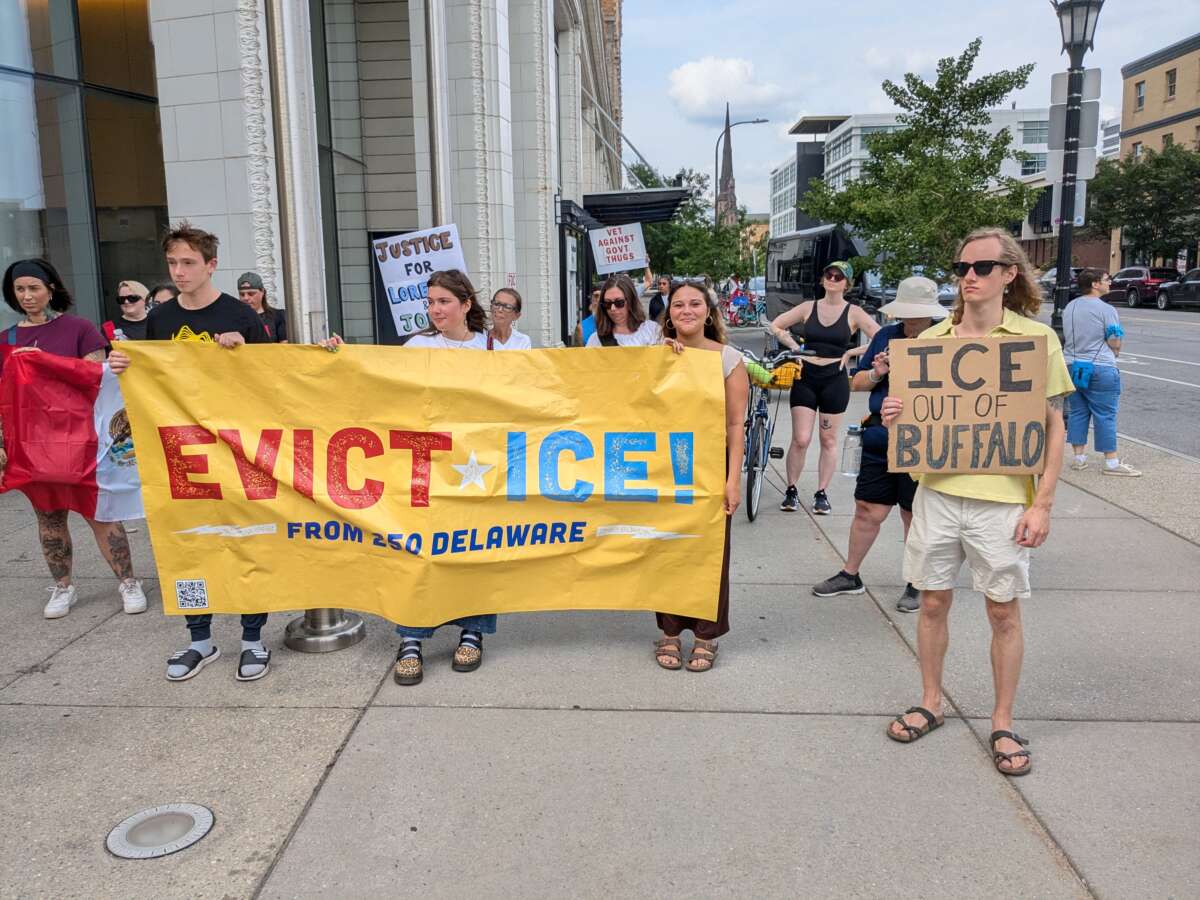
“If you really care about Buffalo, you shouldn’t be putting the safety of your pocketbook over the safety of Buffalonians’ lives,” Alicia Huff, a community activist who co-facilitated the action, told Truthout.
The campaign says it has around 85 volunteers, including new organizers who have joined canvassing teams, led protests, and managed social media efforts. It has an ongoing petition that it says over 6,000 people have signed. It sent letters directly to Uniland asking it not to renew ICE’s lease and Delaware North asking it to advocate against the lease’s renewal. The campaign told Truthout it has not received any responses.
Organizers say that one indicator of the campaign’s influence came in August when the Erie County executive, Mark Poloncarz, cancelled a planned DHS job fair that was scheduled at a government-owned building. The city of Buffalo also recently ended free downtown parking for ICE officials.
Amid loud chants of “Evict ICE!” at the July 25 protest, organizers stated their commitment to see the campaign through to victory. “We’re going to show how much opposition the entire city of Buffalo has to ICE’s field office existing here,” said Tom Griffin, another rally co-facilitator.
“We’re going to continue standing in solidarity with all of Buffalo,” said Griffin.
Power Mapping
The Buffalo campaign can also be seen as one expression of a wider strategy being deployed by movements across the U.S.: attempting to isolate and ostracize ICE by driving a wedge between the agency and the public-facing corporations and billionaires that enable its operations.
Nationally, for example, organizers across the U.S. successfully pressured Avelo Airlines to end its contract with ICE to carry out deportation flights. Additionally, activists have targeted hotels like Hilton that house ICE agents who invade localities to carry out the Trump administration’s deportation agenda.
This corporate-focused strategy has a clear logic. While movements today lack the immediate capacity to compel the abolition of ICE at the federal level, they can create friction between the agency and businesses it depends upon.
Many corporations that work with ICE have vulnerabilities. They depend on a healthy brand image or desire public subsidies. Through their sponsorships, donations, and executive and board member connections, ICE-tied corporations often have a wide presence across local and regional philanthropic, educational, and cultural institutions — all of which widen the surface area for activists to protest and confront them locally.
In Buffalo, the use of “power mapping” — researching and visualizing the relationships of entities and individuals that undergird the local power structure — has been particularly important for campaign strategy. The Evict ICE website includes visual maps of the campaign’s main corporate targets, revealing their extensive imprint across Buffalo institutions and civic and cultural life.
“Montante Detention Center”
This power mapping, in turn, cracks open tactical possibilities for organizers to protest, shame, and isolate corporate targets.
Around 50 protesters gathered on the steps of the Montante Cultural Center at Canisius University on the afternoon of Friday, September 25, asking the Catholic and Jesuit institution, a flagship Buffalo school, to join the Evict ICE campaign, and demanding it use its longstanding relationship with the Montantes, a major university donor, to pressure the family to not renew ICE’s lease at Uniland’s 250 Delaware Avenue building.
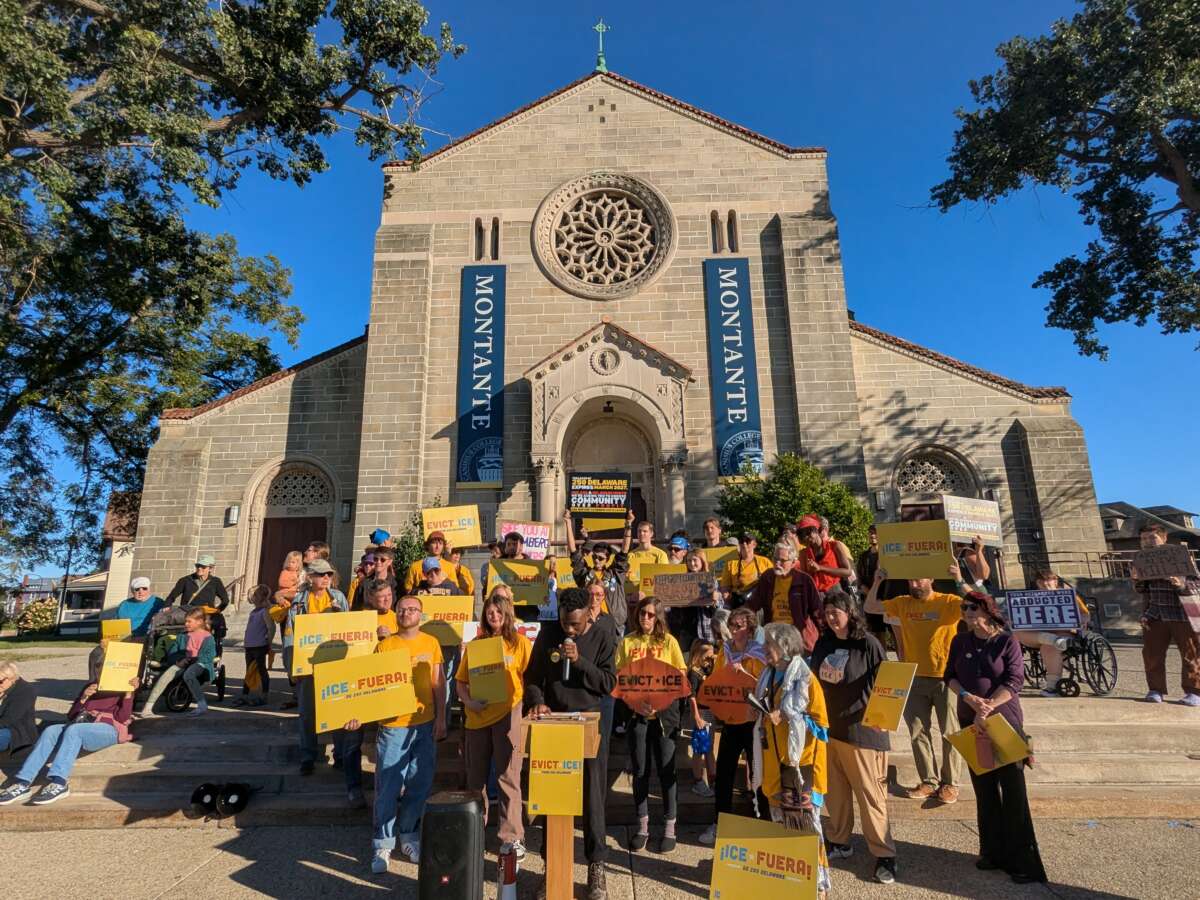
Rush-hour traffic — insofar as it exists in Buffalo — whipped by as students and alumni spoke passionately about the need for Canisius to live up to its “social justice” Jesuit values.
“I am not here just to shame my school, but to ask them to do better,” Canisius alumnus Lauren Narbe told the crowd, adding that the Montantes “are profiting off of someone’s family being ripped apart.”
“We ask that Canisius be on the right side of history, even when their largest donor is the Montante family,” Narbe said.
Canisius told Truthout in a formal statement that “we are aware of the demonstration taking place near campus and understand people’s right to express their views peacefully.”
The campaign escalated the next day, on September 26, when eight campaign activists, supported by a hundred picketers, blocked the intersection in front of 250 Delaware for two hours.
The protesters staged the action to rechristen the 12-story building the “Montante Detention Center.”
“We are renaming the ‘Delaware North’ building to reflect its owners’ abuse and greed: Montante Detention Center,” the activists said in a statement.
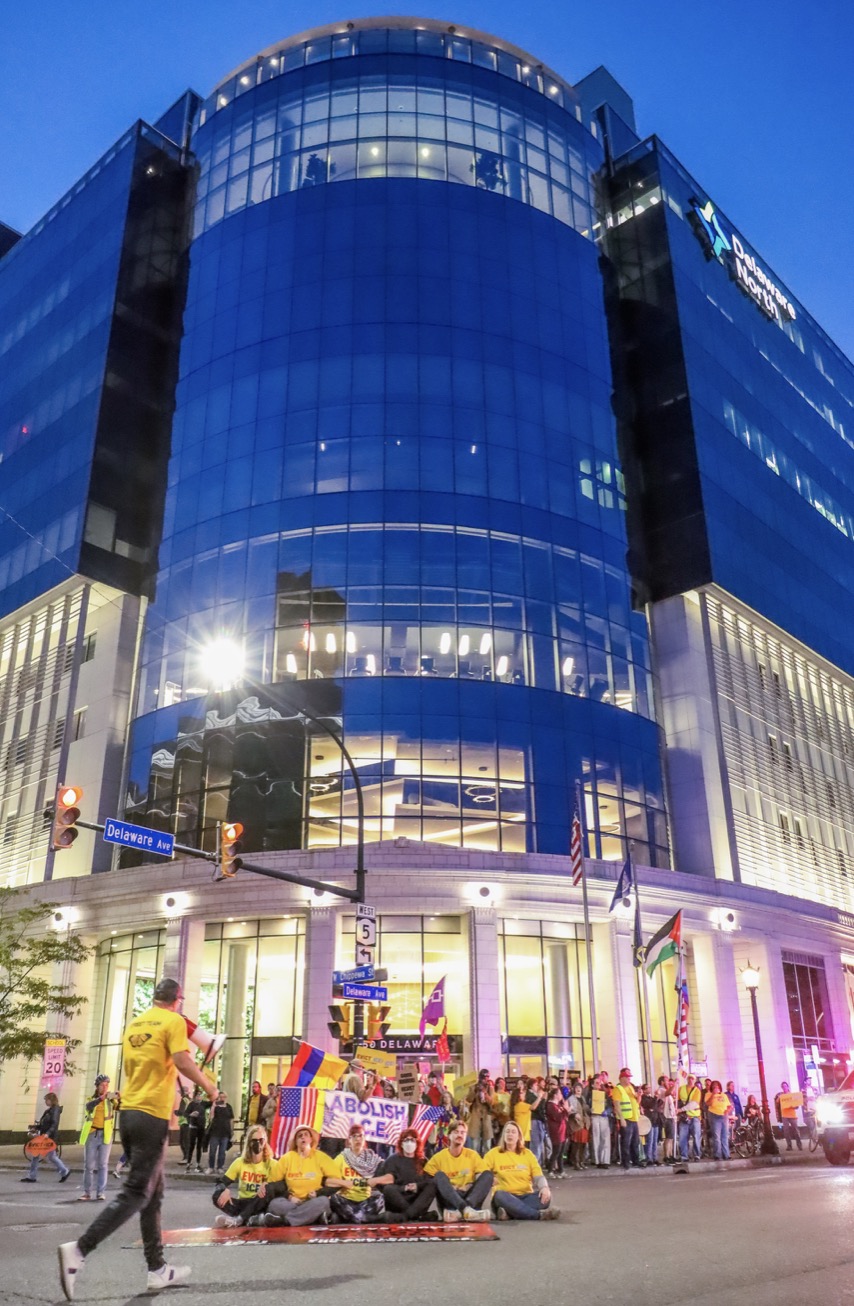
The eight activists who sat down in the intersection were arrested on charges of “disorderly conduct.”
“I find it ironic that the Buffalo Police Department arrested us for ‘disorderly conduct’ for a peaceful protest, when ICE agents are allowed to brutalize and abduct our neighbors every day,” said one arrestee in the press release.
Truthout reached out to both Uniland and Delaware North for comment on this article but did not receive responses.
On September 27, the Buffalo News published a prepared statement from Uniland saying the company was “legally and contractually obligated to honor all lease agreements and abide by their terms, just as we do with every client” and that “as with all lease agreements, the lease renewal is governed by previously agreed upon contractual terms and conditions.”
From Eviction to Abolition
The Evict ICE campaign has a ticker atop its website counting down the days until ICE’s lease in the Delaware North Building expires.
In the meantime, organizers plan to continue to ramp up protests against ICE’s corporate enablers. In a place like Buffalo, the purported “City of Good Neighbors,” this means breaking through surface-level civility and forcing powerful people — who otherwise enjoy fine local repute in polite society — to make clear which side they’re on.
“It’s very easy for Uniland to not respond,” said Forti. “To get them to evict ICE, we need to be disrupting them more and make it impossible for them to ignore us.”
I asked Harper Bishop, a key leader in the campaign, what victory would look like.
“Victory would look like ICE no longer operating its regional headquarters in downtown Buffalo,” he said, adding that this would represent an “incremental win” toward ICE’s abolition.
“Having ICE leave one building isn’t enough,” Bishop added. “This campaign is giving people the feeling that their voices and actions matter and they have the power to change material conditions on the ground.”
“It’s bringing people into the place of fighting for what we ultimately need: ICE out of Buffalo and abolished completely,” he said.
Press freedom is under attack
As Trump cracks down on political speech, independent media is increasingly necessary.
Truthout produces reporting you won’t see in the mainstream: journalism from the frontlines of global conflict, interviews with grassroots movement leaders, high-quality legal analysis and more.
Our work is possible thanks to reader support. Help Truthout catalyze change and social justice — make a tax-deductible monthly or one-time donation today.











+ There are no comments
Add yours