






Truthout is an indispensable resource for activists, movement leaders and workers everywhere. Please make this work possible with a quick donation.
After setting up robust rapid-response groups to resist Immigration and Customs Enforcement (ICE) abductions and stopping the buying up of warehouses to detain thousands of immigrants, activists are now focusing on other ways they can disrupt the Trump administration’s plans for mass deportations. On the East Coast, some are targeting the parking spots that ICE uses for staging arrests. In Buffalo, New York, people are fighting to evict ICE from an office building where they coordinate operations and detain people. In Vermont, activists are planning a week of action to shut down a major ICE surveillance center hidden away in an office park.
Vermont has a reputation as a progressive state that is home to the democratic socialist Sen. Bernie Sanders and the birthplace of Ben & Jerry’s ice cream, whose founders are known for their political activism. The second-least populous state in the country, the federal government is also taking advantage of Vermont’s remoteness to conduct surveillance on immigrants.
The National Criminal Analysis and Targeting Center is housed at the White Cap Business Park in Williston, a rural town in Vermont with a population of about 10,000. Activists say it is one of two such centers, with the other one located in Laguna Niguel, California, based in conservative Orange County.
park.
The Law Enforcement Support Center is also located nearby, on Williston’s Harvest Lane, where ICE operates a hotline for anyone across the country who wants to call in to report “suspicious activity.” The hotline center boasts that it is available 24 hours a day, seven days a week to process 55,000 hotline tips annually.
The capability to process mass amounts of data is dizzying. Both facilities are part of a “Targeting Operations Division” that processes 1.55 million biometric and biographic queries annually. ICE claims to have access to 340,000 records. The agency communicates with more than 13,000 law enforcement agencies throughout the country, many of them through an expanding network of 287(g) agreements that incentivize collaboration between ICE and local police. In 2021, the division analyzed records of some 7.7 million people for the “identification and removal of criminal noncitizens in the United States.”
Since 9/11, there has been a proliferation of these kinds of fusion centers and real-time crime centers, which amass large amounts of information for police surveillance systems. Automated license plate readers, like those sold to police by Flock Safety, have received the greatest amount of public scrutiny, but there are other tools like facial recognition technology, drones, ShotSpotter, and social media monitoring software.
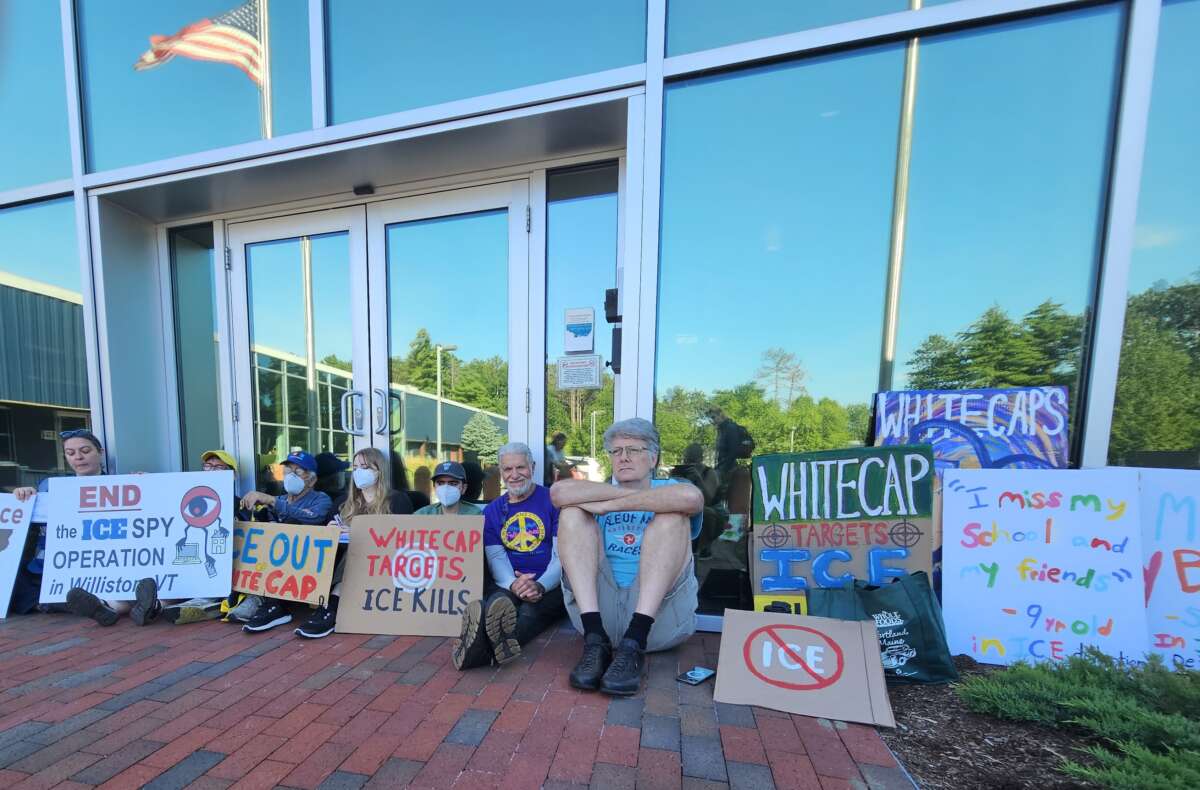
Activists in Vermont are putting a spotlight on the ICE office to expose what they call a major “spy center” carrying out an unprecedented level of state violence.
Midway Blitz Surveillance
The full scope of the government’s growing surveillance operations is not yet known, but details about last summer’s escalation of ICE violence are emerging.
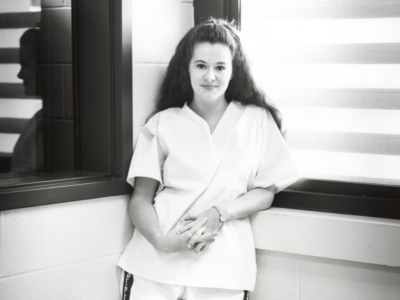
During so-called “Operation Midway Blitz” in Chicago, Marimar Martinez, a 30-year-old citizen and school teacher, was shot five times by Border Patrol agent Charles Exum. She later testified before members of Congress about the horrifying incident. Martinez’s lawyers just announced she is filing a civil lawsuit in federal court.
On October 4, 2025, while driving to church, Martinez spotted federal agents patrolling her neighborhood. She started to follow them, honking her horn and shouting “la migra” out of her window. The agents rammed into her car with their truck. Exum then got out and opened fire on Martinez’s car as she drove off. She was taken to a hospital and treated for her wounds. The next day, she was charged with assault of federal agents and labelled a “domestic terrorist” in a Homeland Security statement.
The charges against her were later dropped, but new information has come out that federal agents tapped the network of Flock automated license plate reader cameras maintained by local police in an attempt to locate Martinez. A federal attorney testified that prosecutors gathered photos from Flock cameras of Martinez’s car as she made routine trips to the grocery store and other errands in the weeks before the shooting. These images were collected in a remote federal office and given to prosecutors. The case shows how surveillance data collected by local police can become available to federal immigration investigators.
Shutting Down the Spy Center
“Surveillance is a crucial part of the ICE infrastructure that is hyper concentrated in this one town,” said Julie Macuga, who grew up in Williston, Vermont, and is one of the organizers planning the week of action, called “Shut Down ICE in Vermont.” The surveillance center is intentionally hidden, she said, “in this little town that nobody knows about.”
“Surveillance is a crucial part of the ICE infrastructure that is hyper concentrated in this one town.”
ICE has always operated in the “shadows” of Vermont, Macuga explained. There have been ICE raids at dairy farms and construction sites across the state. ICE agents have not shown up wearing masks and bulletproof vests, Macuga said. An agent could look like “some guy in a beard and flannel who could be anyone in Vermont.”
Last year, activists protested at the Burlington airport, where, they discovered, ICE was using commercial flights to deport immigrants. Activists say they have not heard any reports of ICE transporting detainees from the airport in more than a year.
Activists then turned their attention to the surveillance center in Williston. Wired magazine reported in October 2025 that ICE was hiring a dozen data analysts to work at the Williston office. Their job is to take hotline tips and create profiles of individuals by mining data from social media accounts and other government records.
surveillance center
According to a report put out by Georgetown Law’s Center on Privacy and Technology, ICE built a surveillance infrastructure during the first Trump administration that is being further expanded today. The study found that ICE has compiled a wealth of data on all residents in the United States, including driver’s license photos of one in three adults; driver’s license data of three in four adults; and utility records for three in four adults.
“The surveillance power for these centers comes through their interoperability,” Sarah Hamid, director of strategic campaigns at the Electronic Frontier Foundation, told Truthout. “The information is being collected in one context, but then it can be connected to immigration or biometric border crossing, visa, court, criminal history, and warrant data. It is operating at an industrial scale.”
In 2026, after learning that ICE was surveilling communities from these offices in rural Vermont, activists started to escalate their tactics against what activist Sharri Wormser called the “spy center.” They held noise demonstrations at the office building, canvassed other businesses there, and recorded a podcast about the center.
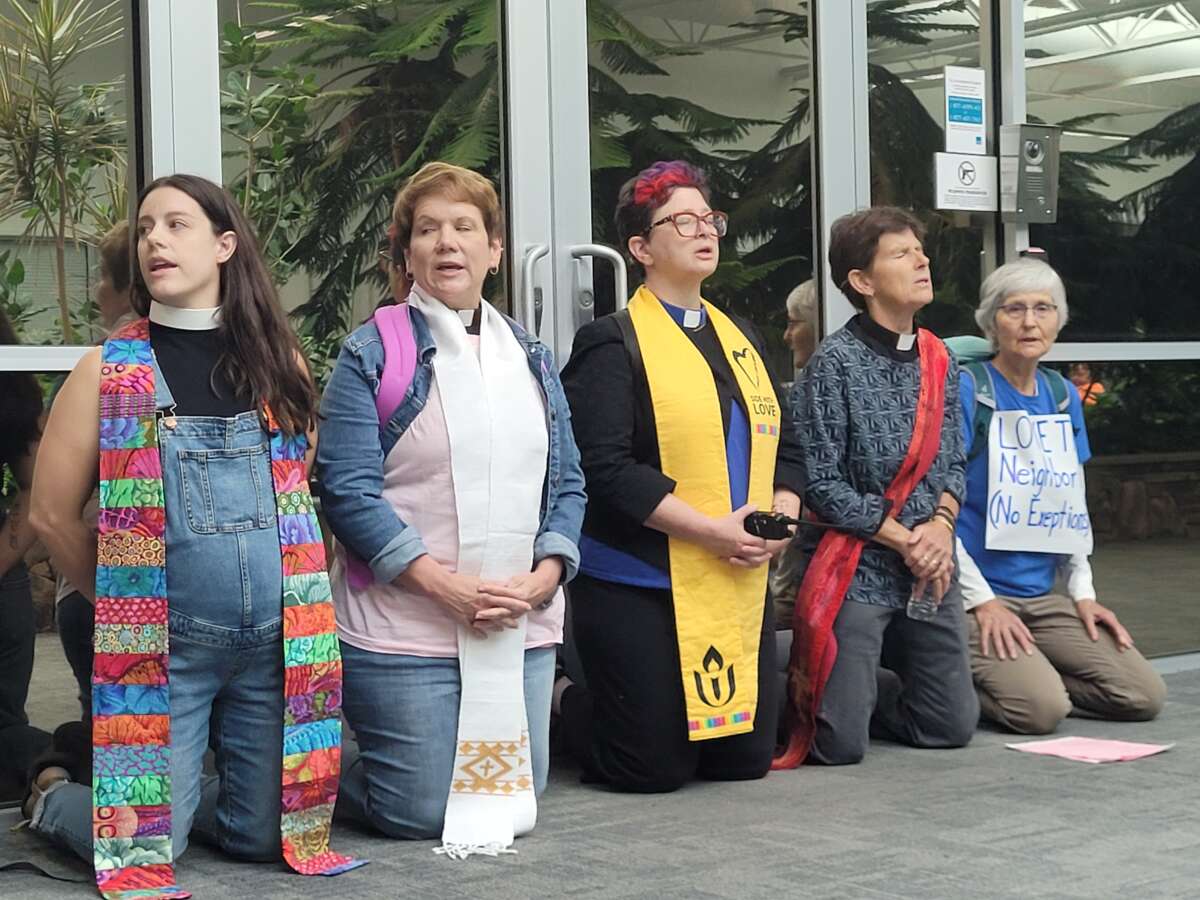
“We’ve had clergy standing outside the windows and singing prayers and offering prayers,” Wormser told Truthout.
ICE has compiled a wealth of data on all residents in the United States, including driver’s license photos of one in three adults; driver’s license data of three in four adults; and utility records for three in four adults.
Soon, they turned to acts of civil disobedience. On February 9, 2026, 11 protesters were arrested at a sit-in demanding the owner of the office park cancel the lease with ICE. On July 24, another 13 protesters were arrested after being escorted out of the building by state troopers. On May 14, four were again arrested for blockading the building. After the Chittenden County State’s Attorney refused to charge the activists, saying a prosecution would not serve the interests of justice, Vermont Attorney General Charity Clark filed trespassing charges against 13 activists. Additional federal charges were recently filed against five activists for the February action, a part of the Trump administration’s ongoing attack on First Amendment rights.
Imperial Violence
Roan Wade has been arrested twice at the National Criminal Analysis and Targeting Center and is one of those currently facing state and federal charges. They see the Vermont campaign as “intersectional,” highlighting the connections between “opposing the occupation of Palestine and opposing the violence that ICE is causing across the country.” Wade is currently on “indefinite suspension” at Dartmouth College, where as a student they participated in pro-Palestine actions.
“A lot of the surveillance technology that ICE uses is actually Israeli surveillance technology,” Wade told Truthout. “Israel has some of the most high-tech, and I guess you could call it world-leading surveillance technology. So we’re seeing a boomerang effect of imperial violence.”
Companies profiting from supplying Israel’s apartheid regime have found lucrative customers in the United States immigration policing apparatus. Elbit Systems, Israel’s largest weapons manufacturer, has helped to militarize the U.S.-Mexico border wall with surveillance camera towers. Paragon Solutions, founded by former Israeli military intelligence officers, signed a $2 million contract with ICE for Graphite, a spyware program that can hack into phones. Cellebrite, another Israeli firm, sells phone hacking technology to local police departments in the U.S.
The global exchange goes both ways. The Miami-based Palantir, a company founded by Facebook investor Peter Thiel, has millions of dollars in contracts with ICE, and has a history of working with the Israeli military.
Karen Bixler has lived in Vermont for 33 years and is participating in the week of action to shut down the ICE office. She is a lifelong activist who witnessed U.S. government surveillance firsthand during the Vietnam era. In the early 1970s, she lived in Germany and was working with U.S. soldiers being sent to fight in the war. A group she was a part of was being surveilled by military intelligence. “They were tapping phones and sending moles into places we were organizing, including lawyer’s offices,” Bixler told Truthout. “I’ve had a background of having been surveilled,” she said, “so I’m very willing to believe the worst of the worst.”
Organizers are calling for people from across the country to join the week of action in Vermont.
“We’re going to raise hell on every corner of Williston and Burlington for a week and annoy the hell out of them … There’re noise demos. There’re possibly sit-ins, lots of stuff,” said Bixler. “Hopefully we’ll keep them from working for a week.”
We lost 15 percent of our traffic overnight.
We now have three full months of data since Google changed its search to feature AI results. The numbers are worse than we anticipated. Overall readership that comes to Truthout through Google is down 54 percent against last year. The number of new readers who discover Truthout via Google searches is down 49 percent, and returning users from Google are down 51 percent.
We lost 15 percent of our readership overnight. This was a readership we painstakingly built over decades, and it vanished because Google chose corporate greed over a healthy democracy.
We anticipate a loss of roughly $500,000 in online revenue as a result of this massive traffic plunge in the next year alone.
The only way we can keep publishing is with strong reader support. We are asking you to start a monthly donation to Truthout today — anything you can do, whether $5 or $25, makes a difference.








+ There are no comments
Add yours