






Armed Conflicts, Featured, Global, Headlines, IPS UN: Inside the Glasshouse, Nuclear Disarmament, Nuclear Energy – Nuclear Weapons, TerraViva United Nations
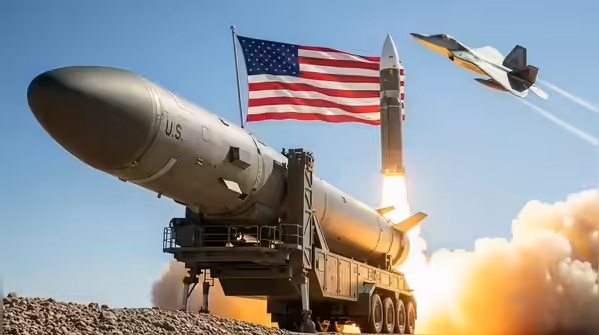
(AI image for representative purpose)
– As ongoing military conflicts in Europe and the Middle East continue with no signsof winding down, there is increasing focus on nuclear weaponsamid heightened risks of escalation.
The Stockholm International Peace Research Institute (SIPRI),in its annual assessment of the state of armaments, disarmament and international security, singles out key findings in its SIPRI Yearbook 2026 that “states are increasingly relying on nuclear weapons as instruments of national power—reversing decades of efforts to reduce the numbers and role of nuclear weapons—even as the risks of miscalculation and escalation are rising”.
World’s nuclear arsenals expanded and upgraded
The world’s nine nuclear-armed states—the United States, Russia, the United Kingdom, France, China, India, Pakistan, the Democratic People’s Republic of Korea (North Korea) and Israel—continued programmes to modernize and enhance their nuclear arsenals in 2025, and most deployed new nuclear-armed or nuclear-capable weapon systems during the year, said SIPRI.
The current military conflicts include a nuclear Russia vs non-nuclear Ukraine, a nuclear US vs non-nuclear Iran and a nuclear Israel vs non-nuclear Palestine and Lebanon.
Of the total global inventory of an estimated 12, 187 warheads in January 2026, about 9,745 were in military stockpiles for potential use.
An estimated 4,012 of those warheads were deployed with missiles and aircraft and the rest were in central storage. Between 2100 and 2200 of the deployed warheads were kept in a state of high operational alert on ballistic missiles, according to the report.
Nearly all of these warheads belonged to Russia or the USA, and to a lesser extent France and the UK, but China and India may now occasionally deploy a small number of warheads mounted on missiles during peacetime.
‘Influential voices, including some world leaders, are advocating nuclear weapons as a guarantee against attack by a hostile state. But making national defence and security strategies dependent—or more dependent—on nuclear weapons could significantly increase nuclear risks,’ said SIPRI Director Karim Haggag.
‘The dangers associated with nuclear weapons are growing due to advances in weapon technology, the breakdown of nuclear arms control and heightened geopolitical tensions, among a range of other factors. At the same time, world events—not least the outbreak of conflict between nuclear-armed India and Pakistan—are challenging nuclear deterrence logic.’
Dr M. V. Ramana, Professor and Simons Chair in Disarmament, Global and Human Security, Director pro tem, School of Public Policy and Global Affairs at the University of British Columbia, Vancouver, told Inter Press Service the continued modernization of nuclear weapons and the increased emphasis on nuclear weapons in military doctrines is a dangerous trend, especially when this is happening when many of the most military powerful countries in the world are resorting to attacking other countries with bombs, missiles, and drones rather than diplomatically settling differences.
“Any of these ongoing wars can easily escalate into ones where some country resorts to using nuclear weapons, which would result in destruction an order of magnitude greater than what is already being wrought by the weapons being used currently,” he pointed out.
Such a contingency becomes even more imaginable with the integration of Artificial Intelligence and other software tools to accelerate the kill chain, and possibly removing people from the process of deciding who to attack and what weapons to use, h argued.
Countries without nuclear weapons currently are also witnessing recommendations from influential spokespeople to consider developing a nuclear arsenal. Such a race can quickly spiral out of control, making it urgent that the world collectively step away from expanding nuclear arsenals and considering their use, and more generally, cease the use of militaristic violence to settle differences, said Dr Ramana.
Since the end of the cold war, says SIPRI, the gradual dismantlement of retired warheads by Russia and the USA has normally outstripped the deployment of new warheads, resulting in an overall year-on-year decrease in the global inventory of nuclear weapons. This trend is likely to be reversed in the coming years, as the pace of dismantlement is slowing, while the deployment of new nuclear weapons is accelerating.
‘The evidence is growing that the nuclear weapon states are sidelining, and even walking away from, their disarmament commitments and are instead flexing their nuclear muscles,’ said Hans M. Kristensen, Associate Senior Fellow with SIPRI’s Weapons of Mass Destruction Programme and Director of the Nuclear Information Project at the Federation of American Scientists (FAS).
‘By reaching for nuclear solutions, states are creating new risks and fuelling arms-race dynamics,’ he said.
Dr. Natalie Goldring, the Acronym Institute’s representative at the United Nations, told IPS the nine countries with nuclear weapons are engaged in extremely destabilizing behaviors — developing new weapons, increasing the size of their nuclear arsenals, abandoning arms control frameworks and verification systems, and threatening to use nuclear weapons in response to conventional weapons attacks, among other dangerous moves. Each of these choices increases risk; taken together, the potential consequences are terrifying.
Even the existence of nuclear weapons poses enormous military, economic, and environmental threats, among others. Fortunately, there’s a promising way forward — the Treaty on the Prohibition of Nuclear Weapons (TPNW), which rejects the contention that nuclear deterrence and continued development of new nuclear weapons somehow make us safer.
Under the TPNW, States commit themselves to not develop, test, produce, acquire, possess, stockpile, use, or threaten to use nuclear weapons. The TPNW has 74 States Parties, with an additional 25 signatories that have not yet become States Parties. It’s arguably our best hope of breaking the cycle of continual upgrades and “modernization” of weapons, while decreasing nuclear threats.
“We don’t know whether the fact that nuclear weapons haven’t been used in wartime since the United States military dropped nuclear bombs on Hiroshima and Nagasaki is because of luck, skill (including deterrence), or a combination of those factors. Proponents of deterrence don’t tend to talk about the role of luck. They also don’t tend to talk about the risk of nuclear use through accident or miscalculation. That’s a short-sighted, high-risk approach. Militaries frequently have accidents; they also frequently fail to correctly calculate their adversaries’ capabilities and motivations.”
“The inherent risks of these weapons are compounded by the individuals involved. For example, US President Donald Trump is a threat to international security. He is unpredictable, prone to fits of rage, disinclined to listen to or learn from experts, and poorly informed about specific and general US military policies. And because of US nuclear weapons policy, he has the authority to order the launch of nuclear weapons without anyone else needing to confirm that order. That’s an extraordinarily dangerous situation, especially given his volatility.”
Recent events also increase risk. For example, the New START Treaty limited the number of deployed nuclear weapons for both the United States and Russia and contained useful verification provisions. Unfortunately, the treaty expired in February 2026, removing both the numerical limits on US and Russian nuclear stockpiles and the verification procedures.
Another example is the recent conclusion of the 2026 Review Conference on the Nuclear Non-Proliferation Treaty. This conference continued the pattern from the previous two review conferences, as States were not even able to agree on an outcome document. More importantly, the five nuclear weapons states defined by the treaty (the US, Russia, the United Kingdom, China, and France) continue to fail to meet their commitment to disarmament under Article VI of the Nuclear Non-Proliferation Treaty.
“The US’s stated reliance on the idea of nuclear deterrence may have encouraged other countries to do the same. I remember being at a meeting many years ago, where a South Asian diplomat asked me why the US government was so arrogant that it thought it had a monopoly on nuclear deterrence. He said there was no reason that India and Pakistan couldn’t or shouldn’t have a similar set of strategies. TPNW provides a more sensible answer – all of these States should renounce nuclear weapons.”
IPS UN Bureau Report









+ There are no comments
Add yours