





Support justice-driven, accurate and transparent news — make a quick donation to Truthout today!
This summer, military forces from 30 nations are gathering in Hawaii for Rim of the Pacific (RIMPAC) 2026, the world’s largest maritime exercise. For its organizers, RIMPAC isn’t just five weeks of trainings, drills, and live-fire exercises — it’s an opportunity to enhance coordination and communication (what the military calls “interoperability”), which they say is critical for military operations, humanitarian assistance, disaster response, and other contingencies.
First held in 1971, the biennial RIMPAC includes 25,000 personnel, 40 surface ships, 5 submarines, and 140 aircraft. RIMPAC organizers say the exercise promotes regional stability and provides an economic boost for Hawaii.
But for opponents, RIMPAC exemplifies a global order structured around militarism and regional domination. They say RIMPAC calls into question the true costs of an increasingly militarized Pacific where international cooperation and economic prosperity are predicated on the threat of military force and characterized by environmental degradation with overstated economic benefits. Critics say the exercise is an insult to Hawaiian culture, sovereignty, and society.
A Nation Devoted to Peace
Jonathan Kay Kamakawiwo’ole Osorio, a professor of Hawaiian studies at the University of Hawaii Manoa, told Truthout that “the United States has this understanding of Pacific Islands and Hawaii as important to its ambitions in Asia.”
“If you’re going to talk about RIMPAC … those exercises are all about ‘how do we prepare for warfare that would be conducted most likely with a Eurasian enemy,’ but would certainly involve these Pacific islands in one way or another.”
Referring to the formerly independent Hawaiian Kingdom prior to its illegal overthrow by the U.S. in 1893, Osorio says RIMPAC has enveloped Hawaii “despite the fact that our nation, our Kingdom was devoted to peace, did not militarize, and saw our relationship with other countries in the world … as unquestionably peaceful and where diplomacy was the actual tool that we used to further our own interests.”
Pacific in Name, Global in Practice
Most RIMPAC participants are Pacific or Asian nations, but this year’s exercise also includes eight European countries. The Israeli navy is also participating for the fourth time. An Israeli military spokesperson declined to provide information about the number of personnel participating, the type of exercises it would join, or the equipment it would deploy.
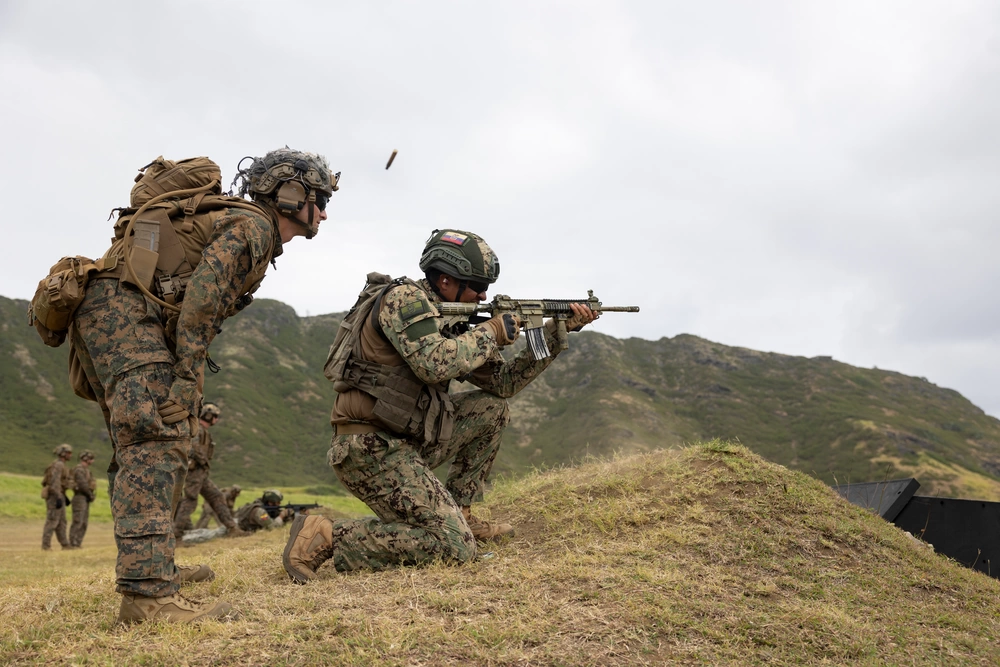
RIMPAC takes place on and below Hawaiian waters, on land, in the air, and in space and cyber domains with activities including anti-submarine warfare, mine clearance, explosive ordnance disposal, and amphibious raids. RIMPAC includes sinking exercises in which several countries coordinate to target, fire upon and sink decommissioned naval ships. RIMPAC also provides an opportunity to test new capabilities including unmanned systems and robotic surface vessel-fired missiles.
This comes as all major military spending metrics are on the rise: Global military spending is up. Nuclear weapons spending is up. U.S. military spending is up, and the Trump administration is calling for a record-smashing military budget increase to $1.5 trillion for fiscal year 2027. A recent report by the Project on Government Oversight argues that the true cost of military spending is vastly underestimated.
As a large-scale mobilization of military hardware crossed the Pacific Ocean to converge in Hawaii, Laurie Moore, executive director of the state’s Military and Community Relations Office (MACRO), told Truthout in an email, “RIMPAC isn’t just about ships and aircraft. It’s also about relationships.” She said Hawaii’s unique location and diverse population makes it a “natural place to bring partners together.”
RIMPAC does allow the militaries of different nations to cooperate in activities like urban combat and sniper training. During the 2018 RIMPAC, Japan’s Ground Self-Defense Force coordinated with the U.S. and Australia to fire HIMARS rockets in Japan’s first such launch from U.S. territory.
Moore said that “Hawaii’s land and ocean resources are among its greatest assets, and their protection must remain a priority,” adding, “MACRO supports continued efforts to incorporate lessons learned and ensure that training activities are carried out responsibly and with respect for Hawaii’s natural and cultural resources.” That message was delivered to RIMPAC participants in a MACRO-produced video presentation.
The U.S. military has faced increased scrutiny in Hawaii after a series of major fuel storage leaks contaminated residential drinking water in 2021. In May, the Institute for Policy Studies (IPS), the Cost of War Project, and others published a report entitled The True Cost of the Military in Hawaii which analyzes the economic, environmental, strategic, and social impacts of military activities in Hawaii. The report examines what it calls “the myth of military environmental stewardship.”
Uneven Geographies
In an interview with Truthout, one of the authors of the IPS report, Laurel Mei-Singh, an assistant professor with the department of geography and environment at the University of Texas at Austin, said militarism reorders collective life according to the needs of the military. The report, which challenges commonly held beliefs about the military contribution to Hawaii’s economy, asserts a litany of harmful outcomes and offers alternatives to military dependency, including a chapter on the public health impacts to communities living near military bases.
“We get used as the weapon against adversaries, but it also puts a bullseye on our back.”
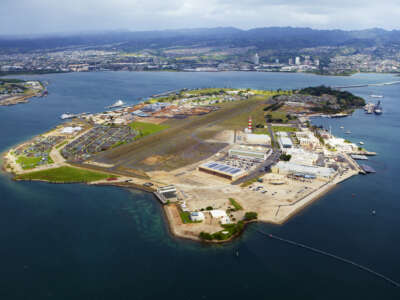
Mei-Singh, who was born and raised on Oahu, says the military presence in Hawaii separates Native Hawaiians from ancestral lands and is associated with poor health outcomes in communities living near military bases. “People on the Waianae Coast [west Oahu] and places like Pearl Harbor self-report poor or fair health at significantly higher rates than the rest of the island,” Mei-Singh said. The chapter she co-authored examines pollution, access to resources, and public health in those highly militarized communities and the disparities even among militarized parts of Oahu.
“There are the obvious environmental impacts of RIMPAC … very much bound with societal impacts because people depend on the natural resources including the ocean resources,” Mei-Singh said. “While RIMPAC might bring some short-term economic activity to the islands, we need to consider the much more long-term costs that we outline very thoroughly in the report.”
Kyle Kajihiro, an assistant professor of ethnic studies at the University of Hawaii, also contributed to the IPS report. He told Truthout that while RIMPAC is characterized as a form of strategic and economic security, it can also be seen as provocative to rival nations, specifically China. Kajihiro points to the concentration of U.S. military bases in Persian Gulf states which, instead of ensuring security, became targets in the U.S.-Israeli war against Iran.
“When we think about potential for a war with China, all these places in the Pacific, including Hawaii, Guam, Okinawa, all potentially become targets in that conflict. We get used as the weapon against adversaries, but it also puts a bullseye on our back,” said Kajihiro.
Kajihiro sees a connection between RIMPAC and wars in other parts of the world, particularly the Middle East. He cites pro-peace groups who charge that RIMPAC normalizes relations with states accused of war crimes and human rights violations, pointing to RIMPAC participants Israel and Indonesia as examples.
“One of the things that our report points out is that we’ve been told that the enormous military presence benefits Hawaii economically and for security purposes … This is an attempt to look at a critical assessment of those costs that haven’t been taken into account.”
Economic Injection
Criticism of military activities in Hawaii can be a difficult position to take when so many residents and businesses depend on the military for their income, but the recent IPS report argues economic benefits are overstated and other costs are hidden. Organizations like MACRO and Hawaii’s Chamber of Commerce see RIMPAC as an important economic driver.
In an email to Truthout, Jason Chung, vice president of the Chamber of Commerce of Hawaii’s Military Affairs Council, praised RIMPAC’s contribution to Hawaii’s economy which he described as a “meaningful short-term economic injection for local businesses.”
The figure of $50 million injected into Hawaii’s economy is frequently cited as an economic impact of RIMPAC, although that number is over a decade old and its source is unclear. Hawaii’s Department of Business, Economic Development & Tourism did not respond to a query about RIMPAC’s economic benefit.
“What is the cost to our community? We’re getting all the exhaust. Every time they dump chaff we’re getting it in our community.”
Chung also acknowledged the legitimacy of RIMPAC critics’ concerns about environmental stewardship and other community impacts and said there needs to be “transparency, accountability, mitigation, and sustained dialogue” between the military and local officials and affected communities.
“Any large event (military or non-military) creates impacts that should be communicated and managed. RIMPAC organizers should continue to engage early with the state and community, explain what is occurring and why, and demonstrate how concerns are addressed,” Chung said.
The U.S. Navy Third Fleet and RIMPAC organizers did not respond to multiple requests for comment.
Polluted Water, Air, and Land
Speaking from the west side of Oahu, Sparky Rodrigues, a Native Hawaiian who served as a Navy Seabee during the Vietnam war, was strongly opposed to the militarized state of Hawaii and RIMPAC. “It doesn’t benefit our community,” Rodrigues said.
From excessive aircraft noise to fallen ash generated by military activity, contamination and unexploded ordnances on land and in the ocean, Rodrigues told Truthout that, “their presence, their activity has been very abusive to our community.”
“RIMPAC is really the culmination of all these individual community impacts …What is the cost to our community? We’re getting all the exhaust. Every time they dump chaff [small aluminum-coated glass fibers used as a radar countermeasure] we’re getting it in our community and we can’t even see it but we’re going to end up absorbing all of that. So, for me, ‘No RIMPAC.’”
Growing a Different Future
Also on west Oahu is Kukui Maunakea-Forth, founder and executive director of MA‘O Organic Farms, which covers around 500 acres on the Waianae Coast. The farm is located next to a more than 9,000-acre naval complex and radio transmitting facility. MA‘O is focused on bolstering community farming, youth education, Indigenous agroforestry, and biocultural restoration. “Our goal is to malama (care for) all those lands,” she told Truthout.
“The thing about RIMPAC is that it hurts our land. Anything that hurts our land, it hurts us.”
Speaking about land once farmed by Native Hawaiians where water is now diverted for fire control on military-occupied land, Maunakea-Forth said “the lack of care of those lands is concerning.” She talked about the importance of building relationships, encouraging better land stewardship, and developing a Native Hawaiian work force with the skills to manage the land for “when they do leave,” referring to what she envisions will be the military’s eventual departure.
“The thing about RIMPAC is that it hurts our land. Anything that hurts our land, it hurts us,” she said. Maunakea-Forth says MA‘O is working to bolster education and improve local food security. “I think MA‘O doesn’t have a specific position on all the things that are happening on our land without our consent. So maybe that’s where I’ll leave it because all of the things that have happened to our people have happened without our consent. We never left. We are still here and we never relinquished our ea (sovereignty).”
“There’s an economy around RIMPAC that is so deep and on its own is probably exploitive and extractive and those things are antithetical to our values,” Maunakea-Forth added.
When she sees trucks driving onto the nearby military base, a facility she describes as “literally falling apart,” she reflects that the community could be using that land to grow food and house people or to stimulate economic activity.
She says the problem is not only RIMPAC. “Our target is not just the military. It’s about all misuse of aina (land) and the resources that we depend on for life.”
“For us we live in that reality every day.”
Important Message: Please Read
For 25 years, Truthout has survived by publishing impactful investigative journalism and analysis; distributing full editions 365 days a year; and building a community of readers who support us with small, hard-earned donations.
Eighty percent of our $3 million yearly budget comes from small donors alone. Of those, 8,000 readers support us with monthly donations. Back in 2018, when Facebook decided to suppress the circulation of posts made by organizations, thereby cutting readers off from seeing many articles shared by the news organizations they had intentionally decided to follow, Truthout’s total traffic declined by 40 percent, as nearly all of our traffic from that platform disappeared.
As Google plans to roll out its new AI search bar, providing shoddy AI summaries instead of directing readers to our site, the consequences promise to be even more explosive. Google Search is our single largest source of traffic; it’s the route by which 27 percent of our readers find us. If even half of that 27 percent disappears, it will have a devastating impact on our journalism.
The entire journalism ecosystem will shoulder this blow, particularly independent publishers and news sites that depend on traffic and aren’t bankrolled by large corporations. If you can support Truthout with a donation today, you can help us resist the inevitability of Big Tech’s AI takeover. Please give today.




+ There are no comments
Add yours