





Part of the Series
Struggle and Solidarity: Writing Toward Palestinian Liberation
Did you know that Truthout is a nonprofit and independently funded by readers like you? If you value what we do, please support our work with a donation.
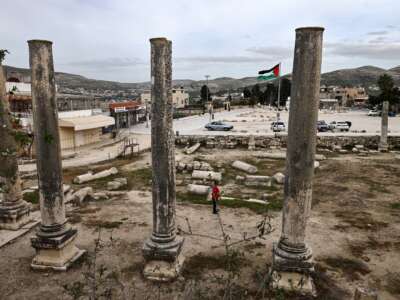
Since the beginning of Israel’s war on the Gaza Strip, archaeological sites, museums, and historic buildings have suffered extensive destruction. Hundreds of heritage objects are now at risk of being lost beneath the rubble or damaged as the buildings that once housed them are destroyed. Amid this devastation, Palestinian volunteers are working to rescue what remains of Gaza’s cultural heritage and protect it from deterioration and disappearance.
International figures reveal the extent of the damage inflicted on Palestinian cultural heritage. According to an update published on March 25, 2026, the United Nations Educational, Scientific and Cultural Organization (UNESCO) had verified damage to 164 cultural sites in the Gaza Strip since October 7, 2023. These included 14 religious sites, 128 historic or artistic buildings, three depositories of movable cultural property, nine archaeological monuments, two museums, and eight archaeological sites. UNESCO’s assessment is based on satellite imagery analysis, alongside limited field assessments where security conditions and access permit.
A report by the United Nations Independent International Commission of Inquiry, published among the documents of the UN Human Rights Council, also referred to a World Bank assessment from February 2025 estimating that 53 percent of Gaza’s heritage sites had been damaged or destroyed. The World Bank estimated the damage to heritage sites at approximately $120 million, while economic losses in the sector were estimated at $55 million.
Amid this destruction, the Heritage Guardians team, affiliated with the nongovernmental Mayasem Association for Culture and Arts, began its work in late 2024 with a small group of 20 volunteers. They established a temporary storage facility inside a tent in the Al-Mawasi area of Khan Younis, where they preserve archaeological and heritage objects rescued from destroyed buildings and endangered sites.
Shaimaa al-Natour, assistant coordinator of the Heritage Guardians project at the Mayasem Association, says the initiative began with an effort to save the Al-Qarara Museum. The volunteers agreed on the urgent need to remove the objects inside and around the museum and transfer them to a relatively safer location. Their efforts later expanded to include other artifacts at risk of being lost.
Al-Natour says the volunteers have visited archaeological sites and damaged buildings to recover heritage objects and transport them to the team’s temporary storage facility. There, the objects are cleaned, restored, documented, and placed in wooden boxes for safekeeping.
The volunteers’ concerns reflect warnings from international organizations working to protect cultural heritage. The International Council on Monuments and Sites has documented extensive damage to historic and archaeological sites in Gaza, warning that the continuation of the war increases the risk of losing Palestinian cultural heritage.
The tent houses hundreds of heritage and archaeological objects that were damaged or endangered after the destruction of the buildings and museums in which they had been kept. Although the tent does not provide ideal conditions for long-term preservation, it offers temporary protection until the damaged heritage sites and museums can be restored and the objects returned to their original locations.
Al-Natour explains that the team follows a process that begins with field surveys to identify owners of private museum collections and archaeological artifacts. The volunteers then coordinate the transfer of the objects to the storage facility. Once the items arrive, they clean and restore them, document their details, archive the records in both paper and digital formats, and place the objects in wooden boxes.
Each object is assigned an identification code linking it to its owner. The team also assigns each collection owner a code that helps identify the number of artifacts in their possession, allowing the volunteers to track the objects and preserve their records.
However, the volunteers’ work is not limited to the objects they have managed to recover. According to al-Natour, the team has identified and documented around 300 additional artifacts that it has been unable to retrieve because they are located in dangerous areas that remain inaccessible.
Al-Natour warns that other heritage objects are at risk of disappearing after residents discover them among the rubble without recognizing their historical value. This increases the likelihood that the objects could be lost or handled in ways that cause further damage.
The team consists of 20 volunteers united by a common goal: protecting Gaza’s Palestinian cultural heritage despite the severe security and logistical challenges facing their work.
Among the main obstacles, al-Natour says, are the dangers of reaching archaeological sites, difficulties with transportation, and the shortage of materials needed to restore heritage objects. She says Israel has prevented these materials from entering the Gaza Strip since the beginning of the war.
These challenges are compounded by the scale of destruction affecting Gaza’s archaeological sites. Hamouda al-Dahdar, director of the Archaeological Sites and Excavations Department in Gaza’s Ministry of Tourism and Antiquities, said that 220 of the Strip’s 380 archaeological sites had been destroyed.
Al-Dahdar also stated that approximately 25 percent of archaeological sites are located within what is known as the “Yellow Line,” limiting the ability of relevant authorities and preservation teams to reach these locations, assess the damage, or rescue the remaining artifacts.
The comparison between local and international figures highlights the importance of distinguishing between sites that have sustained damage and those that have been completely destroyed. UNESCO’s figures refer to cultural sites the organization has verified as damaged; they do not necessarily mean that every site has been entirely destroyed. Differences between international and local figures may reflect variations in the definitions of heritage sites, the scope of documentation, and the dates of assessment.
Amid these risks, the Heritage Guardians team continues working with limited resources, attempting to recover objects that remain accessible, document them, and protect them while awaiting the conditions necessary to return the artifacts to their original locations.
Between the objects retrieved from the rubble and those still trapped in areas that volunteers cannot reach, the team’s mission extends beyond protecting physical artifacts. It is also an effort to preserve traces of Gaza’s history and cultural identity at a time when widespread destruction threatens to sever these objects from the places and communities that have safeguarded them for generations.
Press freedom is under attack
As Trump cracks down on political speech, independent media is increasingly necessary.
Truthout produces reporting you won’t see in the mainstream: journalism from the frontlines of global conflict, interviews with grassroots movement leaders, high-quality legal analysis and more.
Our work is possible thanks to reader support. Help Truthout catalyze change and social justice — make a tax-deductible monthly or one-time donation today.





+ There are no comments
Add yours