







Truthout is a vital news source and a living history of political struggle. If you think our work is valuable, support us with a donation of any size.
In 2004, Microsoft’s future chief sustainability officer, Melanie Nakagawa, co-edited a law journal issue on Indigenous peoples’ right to prior informed consent. This month, as a data center developer routed around exactly that standard in New Mexico, she didn’t answer whether it applies to her own company’s work.
Ask Google, Amazon, and Microsoft whether they consult Native nations before building a data center, and you’ll get the same answer: silence dressed up as sustainability commitment — as if the law here were unsettled, rather than two centuries old. Chief sustainability officers operate by ESG (environment, sustainability, governance) principles that imply tribal consultation, typically executed either to pacify objecting community members or to comply with an environmental review process. ESG reports are meant to define a company’s community impact but instead serve as shields for deals structured to sidestep responsibility.
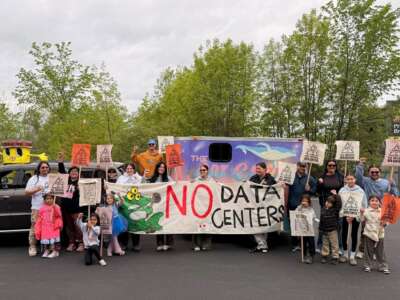
Project Jupiter, a 1,400-acre Oracle and OpenAI hyperscale data center under development in Santa Teresa, New Mexico, is leased by these tech titans from BorderPlex and Stack: two companies handling physical infrastructure, simultaneously distancing the lessees from responsibility for their environmental and tribal impacts.
ESG (environment, sustainability, governance) reports are meant to define a company’s community impact but instead serve as shields for deals structured to sidestep responsibility.
On August 23, the New Mexico Supreme Court temporarily halted construction for air quality review and ordered a state engineer to diminish water use. Oracle has forecast its use of 11 million gallons of water for an initial fill, plus roughly 168,000 gallons per year in ongoing maintenance. Sen. Melanie Stansbury has separately put the figure at “over a million gallons a day” — a gap neither company nor state officials have reconciled. Lisa Henne, general counsel for the Interstate Stream Commission, told Truthout the water used for construction is purchased from an existing water right holder, not a new appropriation, and that New Mexico’s Pueblos — all located upstream of Elephant Butte Reservoir — aren’t affected, since Jupiter sits in the Lower Rio Grande, a separate hydrological zone.
That leaves an open question: Ysleta del Sur Pueblo, based across the state line in Texas, sits in the same Lower Rio Grande stretch, closer to the site than any New Mexico Pueblo. Asked whether the Commission had been in contact with the Pueblo, Henne confirmed it had not. She added, though, that the Commission “would not expect” the project to affect it, based on the same reasoning she applied to New Mexico’s own Pueblos. In other words: no contact, but a conclusion about impact reached anyway.
Even that thin standard assumes someone’s title implies responsibility. OpenAI has no chief sustainability officer at all. The closest approximation would have been the company’s Head of Data Centers Chris Malone, who just left the company in August amid a wave of executive departures, leaving infrastructure decisions split across engineers with no explicitly named party responsible for considering environmental or community impact.
Zephyr Jaramillo of Isleta Pueblo, speaking for Youth United for Climate Crisis Action at the Santa Fe County hearing, put it plainly: “Communities are already considering considerable harm … We look forward to engaging with communities throughout this process.” Whether that engagement extends to Project Jupiter and the Pueblos with senior water rights along its stretch of the Rio Grande, remains an open question that no one — not Oracle, not OpenAI, and not the state — has yet answered.
Amazon is the sole data center builder that appears to uphold a minimal standard of tribal consultation. Teara Farrow Ferman, the program manager for the Department of Natural Resources’ Cultural Protection Program, says, since 2019, the company has held monthly meetings with the Confederated Tribes of the Umatilla Indian Reservation (CTUIR), signing a memorandum of understanding with the tribes in 2023, and funding cultural mitigation projects and community programs.
But even here, true prior informed consent remains out of reach: CTUIR learns of new projects only once Amazon’s internal site-review process is already underway, after land and design decisions are effectively locked in. What’s more, the relationship only works because Amazon builds exclusively on private and municipal land. The company’s data centers sit on what the tribes call aboriginal, or ceded, territory. But under the Stevens Treaties, hunting and gathering rights attach only to land that remains publicly owned and “open and unclaimed,” not to land that’s since been privately developed. Fishing rights at usual and customary places are broader and persist regardless of ownership. But hunting and gathering rights are narrower, and it’s those rights — not fishing — that might otherwise compel something more than a courtesy conversation on land like this. On these specific parcels, the broader treaty obligation simply doesn’t reach.
Amazon’s relationship with CTUIR isn’t uniformly cooperative, either. When Amazon made the announcement of plans for small modular nuclear reactors near Hanford to help power its Umatilla and Morrow County data centers, CTUIR issued a formal statement opposing any “expansion of nuclear energy” unless developers actually sought permission through the CTUIR government, Oregon Public Broadcasting reported in January 2025.
When asked whether Amazon has a company-wide tribal consultation policy that applies before site selection, or whether the CTUIR agreement is a template used elsewhere, Amazon spokesperson Margaret Callahan said only that the company’s “partnership with the Confederated Tribes of the Umatilla Indian Reservation reflects years of direct collaboration in eastern Oregon … grounded in listening and long-term partnership.”
Her response did not answer the question directly. If the industry’s best example of consultation still draws objections from the nation it consulted with, and the company won’t say whether it’s a policy or a one-off, the standard itself is the problem, not just the companies falling short.
If the industry’s best example of consultation still draws objections from the nation it consulted with, and the company won’t say whether it’s a policy or a one-off, the standard itself is the problem, not just the companies falling short.
Microsoft Communications Director Jennifer Lyons, when asked about tribal consultation specifically, offered only this: “Indigenous and tribal communities are an integral part of many of the communities we operate in … we strive to engage with the community early, and both understand and support community-informed priorities.” This framing folds sovereign Native nations into the same undifferentiated category as any other neighbor, erasing, whether by design or carelessness, the treaty and federal trust obligations that make tribal consultation categorically different from “community engagement.”
Across three major data center companies, the pattern is the same: no one appears to accept explicit responsibility for ensuring proper tribal consultation. All three chief sustainability officers have advanced degrees — Google’s Kate Brandt from the University of Cambridge, Amazon’s Kara Hurst from UC Berkeley, and Microsoft’s Melanie Nakagawa from Washington College of Law. Ignorance is clearly an insufficient excuse.
Across three major data center companies, the pattern is the same: no one appears to accept explicit responsibility for ensuring proper tribal consultation.
Amazon and Google’s chief sustainability officers were also asked bluntly for comment. Hurst did not respond individually. Amazon’s reply came only through spokesperson Margaret Callahan. Brandt and Google did not respond at all, including about a data center the company has proposed directly on Native land. The project, approved by the City of Sand Springs, Oklahoma, in February 2026, sits on the Osage Nation Reservation, with construction planned for 2027. Developers are seeking support from the Osage Minerals Council, which controls the nation’s 1.47 million acres of oil and gas subsurface rights.
Neither Hurst nor Brandt has a public record of addressing tribal consultation specifically — not in any speeches, interviews, or panels — despite both of their years of climate conference appearances, including Brandt’s own remarks at COP30, a summit where Indigenous delegates and protest were central to the proceedings. The silence isn’t limited to this reporting. It’s the pattern of their public careers.
Nakagawa’s exposure to the topic of tribal consultation is the most prominent. As co-editor-in-chief of Sustainable Development Law & Policy’s 2004 special issue on prior informed consent, she personally wrote the issue’s framing overview and posed, in her own words, the question at the center of this reporting: “Whose consent?” — who actually gets to decide, and who is left out. Two decades later, as Microsoft’s chief sustainability officer, she did not answer that question when it was put to her directly. Asked specifically whether Nakagawa saw any contradiction between the standard she helped define in 2004 and her current silence, Microsoft did not make her available. A spokesperson responded on her behalf: “We don’t have anything additional to share.”
Consent Was Never the Companies’ to Give
None of this is merely a matter of corporate best practice. The United States already owes Native nations a binding, government-to-government relationship on any development affecting their land — an obligation rooted in treaty and federal trust doctrine, not a courtesy companies can extend or withhold.
Deb Haaland made this distinction explicitly as interior secretary: “I want to just be clear about the word ‘reparations,’ you will never hear me using that term, because we have a government-to-government relationship with our nation’s 574 federally recognized tribes. The United States, the federal government, has obligations to uphold the trust and treaty obligations to those tribes.”
That relationship isn’t a policy preference. The Supreme Court settled its legal status nearly two centuries ago: In Worcester v. Georgia, Chief Justice John Marshall held that the Constitution, “by declaring treaties already made, as well as those to be made, to be the supreme law of the land, has adopted and sanctioned the previous treaties with the Indian nations.” Treaties carry the same constitutional weight as the Constitution itself. They don’t simply bear the discretionary weight of a statute an agency can decline to trigger.
There is no more salient an example of this absent supremacy and overreliance on agency triggers than the Standing Rock and Dakota Access Pipeline (DAPL) fight. In their 2018 analysis of the struggle over DAPL, scholars Carla Fredericks and Jesse Heibel, of the University of Colorado Law School, rhetorically posed the same question this reporting keeps landing on: “whether treaties made with Indian tribes can be considered the ‘supreme Law of the Land.’”
The United States already owes Native nations a binding, government-to-government relationship on any development affecting their land — an obligation rooted in treaty and federal trust doctrine, not a courtesy companies can extend or withhold.
Reparations is fundamentally abstract; it’s a debt to be negotiated. A treaty is neither — it’s a formal, binding agreement between sovereigns, already signed, already owed. When a chief sustainability officer’s silence functionally stands in for that relationship, or a county moratorium does, or an ESG report does, this legal requirement remains unfulfilled. The result is the federal government reneging on a commitment it has never stopped being legally bound to keep, and routing that failure downward onto parties — states, counties, corporations — that were never actually party to the treaty and owe tribes nothing comparable under the law.
The Department of the Interior, which is a statutory member of the federal body overseeing exactly this kind of consultation, and the agency that really holds trust responsibility to tribes directly, did not respond to a request for comment on whether Secretary Doug Burgum supports the standard Haaland described, or whether Interior actually consulted any Native nation before backing a rule that would make government-to-government consultation optional rather than required.
That rule change is already moving: the Advisory Council on Historic Preservation voted this summer to rewrite Section 106 of the National Historic Preservation Act, the primary federal mechanism requiring consultation before development on culturally significant land, with a Department of the Interior official personally pushing to fast-track the change. The government isn’t just declining to answer for its obligation. It’s rewriting the rule that would have required it to do so.
But the absence of statutory trigger — no federal land, no federal permit, no federal undertaking — does not absolve the United States of its underlying obligation. Treaties are not administrative technicalities activated by regulatory paperwork. Under Article VI of the Constitution, they are the supreme law of the land, binding regardless of whether any particular statute happens to reach the transaction in question. Amazon’s private-land parcels, Project Jupiter’s non-federal permits, and a rewritten Section 106 all rely on the same evasion: mistaking a missing trigger for a missing debt.
None of this development waits for the law to catch up. In Umatilla and Morrow Counties, Amazon’s “due process” moves forward on its own schedule, including permitting, design, and construction, and Teara Farrow Ferman finds out once it already has. The treaty was signed in 1855. The question of whether it still binds anyone, apparently, is still open.
25 Years of Truthout: An important fundraising appeal
This September, Truthout is celebrating 25 years of publication. For over two decades, we have been a trusted source for fiercely independent journalism thanks to readers like you.
As we look to the next 25 years, we have launched a special fundraising campaign. Looking to a sustainable future for our publication, we have a fundraising goal of $71,000 in the next 5 days.
We are asking for your support at this juncture because we face greater threats than ever before in our organizational history. Trump and his MAGA allies are determined to control the information ecosystem, and movement-based organizations are subject to dangerous censorship and scrutiny.
If you can support Truthout with a one-time or monthly donation, you will make a significant impact on our work and our legacy. Anything you can do makes a difference!










+ There are no comments
Add yours