



Support justice-driven, accurate and transparent news — make a quick donation to Truthout today!
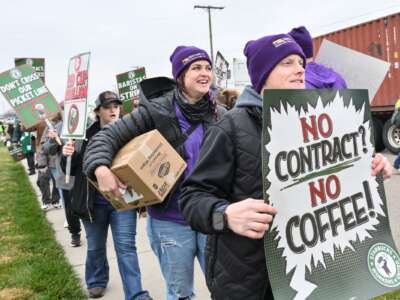
The boycott of Starbucks’ multinational coffee chain is still in full swing this Labor Day weekend as Starbucks workers push to secure a new contract.
The AFL-CIO and Chicago Teachers Union have already expressed support for the boycott, which unionized Starbucks workers initiated to support their demands for a minimum hourly wage of $17, improved staffing, and better workplace protections.
“At a time when working-class people across the country are struggling in a challenging economy, it is no longer possible to be both a Starbucks customer and in support of workers,” said Starbucks Workers United in a statement. “Choosing to spend money at Starbucks is choosing a law-breaking corporation over the baristas who make your coffee every day exactly as you ask for it.”
Starbucks Workers United was started in 2021, after the Elmwood store in Buffalo became the first Starbucks to unionize. Since then, it has grown to 12,000 members, and almost 700 Starbucks stores have been unionized. In 2025, the union won 125 elections and had an election win rate of 82 percent.
The latest boycott campaign comes amid setbacks at the federal level, as Trump’s National Labor Relations Board (NLRB) currently holds a Republican majority.
Last month, the NLRB ruled that a Starbucks manager didn’t violate labor law when she told an employee that workers from unionized stores might be prohibited from picking up shifts at non-union stores.
The case involved Alejandra Toscano, a barista who worked at the Seattle-area Holman Road store from February 2021 until July 2022. After the store voted to unionize, workers at a nearby non-union store informed Toscano that she wouldn’t be able to “borrow” shifts at locations that weren’t unionized.
Toscano asked her manager, Chelsea Zapata, whether this was correct. Zapata told her that that she had heard the same thing at a meeting with lawyers, but that “didn’t know exactly what was true,” and suggested she keep trying to pick up shifts.
The Workers United Labor Union International, which is affiliated with the Service Employees International Union (SEIU), filed a labor complaint over the issue and, in May 2023, an administrative law judge determined that Zapata had violated Section 8(a)(1) of the National Labor Relations Act.
However, this ruling was dismissed in August 2026 by the NLRB. The Trump appointees, Chairman James Murphy and member Scott Mayer, determined that Zapata had simply made an “equivocal comment” that could not be classified as an unlawful threat.
In his dissent, David Prouty, the only Democratic member of the board, said his colleagues were leaving out crucial context. In 2024, the board had determined that multiple Starbucks managers had made unlawful threats about shift borrowing at stores in Michigan, Minnesota, and other locations.
“Thus, at or around the same time that Zapata issued the threat (in response to a rumor Toscano heard from colleagues), the Respondent’s managers were violating the Act by, among other things, making those same threats at locations across the country,” it reads.
Meanwhile, in July, the NLRB prevented a Seattle Starbucks from unionizing when it ruled that the vote was invalid because it included two mail-in ballots. Once again, Prouty was the only member to object. In his dissent, he pointed out that nothing in the Board’s rules prohibits the use of mail-in ballots and that the union vote was held in 2022, when many people were still taking COVID-19 precautions and avoiding in-person meetings.
Biden-era NLRB wins for the union are also being undone.
In May, the U.S. Court of Appeals for the Fifth Circuit, which has a Republican majority, vacated an NLRB decision finding that the company had illegally fired a barista over union activity in New York and, in June, the court overturned an NLRB ruling that found a Southern California worker was terminated for organizing.
Writing at Bloomberg Law in February, reporter Parker Purifoy pointed out that the new Trump-shaped NLRB could settle cases more readily, and impair the union’s litigation path. There are currently over 600 active unfair labor practice charges pending against Starbucks, which could end up being dismissed. Additionally, efforts to oust the union (there are currently multiple petitions seeking to remove Starbucks Workers United) might end up being greenlit by the GOP-controlled board, which could force a premature contract deal.
Jeffrey Hirsch, a labor law professor at the University of North Carolina told Bloomberg Law that a contract is the union’s “Holy Grail right now,” but that they had to be careful to not alienate workers who are anxious about their cases going through litigation.
None of these developments have slowed down organizing at Starbucks.
Earlier this summer, Starbucks stopped using a specific silica-based blending powder for a new line of refresher drinks, after workers complained that it was making them cough and sneeze.
“Any time I had to use it, I had to hold my breath,” Destiny Valencia, a barista working at a San Jose Starbucks told The New York Times.
Suspicions about the product were first raised after Starbucks employees began making Tik Tok videos pointing out that the powder contains amorphous silica, a different form of the same compound has been found to cause the lung disease known as silicosis.
Starbucks Workers United asked occupational health physician Dr. Peter Orris to evaluate the workers’ exposure to the powder. He concluded that the substance poses no long-term health risks but noted that Starbucks “should have evaluated it with respect to its impact on human health prior to introducing it in a setting exposing both employees and customers to the aerosolized powder through both inhalation and skin deposition.”
The union sent Orris’ letter to the Starbucks company headquarters, and the company ultimately ditched the powder despite originally defending its use.
“Don’t get it twisted – our collective action made this happen,” declared Starbucks Workers United. “Even though this is a win for baristas concerned with health issues caused by the silica-based blending powder, we still call on the public to BOYCOTT STARBUCKS until the company finalizes contracts with stronger protections, higher pay, fair hours, and more!”
Collective action also led to a series of walkouts during the store’s August “Unicorn Frappuccino” weekend, where workers were prevented from taking time off while the store offered a limited-time drink that is difficult to make.
“No contract, no coffee!” chanted the departing workers.
Media that fights fascism
Truthout is funded almost entirely by readers — that’s why we can speak truth to power and cut against the mainstream narrative. But independent journalists at Truthout face mounting political repression under Trump.
We rely on your support to survive McCarthyist censorship. Please make a tax-deductible one-time or monthly donation.

+ There are no comments
Add yours