



Part of the Series
Struggle and Solidarity: Writing Toward Palestinian Liberation
Truthout is a vital news source and a living history of political struggle. If you think our work is valuable, support us with a donation of any size.
As a daughter of Gaza City — a place that has endured every possible attempt to destroy the very meaning of life — I had lost every sense of safety and security until the announcement of a ceasefire in October 2025.
At that time, hearing about the ceasefire felt like hearing that a terminally ill patient had finally been cured. At last, we believed we would sleep in peace. We believed we would walk through our streets without fear and live without bombings or death. We thought the nightmare was over, that life was finally giving us a chance to breathe again.
But we soon tragically realized that our city had lost its sense of security entirely, as the bombings never truly stopped, and fear never left our hearts. The chaos left behind by the war has trapped people in Gaza in constant uncertainty. Since then, I have come to understand the value of life more deeply than ever before.
Imagine a city emerging from devastation only to discover that the threat of death still lingers in different forms: through fear, disorder, and the painful realization that the peace we longed for was only a fleeting illusion.
On May 20, 2026, I was speaking with my friend Ghada, who was staying in the southern Gaza Strip. Then, she suddenly disappeared from the call. I tried reaching her several times until I received a voice message from her.
“Do you know? We have nothing left to remember … all our past has been erased,” her message said. “My neighborhood in Al-Maghazi, where I grew up — especially my grandfather’s house — and the entire area were heavily destroyed just moments ago.”
I called her back in panic. “What happened? How? Why?” I asked.
She told me that the Israeli army had contacted her uncle to inform the family, and others in the area, to evacuate immediately because a building sheltering dozens of displaced families — located next to her grandfather’s house and her relatives’ homes — was about to be bombed.
No one knew the reason. Everyone left … except Ghada’s aunt. She stayed inside the house until the rubble crushed her body and shattered glass covered her face.
I recognized the pain in Ghada’s voice because I know exactly what it means to lose the place where you grew up. I wished her story had been the last one of this kind that I would hear, but it wasn’t.
On May 26, during the Day of Arafah — the day before Eid al-Adha, when Muslims fast — we began preparing for what we believed would be our first Eid after the ceasefire.
Usually, the markets are filled with families buying holiday essentials, baking traditional Eid cookies, and preparing for the customary sacrifice. But after months of war and soaring prices, sacrificial animals had become unaffordable for most families.
We settled for baking Eid cookies and buying a little chocolate, hoping to welcome Eid morning with at least a small measure of joy. We had been waiting for that Eid with unbearable anticipation, believing it would be the first one we could truly celebrate since the ceasefire.
The day I was fasting and preparing for Eid with my family became one of the hardest of my life.
We had just prepared our iftar meal when my father called my brother, Mohammed, to check on him. Mohammed told him he would break his fast with a friend nearby.
“I’ll be at Al-Rimal Market, just a short distance from home, so don’t worry,” he said. “Afterward, my friend Helal and I will do a little shopping. Save me some food — I’ll eat it when I get back.”
He hung up.
Moments after we began eating, five missiles struck in rapid succession, shaking our neighborhood with terrifying force. The blasts were so violent that, for a moment, I forgot I had been fasting. I forgot everything.
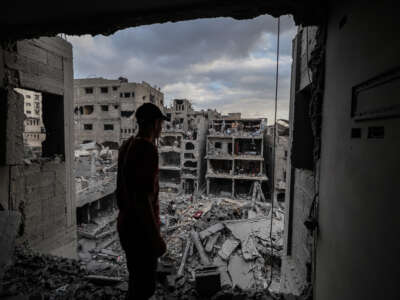
The explosions had landed only a few meters from our home, filling the house with clouds of dust from the blast. The sheer force of the explosions suggested that an entire city block had been wiped out.
My father immediately realized that Mohammed might be in danger. He quickly washed his hands, but none of us had taken a single bite. We left the iftar table exactly as it was, letting the warm meal grow cold, as only one question consumed us: Where was Mohammed?
Outside, our neighbors were shouting that the strikes had hit the area around the Tailandi Restaurant in Al-Rimal Market. It was a place repeatedly targeted despite being one of the busiest parts of the market, crowded with civilians.
And Mohammed was there.
We had no way of knowing what had happened. With most journalists targeted and local reporting severely disrupted, reliable information has become almost impossible to find.
My mother broke down in uncontrollable tears.
“Mohammed … I feel he’s dead. How can Eid come if he isn’t with us?”
My father rushed out to search for him.
Imagine running from the seventh floor to the street in seconds, with no electricity and no working elevator, calling out for your son again and again, only to hear silence.
The explosions had destroyed the communications network, and every unanswered call made us fear that we were already too late.
I tried to reassure my mother, telling her that Mohammed would return to us, God willing. But inside, my siblings and I were falling apart, terrified that our worst fear had come true.
We could not stop her. She followed my father to search for him.
As we waited in fear, I called my father several times. The network was severely weakened by the bombing, but eventually, the call connected.
My father eventually answered: “It took me some time to find Mohammed, but please be reassured … he is safe.”
Minutes later, they returned — but they were not the same people who had left.
Still in shock, Mohammed told us: “Suddenly, I saw the building across from me — only two meters away — being bombed. The entire area started shaking violently. I began running without even knowing where I was going.”
Medical sources initially reported that three Palestinians, including a woman, had been killed and more than 20 others injured in the strike. Hours later, the death toll rose to four after one of the injured women succumbed to her wounds, while several others remained hospitalized with injuries ranging from moderate to critical.
But that was only the beginning.
In the days that followed, Gaza’s Civil Defense announced that 29 Palestinians had been killed in continued Israeli attacks during the Eid al-Adha holiday, many of them women and children, as violations of the October 2025 ceasefire continued.
The war has already returned, even if no one has announced it.
By then, it had become impossible to ignore the truth: The war has already returned, even if no one has announced it.
For a few days, the Al-Rimal neighborhood of Gaza City fell into an uneasy silence. Then in June, that silence was broken by one of the most violent bombardments we had experienced in weeks.
While I was teaching an English class to my students — most of them just 15 years old — a massive explosion suddenly shook the entire neighborhood of Al-Rimal.
I forced myself to remain calm, trying not to let fear spread through the classroom or panic take over. But the first words I heard from my students were: “How will we get home?”
Fear filled their faces.
Within minutes, parents began calling to make sure their children were still with me and had not left the classroom.
Soon afterward, we learned who had become one of the victims of that strike: Raghad Ashour, an 11th-grade student who was walking through the street on her way to school to take her exam.
She was not inside the targeted vehicle, but shrapnel from the strike struck her, and she was killed at the scene.
Her story was especially painful. She was not the target, yet she became one of the victims of that attack.
During her funeral at Al-Shifa Hospital, mourners carried her school bag — the same bag she had been carrying on her way to school when her life was taken.
The war is not merely taking lives; it is stealing childhoods, classrooms, and futures.
I could spend every day telling the painful stories we have lived through, and they still would not be enough. Countless stories remain untold — even among us — because each person is carrying their own grief, fighting their own battles, and surviving their own pain.
On July 12, the Al-Sina’a area was targeted, killing two Palestinians and injuring others. Shortly afterward, residents of the area were ordered to evacuate completely, with warnings that the entire area would be demolished.
Imagine living in a city that has already been destroyed, trying to rebuild a small piece of life among the ruins, only to be told suddenly that you must leave because everything you have repaired will be destroyed again.
Being forced to repeat the same cycle over and over — searching for a place that feels safe when no such place exists — is a form of slow death.
On July 17, 2026, while people were attending the funeral of a Gaza resident killed by the Israeli military at a mosque in the Nuseirat area, the funeral site was struck, killing eight Palestinians and injuring others.
We no longer know how to make sense of the life we are living. Each day leaves us with new questions and growing uncertainty about our futures.
As with many such incidents, the circumstances surrounding the strike remain unclear, leaving families searching for answers about what happened and why.
All we have ever wanted is to live our basic right as civilians, away from political calculations — to live in safety and to have Gaza back as it once was: our city, our memories, our home.
Important Message: Please Read
For 25 years, Truthout has survived by publishing impactful investigative journalism and analysis; distributing full editions 365 days a year; and building a community of readers who support us with small, hard-earned donations.
Eighty percent of our $3 million yearly budget comes from small donors alone. Of those, 8,000 readers support us with monthly donations. Back in 2018, when Facebook decided to suppress the circulation of posts made by organizations, thereby cutting readers off from seeing many articles shared by the news organizations they had intentionally decided to follow, Truthout’s total traffic declined by 40 percent, as nearly all of our traffic from that platform disappeared.
Now, Google has recently rolled out its AI search bar, providing AI summaries instead of directing readers to our site. Google Search is our single largest source of traffic; it’s the route by which nearly one third of our readers find us. Much like in 2018, a shocking 40 percent of our Google traffic has disappeared overnight.
It will not be easy for Truthout to shoulder this blow. Nor will it be easy for our peers and collaborators — news sites that depend on traffic and aren’t bankrolled by large corporations.
If you can support Truthout with a donation today, you can help us resist the AI onslaught. Please give today.




+ There are no comments
Add yours