




Support justice-driven, accurate and transparent news — make a quick donation to Truthout today!
In our closing broadcast from Antalya, Turkey, the site of the 31st annual U.N. climate change summit, we take a look at what has — and hasn’t — been accomplished at this latest attempt to reach an international framework to stem the impacts of climate change.
“This COP was being touted as a COP of implementation, but what it has become is a COP of betrayal and a COP of distraction,” laments environmental justice advocate Harjeet Singh, the founding director of India’s Satat Sampada Climate Foundation. He’s joined on Democracy Now! by Meena Raman of Friends of the Earth Malaysia and Nafkote Dabi of Oxfam International as a number of NGOs announce their rejection of the conference’s final declaration text, which contains no mentions of fossil fuels or clear financial commitments from polluter countries.
“At the heart of the negotiations right now lies money,” says Dabi. “What rich countries, especially the EU, [are] saying is, ‘There is no money at home.’ But we know there’s money. They can tax the richest. They can tax the excess profit of fossil fuel companies. They can tax private jets. They can tax extreme wealth and raise the funds that’s needed to support communities.”
TRANSCRIPT
This is a rush transcript. Copy may not be in its final form.
AMY GOODMAN: This is Democracy Now!, democracynow.org. I’m Amy Goodman. We’re broadcasting from Turkey on the final scheduled day of the global U.N. climate summit, known as COP31.
Climate advocacy groups and Indigenous organizations from across the world have slammed this gathering as the “worst COP ever” and rejected the latest draft text as a “disaster,” urging developing countries to reject the latest draft text.
Meanwhile, at a news conference just before our broadcast, Panama’s Environment Minister Juan Carlos Navarro has threatened to block any final agreement if it doesn’t include a cap on oil production. Earlier this week, he spoke out forcefully against the role of what he described as the “petroleum mafia.”
JUAN CARLOS NAVARRO: I do not bear good news. We are being held hostage by the petroleum mafia.
AMY GOODMAN: And this is Juan Carlos Navarro, Panama’s environment minister, speaking just before we went to air, flanked by representatives from Finland and Vanuatu, Belgium, Ivory Coast, France, Guatemala and other countries.
JUAN CARLOS NAVARRO: We have come together because we feel that the COP can still be saved if we focus on six key issues for our final declaration that clarifies for the world where we must go.
The first is that science must be the foundation. Everything we do must be based on science.
Second, we need a clear transition away from fossil fuels. It is not acceptable to have a COP or a cover document that does not even mention fossil fuels, and we simply will not put up with it. We need to tell the truth and to speak clearly. We must transition away from fossil fuels in an orderly manner, if we are to confront climate change.
The third point for us, which is very important, is that fair contributions to climate finance must come from those with greatest responsibility. You pollute, you pay. It’s actually rather simple. You cause the problem, you must help to fix it. If you are the biggest emitter of CO2, if you are the biggest producers or consumers of petroleum, then you must contribute to solve this problem and these issues.
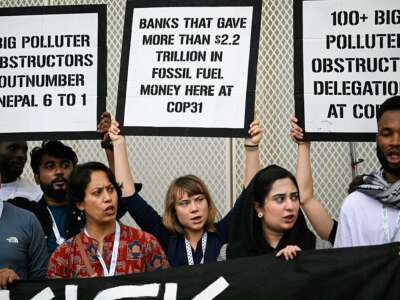
AMY GOODMAN: Earlier today, in a packed room for the press, the Climate Action Network, which encompasses over 2,500 civil society groups worldwide, as speakers detailed the failures of the COP, there were activists in the room, journalists and many others representing this COP31. The activists on the stage called out the European Union and other developed nations for their obstruction. The room repeatedly broke out into chants of “shame.” The moderator of CAN called the draft text a “disgrace” and introduced speakers.
DANNI TAAFFE: Tasneem Essop, executive director of Climate Action Network International.
TASNEEM ESSOP: There is nothing on the table that protects people or addresses the priorities of the Global South. In fact, the opposite is true. … This COP has had the highest number of lobbyists — fossil fuel lobbyists, AI lobbyists, CCUS lobbyists, CDR lobbyists. So, what we’re leaving this COP with is decisions made to actually promote the interests of those culprits.
DANNI TAAFFE: Avantika Goswami from CSE India.
AVANTIKA GOSWAMI: The European Union have, in a way, taken on the mantle that the U.S. has left the vacuum of, the blocker that the U.S. was. Unfortunately, we expected them to be leaders, but they have disappointed us. … And these are the parties that posture the most in the media. They say they are committed to climate multilateralism, and they are concerned about 1.5°C and the breach of the Paris Agreement goals. … So, we want to let them know that we see them and the games they’ve played, and we will not stand for it.
DANNI TAAFFE: Anabella Rosemberg from CAN International.
ANABELLA ROSEMBERG: The COP is not dying. The COP is being killed, not because it’s bloated, not because it’s inefficient or useless. It’s being killed because it’s the last space where civil society, where developing countries can hold developed countries accountable. … We are now asked to accept more empty words. We say no. We will fight back. And we say thank you for nothing. … So, this is also an appeal for all of us, for all the movements, to keep working together and change the faces of who’s representing developed countries in this place.
DANNI TAAFFE: And Mohamed Adow from Power Shift Africa.
MOHAMED ADOW: I can tell you, without any doubt, that this has been the worst COP ever.
AUDIENCE: Shame! Shame! Shame!
MOHAMED ADOW: Communities living in drought, floods and failed harvest were promised action. They cannot survive on an annual renewal of promises. We’re effectively pushing poor, vulnerable countries into further debt to protect themselves from a crisis they did little to cause.
TASNEEM ESSOP: I want to just say two things. One, when you come into a COP and a commissioner of a very important regional bloc says, “We’re not coming with any finance. Finance is dead in the water,” think about that, “dead in the water.” For us in the Global South, dead in the water is very literal. So it’s a shameful way to come to a COP where we are going to be fighting for adaptation finance to protect people from being dead in the water.
Secondly, the pledges that they brought to this COP for adaptation finance, you would have seen totaled around $50 million, which we said in our ECO is half the cost of an F-35 Lightning fighter jet.
AUDIENCE: Shame! Shame! Shame!
TASNEEM ESSOP: And we’re not even going to measure that $50 million in relation to the $3 trillion that rich nations are spending on wars, a genocide and conflicts across the world. Put that into perspective.
AMY GOODMAN: That was Tasneem Essop, the executive director of CAN, Climate Action Network International, and others speaking at a news conference earlier today. She is from South Africa.
For more, we’re joined by several leading environmental justice advocates.
Harjeet Singh is strategic adviser to the Fossil Fuel Treaty Initiative and founding director of the Satat Sampada Climate Foundation, a social justice organization, also global convener of the Fill the Fund campaign.
Nafkote Dabi is the change policy lead for Oxfam International, where she works at the intersection of climate and inequality. She’s from Ethiopia, where the next COP, COP32, will be held, in Addis.
And Meena Raman is with us, head of programs at Third World Network and president of Friends of the Earth Malaysia.
We thank you all for being with us. We’re going to start with Harjeet. You, as well as Nafkote, were holding up a sign behind the speakers that said, ”ECO. End the Genocide,” with big letters, ”SHAME!” There was rage in this room. It was the most packed news conference I had seen, packed with activists. Talk about where we are at on this last scheduled day, though it’s clear it’s going to go further.
HARJEET SINGH: Well, it is a matter of shame, Amy. This COP was being touted as a COP of implementation, but what it has become is a COP of betrayal and a COP of distraction. We have spent more time on talking about electrification, without any details whether it’s going to be green or is going to be accessible to people. We have removed the reference to —
AMY GOODMAN: Wait. Just to explain that, “electrification” is sort of the watchword here.
HARJEET SINGH: Yeah.
AMY GOODMAN: And the idea was renewable electrification.
HARJEET SINGH: Exactly.
AMY GOODMAN: But that seems to be — “renewable” — being dropped.
HARJEET SINGH: Absolutely. And otherwise, why are we talking about electrification in this space, if it is not green? That’s the question we should be asking. We do not see any reference to fossil fuel phaseout. Now, only the words are not enough, and I can explain that later, but that being dropped from the previous draft is just not acceptable. Adaptation finance, there was a clear agreement to scale it to $120 billion annually for developing countries.
AMY GOODMAN: No one knows what “adaptation finance” means.
HARJEET SINGH: OK. So, adaptation means helping communities prepare to deal with climate impacts. It’s about retrofitting their homes. It’s about building dikes. It’s about making sure that their agriculture is resilient and we are food-secure. And if you do not provide money — let’s take the example of Nepal. The reason they faced such a catastrophic disaster, because they were not prepared. When we see people in Ethiopia —
AMY GOODMAN: More than seven — what? About 7,000 people dead or missing?
HARJEET SINGH: Exactly. That’s the number.
AMY GOODMAN: Because of a glacier that melted?
HARJEET SINGH: Absolutely. So, it was a glacial lake outburst floods. And the numbers are important. They lost — the destruction was to the tune of $2.6 billion, and they will need now $5 billion for recovery and rehabilitation, which is 10% of their GDP. Imagine.
AMY GOODMAN: Why should the wealthy countries give it to them?
HARJEET SINGH: Because glaciers melted because of the burning of fossil fuels, and they did not provide money to Nepal for adaptation, and they are facing now loss and damage. So, Nepal, we should see it as a report card of the climate inaction that we have seen over the last 30 years. We did not phase out fossil fuels in time. That resulted in melting of glaciers. And we did not even have a plan or support to Nepal to deal with these climate impacts. And it shows that how we are failing to deal with climate impacts. And that’s why we say “shame.”
AMY GOODMAN: Meena Raman, you are head of programs at Third World Network, head of Friends of the Earth Malaysia. You have been to so many of these conferences. You, too, have expressed rage on each panel you are at. What do you want to see happen here?
MEENA RAMAN: Well, at this particular point in time, it’s relatively empty. The most important aspect of the COP is money, whether it’s for emission reductions, whether it’s for adaptation, whether it’s for loss and damage. The developing world came together, and they said, “We need money on the table of provision of finance.” What the developing countries demanded was actually to ensure that we talk about this. It was about talking about how the developed world is going to do that.
But all we came here as, you know, the EU commissioner was saying anything about finance is dead in the water. Now, that is horror, because we just came out of Nepal, as we know, and you say, “dead in the water.” People are literally dying due to the historical —
AMY GOODMAN: In the water.
MEENA RAMAN: “Dead in the water.” That’s what Hoekstra said. It was — it was for us —
AMY GOODMAN: The EU negotiator.
MEENA RAMAN: The EU commissioner. The EU commissioner. So, even before this COP, he said it. So, when you go to the negotiating halls, what you saw was finance was dead in the water, nothing on finance. So there’s no point talking about having higher ambition in terms of emission reductions or developing countries having to do fossil fuel phaseout or having more targets on electrification. They’re not going to be able to do this, if what they say is the means to implement that is not available. So, this is where this COP always becomes a problem.
AMY GOODMAN: You are wearing a sign — you are wearing a sticker, Nafkote Dabi, on the back of your ID here that says “Make rich polluters pay.” You have said — you’ve talked about inequality. Oxfam International is known for their report, “Disaster Divide.” The richest 0.1%, or 8 million people, have more emissions than the bottom 3.5 billion people, and that their carbon emissions contribute to the increase of climate disasters such as floods, fires, droughts and food crises. Can you explain how you feel this can be remedied? And how close to a tipping point are we?
NAFKOTE DABI: So, at the heart of the negotiations right now lies money, because, ultimately, you know, to support communities to adapt to the climate crisis, they need finance. And what rich countries, especially the EU, is saying is, ‘There is no money at home.’ But we know there’s money. They can tax the richest. They can tax the excess profit of fossil fuel companies. They can tax private jets. They can tax extreme wealth and raise the funds that’s needed to support communities. You know, just private jets alone, you can raise $45 billion a year. From the excess of profit of fossil fuel companies, you can raise $400 billion. So, this money is available, and you can support communities at home, whether in Europe or the U.S. And then you can commit to your international climate finance obligation and support communities in the Global South, especially, you know, in Africa, that are faced with droughts, floods, displacement and death.
AMY GOODMAN: You know, we just had a headline on a vote on war in the U.S. Senate, and the amount — the billions of dollars that are being spent on the war in Iran, which has also led the entire world to understand how dependent we are on fossil fuels.
NAFKOTE DABI: Exactly. You know, emissions from military is about 5%. This is something that we’re not talking about. There’s huge money, as you said, Amy, going towards militarization, when communities around the world are actually literally dying from escalating extreme weather events. For the first time, by the way, Amy, I’m feeling really desperate, because we’re being told next year is going to be the hottest year on record. It’s going to go up to 1.7. Right now as we’re speaking, communities around the world are faced with the worst El Niño on record, and there is no support. These are communities that have done the least to cause the climate crisis, but they’re being left alone to deal with this situation. So, it’s a very shameful COP.
AMY GOODMAN: Now, what are the NGOs going to do? We just have two minutes before we end with an 8-year-old child who spoke out. A few years ago, it was Greta Thunberg, when she was 15 years old. Now we’re going to Little Miss Environment Kenya, who is 8, who has something to teach her elders. But one last statement. Harjeet, where we go from here? Are the NGOs going to reject the text? And what does it matter? What role do you play?
HARJEET SINGH: So, we have already rejected the current text. And what we would like to see: the developing countries really standing up and reject this text. And we keep saying developing countries are here to represent their own citizens. They can’t accept a text which will not enable them to implement climate action back home because there is no money on the table. And that’s exactly the reason developing countries have now — need to be very loud and clear in saying this COP outcome is not going to help us, unless developed countries open their pockets. It’s all about money.
AMY GOODMAN: Meena, how can it be this is the largest COP, and you’re talking about it being the greatest failure? Pick up that mic.
MEENA RAMAN: Yeah. The problem is that when you have the developed world come here and say that they don’t have national budgets to put on the table, and they talk about leadership, I think it is really imperative that we work with our Global North to actually put the pressure on the developed countries. We can’t have COP after COP backsliding. We let alone scaling up our resources. The U.K. has cut its pledge to the Green Climate Fund. The Global Environment Facility, the worst replenishment ever. So, when they are backsliding, here we are asking for more top up.
AMY GOODMAN: And finally, Nafkote, if you can talk about next year? We’re going to Ethiopia for COP32. What is the point of these COPs?
NAFKOTE DABI: You know, Ethiopia is faced — is at the frontline of the climate crisis. Ethiopians know what it means to face drought. Ethiopians are the most resilient people. They have been through many droughts, droughts after droughts. Right now, as I said, we’re faced with El Niño. Next year, the Ethiopian COP presidency needs to deliver justice for communities at the frontline of the climate crisis.
AMY GOODMAN: We have to leave it there, Nafkote Dabi of Oxfam International, Harjeet Singh of Fossil Food Treaty Initiative, Meena Raman of Third World Network.
Fundraising Deadline: Missed
Donations are down for Truthout at a time when media is under immense pressure. Google’s AI search has driven our traffic down by 15 percent, Trump is arresting journalists, and many independent media organizations face heartbreaking cutbacks and closures.
At the same time, movement media is vital in the fight against Trump’s authoritarian reign. Our mandate to tell the truth, share strategies for resistance, and speak against fascism is ever more urgent in this deluge of political censorship and misinformation. Yet, we are struggling to meet our publishing costs when our work is so urgently needed.
Our fundraiser ended last night, but there’s still time for us to meet those basic operating expenses — we need only $10,000. If you can support Truthout with a one-time or monthly donation, you will make a significant impact on our work. Anything you can do makes a difference.

+ There are no comments
Add yours