




Truthout is a vital news source and a living history of political struggle. If you think our work is valuable, support us with a donation of any size.
Cuba’s government has announced that it has run out of oil.
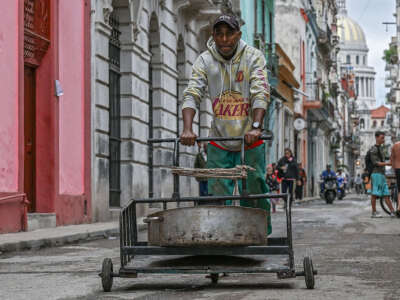
On Wednesday night, Cuba’s energy minister Vicente de La O Levy said that the country has completely run out of diesel and fuel oil, and that the national grid is in a “critical” state. He further described how in the capital city of Havana, “the blackouts today exceed 20 or 22 hours.”
“The situation is very tense, it’s becoming hotter,” he added, referring to the start of summer that brings a need for more energy.
At the start of January, Trump halted Venezuelan oil exports to Cuba, following the U.S.’s kidnapping of Venezuelan President Nicolás Maduro and de facto takeover of Venezuela’s oil industry. Later that month, Trump imposed a total oil blockade on Cuba, imposing tariffs on countries that supply oil to the country, pressuring Mexico to stop its oil shipments to Cuba, and seizing oil shipments traveling to the island country.
At the end of March, a Russian tanker arrived in Cuba carrying an estimated 730,000 barrels of crude oil, breaking the U.S. blockade and temporarily easing the crisis. The crude was refined in April and provided relief for a few weeks. But this fuel has run out, Cuban officials explained. This was the sole shipment of fuel allowed to enter Cuba in more than four months.
Cuba began suffering from power cuts in 2019, after the first Trump administration imposed “maximum-pressure sanctions.” But since January, these have become more frequent and severe, at times lasting several days.
Trump’s blockade has decimated Cuba’s universal health care system, causing deaths and forcing hospitals to close. Schools and government offices have also been forced to close.
In February, the UN Human Rights Office warned that “Intensive care units and emergency rooms are compromised, as are the production, delivery, and storage of vaccines, blood products, and other temperature-sensitive medications.”
“In Cuba, more than 80 percent of water pumping equipment depends on electricity, and power cuts are undermining access to safe water, sanitation, and hygiene. The fuel shortage has disrupted the rationing system and the regulated basic food basket, and has affected social protection networks — school feeding, maternity homes, and nursing homes — with the most vulnerable groups being disproportionately impacted,” the statement went on.
On April 30, Rep. Rashida Tlaib (D-Michigan) wrote on X, “Cuba’s infant mortality has soared by 148% from the tightening of U.S. sanctions. This is every parent’s nightmare. I can’t fathom the heartbreak of the thousands of Cubans who have lost their babies because of a cruel and broken U.S. policy.”
“It’s time to end sanctions on Cuba,” she added.
UN human rights experts also condemned Trump’s blockade on Cuba as a “violation of international law” and an “extreme form of unilateral economic coercion.”
Trump has frequently threatened that Cuba will be “next” after Iran. In March, he said he expects to “have the honor of taking Cuba,” and that “Whether I free it, take it – think I could do anything I want with it.” On May 1, Trump again said the U.S. will be “taking over” Cuba “almost immediately.”
Republicans in the Senate have suggested that Trump focus on reopening the Strait of Hormuz. Many have expressed that they hope Cuba’s government will fall from the U.S.’s economic sanctions, rather than direct military intervention.
On Wednesday, The Guardian reported that more than 30 members of Congress sent a letter to Trump urging him against military intervention in Cuba, and to stop using the U.S. Navy base at Guantánamo Bay for detention of migrants. They warned that increased aggression on Cuba would lead to more migration from the island.
The Trump administration has hoped its pressure would force “regime change” on Cuba, but has also been concerned about a rise in migration from the country due to its aggressive policies.
On Thursday, Trump’s CIA director John Ratcliffe visited Havana, offering an aid package to help ease the effects of the blockade. Cuban President Miguel Diaz-Canel said that for conditions to improve, the U.S. should lift its blockade.
Earlier this month, Cuba’s President Miguel Diaz-Canel responded to Trump’s comments, saying, “When they say we are an extraordinary and unusual threat to the United States — and we are sure that is not how the American people feel, but rather how the U.S. government feels, or the pretext that the U.S. government uses to attack us — one has to ask: What is the threat? What is extraordinary about that threat? What is unusual about that threat, when Cuba is a country of peace?”
Media that fights fascism
Truthout is funded almost entirely by readers — that’s why we can speak truth to power and cut against the mainstream narrative. But independent journalists at Truthout face mounting political repression under Trump.
We rely on your support to survive McCarthyist censorship. Please make a tax-deductible one-time or monthly donation.


+ There are no comments
Add yours