


Truthout is an indispensable resource for activists, movement leaders and workers everywhere. Please make this work possible with a quick donation.
As the sun set in Dearborn, Michigan — a city on Detroit’s western border that is often called the “capital of Arab America” — the sense of urgency to elect Abdul El-Sayed to the U.S. Senate was becoming palpable on an unseasonably warm November election day.
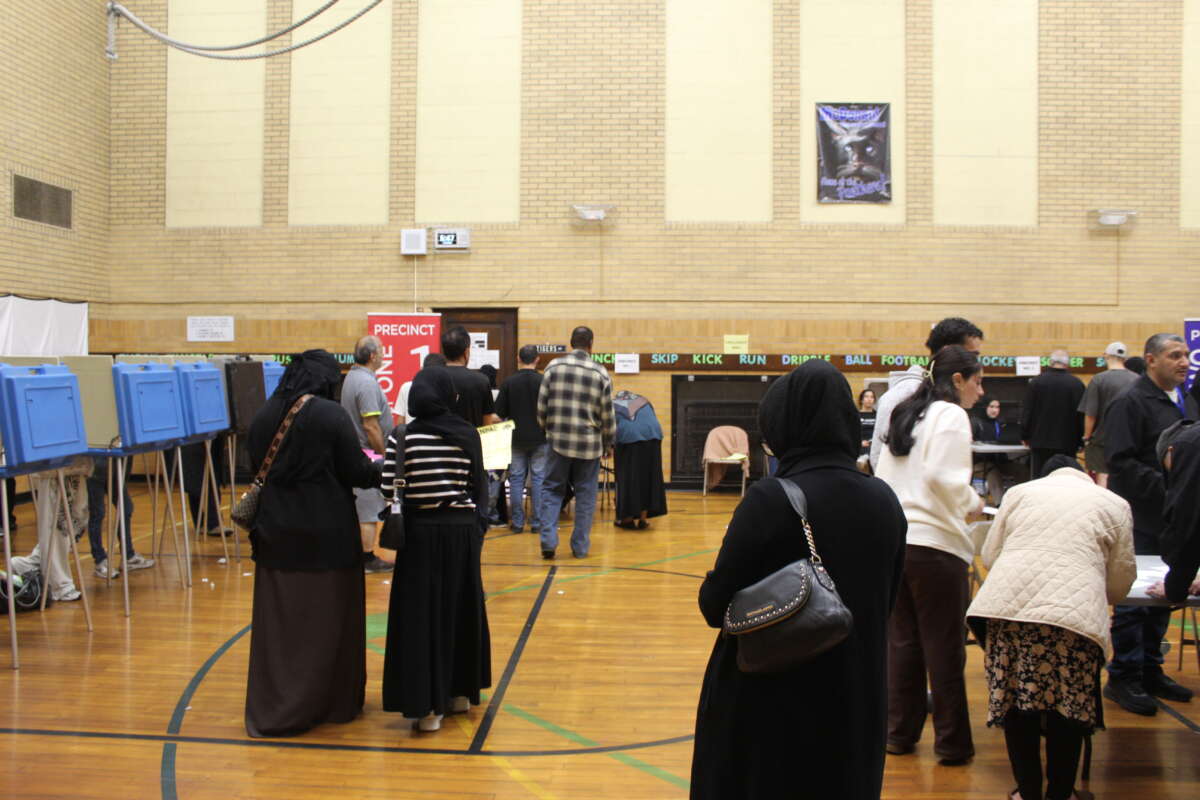
The lines of hijab-wearing women and curly-haired young men at the polling stations on November 3 kept growing longer. More cars clogged up the streets around the schools that were serving as election precincts in normally quiet neighborhoods.
“Today, our vote is our power,” said Fares Alshawhati, an Arab American truck driver who was urging voters outside of a polling location to back El-Sayed, the Democratic candidate.
Now, election data shows that Arab voters in Dearborn needed little convincing to elect El-Sayed. The progressive former public health official approached 100 percent support in some of the most predominantly Arab precincts in the city.
It was a stunning swing in a community that had all but abandoned the Democratic Party two years ago over Israel’s wars on Gaza and Lebanon.
A Dramatic Rebuke to Trump and the Republican Party
In one precinct in Dearborn’s Southend neighborhood, which is home to a large Yemeni community, more than 97 percent of the voters — 927 out of 949 — cast their ballots for El-Sayed. Republican Senate candidate Mike Rogers received less than 2 percent of the votes in the Southend.
In 2024, Republican President Donald Trump won the same precinct with nearly 53 percent of the votes. His Democratic opponent, then-Vice President Kamala Harris, finished a distant third behind Green Party candidate Jill Stein. Harris received less than 13 percent of the votes.
That’s an 84 percentage point shift from Harris to El-Sayed among voters in the same precinct in two years.
And such shifts did not only occur in this one precinct. Across Dearborn, voters swung by dozens of percentage points in a dizzying political whiplash in anger at Trump and his policies.
“The Republicans made a targeted choice to use Islamophobia as their core line of attack against Abdul, and it backfired tremendously.”
El-Sayed won Dearborn with 82 percent of the vote. In predominantly Arab precincts on the east side of the city, support for El-Sayed surpassed 94 percent.
“I think that shift is very healthy actually because it indicates that the community is not a monolith and also that the community is moving where the country’s best interest is,” said Chadi Abdulrazek, an Arab American political activist who was volunteering to help elect El-Sayed.
“Two years ago, we were deep in a genocide,” Abdulrazek told Truthout. “This community was bleeding. We were all hurt. We were all seeing our families being slaughtered. We were all in pain for a long period of time, and the Democratic Party failed to stop that genocide.”
He added that Trump came and made big promises about being a man of peace, and some Arab Americans decided to give him a chance.
“Eventually he failed and made things worse. I think it is actually very smart to see that the community and people across the country are shifting their perspective because they’re seeing what has happened in the past two years,” Abdulrazek said.
Arab American voters interviewed by Truthout in Michigan consistently cited three reasons for backing the Democrats in this election cycle: Trump lied to the community about his foreign policy; they support El-Sayed’s policies, such as Medicare for All; and they were turned off by Republicans’ embrace of Islamophobia.
In the lead-up to the election, many Arab voters criticized Trump for breaking his promises about pursuing peace in the Middle East and for starting yet another destructive war in the region, while also continuing to offer unconditional support to Israel, even as it intensified its abuses in Gaza and the West Bank and sought to annihilate South Lebanon.
El-Sayed’s platform of ending funding to Israel and investing in local priorities also aligned with the community’s agenda. And his being Arab and Muslim further boosted his standing.
El-Sayed’s campaign manager, Alia Kapasi, hailed his gains in the Arab community, releasing a statement on November 5 saying:
In 2024, the Democratic ticket performed poorly with Arab-American voters in Dearborn. Abdul didn’t just make up those losses, but ran up the score. Record-breaking turnout in Dearborn was nearly 5% above 2024 turnout. While Harris lost the city by 6%, Abdul won by more than 65%. In Dearborn, nearly 3,700 more voters voted in the Senate contest than in the race for Governor.”
Kapasi also paid a nod to El-Sayed’s dominant performance in neighboring Dearborn Heights, which is also home to a large Arab community.
A Statewide Victory Against Overt Anti-Muslim Bigotry
In order to win the senatorial race, El-Sayed was forced to overcome extreme and persistent targeting for his Muslim identity: Rogers and Trump had made El-Sayed’s faith a focal point of their campaign in Michigan.
Trump repeatedly called the Democrat a “jihadist,” as Rogers falsely accused him of ties to the Muslim Brotherhood, Hamas, and Hezbollah.
Voters were flooded with misleading ads on the subject.
One Republican-funded video commercial featured a woman in a burqa and baselessly suggested that El-Sayed would impose Sharia law if elected, warning that under Islamic rules, women cannot leave the house without a guardian.
“We concluded that the best response is through the ballot box — that we must all come out and vote.”
In her November 5 statement, El-Sayed’s campaign manager, Kapasi, underscored the bigotry against him, saying: “The Republicans made a targeted choice to use Islamophobia as their core line of attack against Abdul, and it backfired tremendously with one of the key constituencies that won Trump the presidency in 2024.”
In 2024, Republicans had softened their tone on Arabs and Muslims, seeing an opening in a community that was furious at Democrats over then-President Joe Biden’s uncompromising support for Israel.
According to estimates by the Arab American Institute — which corrects for undercounting by the U.S. Census — Michigan is home to nearly 400,000 Arab residents. In a state of 10 million people, that bloc of voters can be decisive.
So back in 2024, Trump and his team decided to woo them.
He personally visited Dearborn, spoke of peace, and invited Arab American supporters and local Muslim imams to the stage in one of his rallies.
The Republican president ended up winning Dearborn that year, and his staunchly anti-immigrant adviser Stephen Miller thanked the city on election night.
The honeymoon, however, was short-lived.
On his first day in office in 2025, Trump revoked U.S. sanctions against violent Israeli settlers. Weeks later, he called for removing Gaza’s entire population from the Palestinian territory and turning it into the “Riviera of the Middle East.”
While some may have given Trump the benefit of the doubt, the war on Iran — which he launched jointly with Israel earlier this year — left few Arab Americans in Dearborn on his side.
Then came Trump and Rogers’ Islamophobic campaign against El-Sayed, which pushed what remained of the local community’s Republican voters to the Democratic camp.
“The Republican Party and Trump came to Dearborn and … gave us false promises. But they don’t know the Arab community. The Arab community doesn’t forget.”
Trump had especially angered the Yemeni voters who backed him in 2024 after revoking temporary protected status for Yemeni immigrants earlier this year. More recently, the U.S. president called Yemen and other developing nations “shithouse” countries.
Abdulrahman Barman, an activist in Dearborn, said the Yemeni community had discussed ways to respond to the president’s comment and decided not to release angry statements.
“We concluded that the best response is through the ballot box — that we must all come out and vote, so our response is direct and practical,” Barman said.
In the mostly Yemeni Southend neighbourhood, turnout comfortably surpassed 2024 levels despite presidential elections usually drawing out more voters than the midterms.
After the polls closed on November 3, dozens of Arab Americans flocked to an election results watch party at a banquet hall on the east side of the city.
Celebrations began even before the results started to trickle in. The high turnout was enough reason for joy.
“Two years ago, the Republican Party and Trump came to Dearborn and … they bamboozled the Arab community and gave us false promises,” journalist and activist Hussein Hachem told the crowd. “But they don’t know the Arab community. The Arab community doesn’t forget. Today, the Arab community in Michigan and across the nation gave Trump a slap in the face that he will never forget for the rest of his life.”
Media that fights fascism
Truthout is funded almost entirely by readers — that’s why we can speak truth to power and cut against the mainstream narrative. But independent journalists at Truthout face mounting political repression under Trump.
We rely on your support to survive McCarthyist censorship. Please make a tax-deductible one-time or monthly donation.
+ There are no comments
Add yours