






Support justice-driven, accurate and transparent news — make a quick donation to Truthout today!
Ever since he reentered office, Donald Trump has laid siege to Washington, D.C., dropping banners with his face all over federal buildings, enacting a bizarre “beautification” project, and unleashing thousands of National Guard members to effectively put the city under military occupation. Now, as D.C. residents wonder what awaits the rest of his term, the delivery company DoorDash is joining forces with Republicans in Congress to further undermine the capital’s right to govern itself.
That right to govern, otherwise known as home rule, is a precedent which has allowed Washington, D.C. to elect a mayor, council members, and neighborhood commissioners who manage the day-to-day affairs of life in the District. Since the passage of the D.C. Home Rule Act of 1972, Republicans and special interest groups have continued to challenge the District’s ability to make decisions for itself, including when it comes to taxation.
The DoorDash saga began in July, when the D.C. Council approved a new 20-cent fee for third-party deliveries. The revenue from the 20-cent tax will go directly toward addressing food deserts and improving food access across D.C.
DoorDash unsuccessfully fought the new tax with polls, petitions, and ads. The company argued that the new measure implemented “regressive taxes that hit small businesses and working families the hardest.”
After losing the fight against this new tax with the D.C. government, DoorDash quickly pivoted to a new medium: Congress. Just days after the new tax was approved by the council, Rep. James Comer (R-Kentucky) introduced a resolution with significant support from DoorDash that would “functionally end home rule” in Washington, D.C.
While sources familiar with the law — H.R. 9720, the D.C. Taxing Authority Review Act — consider it a long shot, the intention behind the resolution worries advocates for D.C. statehood.
“It would block D.C.’s elected local officials from changing local taxes and fees without the explicit approval of Congress,” said Melissa Wasser, senior policy counsel at ACLU-D.C. “Introducing this bill and then immediately moving this bill is a tyrannical and nonsensical power grab, plain and simple.”
20 Cents to Help Close the Gap
In Washington, D.C.’s least-populated ward, Ward 3, where the median household income is over $140,000, there are currently 17 full-service grocery stores. In D.C.’s most densely populated ward, Ward 7, where the median household income is under $70,000, there are just three full-service grocery stores.
The new 20-cent tax is designed to help close that gap. The funds will go to a pilot program offering free Instacart memberships to low-income residents, a nonprofit grocery store in Ward 8, and a program that allocated grants to new food businesses in neighborhoods with food inaccessibility. According to local organizers, these solutions to food access are a reasonable cost for delivery services.
“These delivery companies should be paying a fee to address food deserts and food access. DoorDash profits off food deserts,” said Alex Dodds, campaign director and co-founder of Free DC, a fiscally sponsored project of Community Change that advocates for the dignity of the residents of D.C. “It only makes sense that they should give some of that money back to address the problem they are profiting off of.”
Truthout reached out to DoorDash for comment; at the time of publication, the company has not responded. In a recent letter addressed to the D.C. Council, DoorDash defended its support for H.R. 9720 and insisted that it is in favor of home rule.
“Fundamentally, DoorDash didn’t like something that D.C. government did. And for some reason, the company thought that it was appropriate to go around the back of D.C. government and try to overturn the law altogether, rather than just be a good partner for D.C. communities,” said Dodds.
Undermining Home Rule
H.R. 9720 would require both the House of Representatives and the Senate to approve any tax increases or additional fees passed by the D.C. Council. If passed, the legislation would strip D.C. of the ability to change its own tax code.
Under the current process, any changes to local D.C. tax code go into effect after a 30-day congressional review window. At any time in this window, Congress can block changes passed by the D.C. Council. H.R. 9720 would instead make congressional approval mandatory for any changes, creating a permission structure further limiting D.C. legislators from autonomous governance.
“That law functionally ends home rule,” said U.S. Sen. for Washington, D.C. Ankit Jain. “I don’t understand why a company would support a bill that’s unlikely to pass and antagonize the government that runs one of their major markets.”
In a case that H.R. 9720 does make it through the House and the Senate and becomes law, local leaders warn of the impending consequences.
“We would have no recourse, which is why this is so devastating that a District-based company would be undermining us in this way,” said D.C. Councilmember Zachary Parker. “We all want to advance a responsible budget and act fiscally responsibly … reasonable people can disagree on policy, but we should all agree here in D.C. that decisions about D.C. should be in the hands of D.C. electeds who are held accountable by D.C. residents and not Congress.”
While DoorDash is headquartered in San Francisco, the company operates out of an additional office in Ward 6.
This is not the first time that outside interests have acted to influence democracy in D.C. In 2018, D.C. voters passed Initiative 77, which would have increased the tipped minimum wage to $15. Following pressure from the restaurant lobby and Trump-affiliated consultants, the council voted down the initiative. In 2022, a similar piece of legislation, Initiative 82, was approved by 74 percent of voters but again was struck down by the council after significant pressure from the restaurant lobby.
“This is all happening because D.C. is not a state, and D.C. statehood is the only solution.”
Local leaders point to the lack of statehood as a paramount reason why D.C. is so vulnerable to corporate interests and external powers.
“This is all happening because D.C. is not a state, and D.C. statehood is the only solution,” said Senator Jain. “Until D.C. is a state, we will always be at risk of these kinds of big corporations exploiting our lack of democracy to advance their interests over the interests of the people of D.C.”
#DeleteDoorDash
While H.R. 9720 is awaiting further action in the House of Representatives, residents of D.C. have organized around a response. Free DC launched a campaign called “#DeleteDoorDash.” The organization is calling on communities to delete their accounts on the app and submit proof to a growing list of residents who disagree with DoorDash’s lobbying efforts. Free DC also has demands for the food delivery company, including withdrawing support for H.R. 9720.
“DoorDash is trying to get out of this 20-cent fee by paralyzing the entire city’s ability to regulate revenue,” said Dodds. “There’s just absolutely no excuse for any company that seeks the business of D.C. residents to lobby against home rule.”
DoorDash drivers in D.C. have already reported a drop in orders following Free DC’s boycotting efforts.
One of Free DC’s other demands is for DoorDash to “issue a public statement against ICE and other federal police who are hunting and killing delivery drivers.” Since August 2025, when Donald Trump’s federal occupation of D.C. first began, federal immigration agents started working alongside local police to target food delivery drivers. In addition to other recent cases of violence by federal officers in Maine, Memphis, and Houston, last month U.S. Park Police in D.C. killed food delivery driver Nolberto Meza after a high-speed chase.
DoorDash’s opposition to the 20-cent tax follows $13.717 billion in revenue for fiscal year 2025, a nearly 30 percent increase compared to 2024.
“I think it just exemplifies corporate greed in a way that is not beneficial to the business. And it calls into question what they really value,” said Councilmember Parker. “They are doubling down on whatever will get them more profits, which is a shame.”
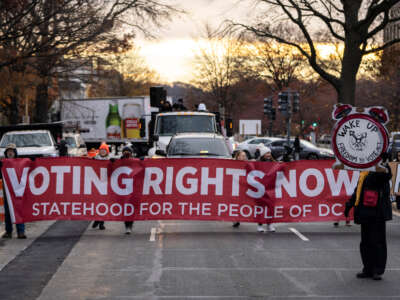
Local leaders continue to point to D.C. statehood as the sole solution to attacks against democracy in the District. About 700,000 people call D.C. home; that’s more people than entire states, including Vermont and Wyoming. As DoorDash continues to support H.R. 9720, Washingtonians set their eyes on the inherent protections that becoming the 51st state would grant.
“There’s no other capital in the democratic world where our residents don’t have these same political rights equal to their fellow citizens,” said Wasser. “It’s beyond time for D.C. to become the 51st state. If we were a state, this would not happen.”
Media that fights fascism
Truthout is funded almost entirely by readers — that’s why we can speak truth to power and cut against the mainstream narrative. But independent journalists at Truthout face mounting political repression under Trump.
We rely on your support to survive McCarthyist censorship. Please make a tax-deductible one-time or monthly donation.



+ There are no comments
Add yours