







When it comes to reducing the corruption of the military-industrial complex, the Pentagon recently took one step forward and two steps back. While the impending cancellation of one problematic program gives cause for celebration, Defense Secretary Pete Hegseth is simultaneously creating new programs that will produce even greater opportunities for corporate executives to squeeze money out of the Pentagon.
The Secretary of Defense Executive Fellows (SDEF) program sends U.S. military officers to work at large private-sector companies for a year in order to learn how they function and then use that experience to suggest efficiency-improving reforms to military leadership. After thirty years of operation, the SDEF program will close its doors this summer.
In reality, the SDEF program functioned as a subsidy to the military-industrial complex. In 2024, Ben Freeman and I published a first-of-its-kind report for the Quincy Institute that exposed new information about the program, including the fact that it disproportionately sent officers to work at big military contractors like Lockheed Martin, Boeing, and RTX (formerly Raytheon). These contractors took advantage of the initiative to push self-interested policies onto the Pentagon under the guise of their fellows’ reform proposals. The program also helped to fuel the “revolving door” between the government and the private sector: compared to the average Pentagon official, former SDEF fellows were more than twice as likely to later work at a military contractor.
The report identified some shocking conflicts of interest created by the SDEF program. Companies funded by government contracts used the program to repeatedly suggest that the government should give them more contracts, deregulate them, and subsidize them. A fellow at Enron pushed to make it easier for Enron to win contracts, and a fellow at SpaceX urged the government to simply give more contracts to SpaceX. Most concerning of all, SDEF fellows often pushed to give military contractors greater political power, including one suggestion to create a “forum of Industry CEOs” to help “craft National Security Strategy.”
The Pentagon never directly responded to the 2024 Quincy report, but they certainly noticed it. SDEF fellows almost immediately encountered the report and debated its findings among themselves, according to a source with knowledge of the conversations. Two months after the report’s release, SDEF’s webpage was updated to share a DOD News statement defending the “prestigious fellowship.” Several days later, a former Bush administration official involved in the program wrote an op-ed boosting the statement, praising SDEF, and arguing for its expansion.
Then, in the summer of 2025, public information about the program started to vanish from the internet. Updates to the Pentagon’s websites caused the program’s webpage to disappear, and documents that were once publicly available were suddenly locked behind a password. It would soon become apparent why.
On June 2, 2025, Acting Deputy Under Secretary of Defense Timothy D. Dill issued a memo announcing that the SDEF program was set to be cancelled after the completion of its final 2025-2026 class — likely in either late May or early June of this year. The decision was apparently motivated by financial concerns, as the memo praised SDEF while arguing that it nonetheless “exceeded the resources needed to sustain it” amid the Pentagon’s search for “fiscal and organizational efficiencies.”
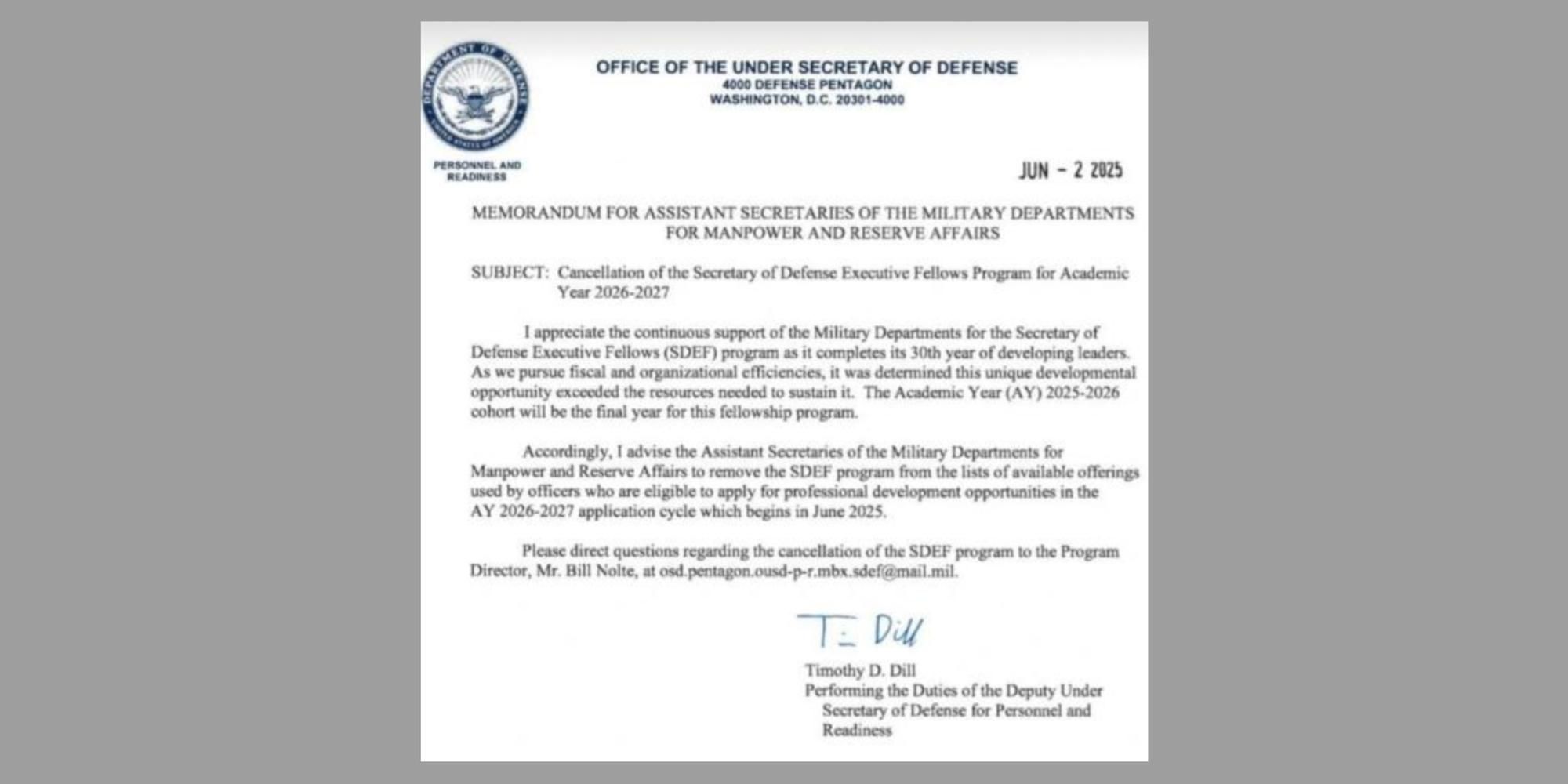
The memo, circulated by former SDEF fellows on social media, has not been released to the public. When asked by Responsible Statecraft to authenticate the memo, both SDEF program director Bill Nolte and the Pentagon press office declined to comment.
Yet other public releases appear to have since confirmed its contents. The memo specifically called on military officials “to remove the SDEF program from the lists of available offerings… in the AY (academic year) 2026-2027 application cycle.” The next month, an unclassified list of fellowship opportunities posted by the Navy cited a memo with the exact same title and subject to confirm that SDEF “has been cancelled for AY26-27.”
The end of the SDEF program is good news for those concerned about government corruption and accountability. It served as a taxpayer-funded channel through which the biggest military contractors could lobby the government for favorable treatment. Its demise means that there will be one less way for the companies of the military-industrial complex to exploit public funds.
Yet not all of the news on this front is so cheery. While SDEF may be on its way out, it is set to be replaced by yet another government program giving for-profit companies a taxpayer-subsidized way to lobby the U.S. military — and this one looks to be even worse.
In February, Secretary Hegseth unveiled the “Business Operators for National Defense” (BOND) program. BOND “embeds elite, private sector patriots” within the government, purportedly to help make the military acquisitions process more efficient. This plan, like SDEF and all of the Pentagon’s other efforts to bring corporate officials into government decision-making, is certain to introduce more corruption and inefficiency into the national security state.
After first touting the idea last year, Hegseth now claims that the BOND program has “engaged over 100 industry experts, with 72 former CEOs, COOs, and CIOs serving alongside Department leadership as we speak.” The goal is to eventually grow this number to 250 executives providing “first-class industry expertise” on how to improve government contracting.
The full list of firms involved in BOND is currently unknown, but Hegseth did mention a handful of companies that included Microsoft (which made over $414 million from military contracts last year) and Tesla (whose owner, Elon Musk, has aggressively pursued government contracts). The former SDEF participant’s proposal to give a “forum of Industry CEOs” greater influence over U.S. military policy seems to have become a reality.
This was not the Trump administration’s first new effort to merge state and industry. The administration also created “Detachment 201,” swearing in four tech executives as military officers to “help guide rapid and scalable tech solutions to complex problems.” One of these new officers is Shyam Sankar, who now serves simultaneously as a U.S. Army officer and as an executive of the controversial military contractor Palantir.
The notion that the government can be made more efficient by giving greater influence to corporate contractors is exactly backward. The companies profiting off of the military-industrial complex are not a solution to government waste and inefficiency; they are a cause of it. Government contractors spend millions each year trying to rig the rules of the game, gain privileged access to contracts, and weaken the transparency and accountability guidelines that keep them in check. With hundreds of billions of dollars in defense contracts on the line, BOND will serve as yet another avenue for big businesses to enrich themselves.
There is little doubt that BOND and Detachment 201 will produce corruption even worse than that of the SDEF program, without any of the benefits. For all of its many faults, SDEF could at least plausibly serve as a skill-building opportunity for U.S. military officers; not so for BOND. And while SDEF had a small group of fellows serving as a bridge between the Pentagon and its contractors each year, BOND’s recruitment of several hundred corporate executives threatens to create a larger, longer-lasting, and more direct channel for contractors to lobby their government customers. These “Business Operators” have a strong incentive to act in their companies’ interest, regardless of how it affects national security.
The purpose of government is to serve the public, and the purpose of a military contractor is to make money. The more that military contractors are allowed to influence the government, the more the government will ignore the common good and adopt a militaristic approach to the world in order to line the pockets of a few well-connected contractors. A rational foreign policy and an efficient military acquisitions process are possible only through reducing contractor influence, not enhancing it.
From Your Site Articles










+ There are no comments
Add yours