







Did you know that Truthout is a nonprofit and independently funded by readers like you? If you value what we do, please support our work with a donation.
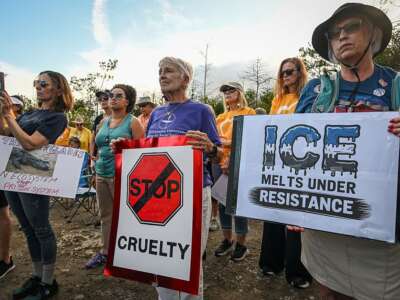
Federal immigration officials have transferred detainees out of the controversial detention facility known as “Alligator Alcatraz,” but environmental advocates say the fight to shut down the Florida Everglades site is far from over.
U.S. Immigration and Customs Enforcement (ICE) confirmed that detainees were removed from the facility, located at a remote airstrip in Big Cypress National Preserve, citing concerns related to hurricane season.
“As we enter into hurricane season, ICE and the state of Florida have moved illegal aliens from the soft sided facility,” a spokesperson said in an email to Prism. “For the safety of the illegal alien detainees, we transferred them to other facilities.”
The announcement follows mounting speculation that the detention center, which was established by the state of Florida in 2025 as part of a broader federal immigration crackdown, would be winding down operations. Environmental groups challenging the project in federal court welcomed the removal of detainees but cautioned against assuming the facility has permanently closed.
“I don’t know that we’re certain that it’s closing just yet,” said Elise Bennett, Florida and Caribbean director and attorney at the Center for Biological Diversity, one of the organizations leading the legal challenge against the facility.
“We have folks who are monitoring the site today, and they’re saying that they are seeing a ton of activity, busses, vans, trucks going not only off the site but also back on to it, and so we’re really trying to get an understanding of exactly what the federal and state government intend to do with the site at this point,” Bennett told Prism in an interview.
The Center for Biological Diversity and Friends of the Everglades sued state and federal officials shortly after construction began, arguing that authorities bypassed required environmental reviews under the National Environmental Policy Act. The Miccosukee Tribe of Indians of Florida later joined the lawsuit, citing concerns about impacts on tribal lands and nearby communities. The Miccosukee Tribe declined to comment on the potential closure of “Alligator Alcatraz.”
“The transfer of detained people out of this dystopian hellhole is a significant milestone, but it’s not enough,” Bennett said during a June 17 press conference. “We’ll keep fighting until panthers can return to the embrace of their native home and bonneted bats can reclaim the star-spangled skies.”
Last summer, a federal district court granted a preliminary injunction that would have required a wind-down of operations while the case proceeded. However, the 11th U.S. Circuit Court of Appeals overturned that injunction in September, allowing the facility to remain operational during litigation.
According to Bennett, the appellate ruling did not decide the merits of the environmental claims. She said the ruling focused on whether plaintiffs had demonstrated sufficient evidence that the project constituted a federal action requiring review under the National Environmental Policy Act (NEPA).
The plaintiffs are now awaiting the formal issuance of the appellate court’s mandate, which will return the case to U.S. District Court. Once that occurs, attorneys plan to pursue discovery and expand their legal claims, including allegations under the Endangered Species Act and the Clean Air Act.
Although detainees have been relocated, Bennett said many of the facility’s impacts remain. According to Bennett, mosquito-control operations, generators, and other support infrastructure remain active. Generators, vehicles, and other infrastructure are still present at the site and continue to pose risks to wildlife and water quality, Bennett said. Additionally, bright nighttime lighting, pavement runoff, fuel storage, and waste management systems have disrupted habitat for endangered species and increased the risk of contamination.
“Panthers have crossed the site, we have documentation of that,” Bennett told Prism. “Florida bonneted bats, another endangered species, have critical habitat that overlaps with this Miami-Dade County property, and they need dark skies to feed, so there’s a concern when you’ve got blinding lights that are still visible via satellite.”
Groups also questioned the decision to remove detainees because of hurricane season after people were housed at the facility during last year’s season.
“‘Alligator Alcatraz’ will go down as one of the biggest failures in American history,” Eve Samples, executive director of Friends of the Everglades, said during the press conference. “Our government failed to protect the Everglades and failed to follow basic environmental laws — while racking up a $1 billion tab paid by taxpayers.”
The groups contend that state and federal agencies constructed the facility without public input or environmental review and have provided little information about plans for cleanup or future use of the property.
“This facility was conceived behind closed doors, constructed without any public input, operated in secret, and now is apparently being mothballed without any explanation of how the site will be remediated,” attorney Paul J. Schwiep, counsel for Friends of the Everglades and the Center for Biological Diversity, said during the press conference.
The dispute carries particular significance because of the site’s history. The airstrip at the center of the controversy was once the focus of a major environmental battle over a proposed jetport in the 1960s. Conservationists led by Marjory Stoneman Douglas successfully fought the project, a campaign that helped inspire the passage of the NEPA in 1970.
Friends of the Everglades, the organization Douglas founded in 1969, argues that the current detention center represents a renewed threat to the same environmentally sensitive landscape that conservationists worked decades to protect.
Gov. Ron DeSantis said Tuesday that the detention center was always intended to be temporary but declined to declare that it was permanently shuttered, noting that future operations depend on decisions by the Department of Homeland Security. Environmental groups say that uncertainty is exactly why they intend to continue pressing their case in court.
“We will not rest until the government is held accountable for violating the law and the public trust,” Tania Galloni, managing attorney for Earthjustice’s Florida regional office, said during the press conference. “It is great that detainees have been removed from this devastating facility. But the risks to people and the environment remain. Now we must make sure nothing like this happens again.”
Prism is an independent and nonprofit newsroom led by journalists of color. We report from the ground up and at the intersections of injustice.
An important fundraising appeal: Fell Short of Our Goal
Truthout is one of only a few platforms for justice-oriented, grassroots journalism. Today, as political censorship from the right intensifies, we have no choice but to ask for your help.
We just finished a fundraiser to cover our basic operating expenses for June, but we fell short of our goal. If you can support Truthout with a one-time or monthly donation, you will make a significant impact on our work. Anything you can do makes a difference — we appreciate your support.









+ There are no comments
Add yours