







Honest, paywall-free news is rare. Please support our boldly independent journalism with a donation of any size.
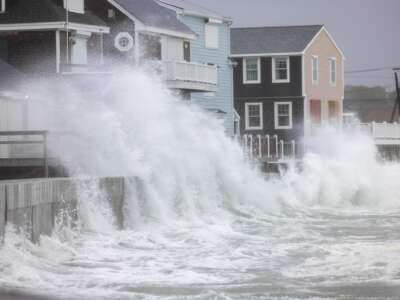
One of the most visible consequences of global warming is the increased frequency and intensity of extreme weather events, such as the powerful nor’easter that hammered the East Coast and mid-Atlantic for several days in late September with heavy rain, winds, and flooding. Indeed, a wide array of scientific studies over the past couple of decades have shown how human-caused climate change affects the intensity, frequency, and impact of extreme weather — from wildfires in the U.S. and Australia to record-setting flooding in China. And now, a major study prepared by two dozen scientists from across the globe has found a link between industrial emissions and the warming of the snow-capped Himalayan region that led to the collapse of the glacier that caused the catastrophic floods in Nepal and Tibet last month, in which over 1,300 people were killed while thousands are still missing.
In light of such developments, programs designed to address climate disasters are urgently needed. In the interview that follows, economist Michael Ash makes the case for the establishment of an Extreme Weather Superfund to protect U.S. communities from extreme weather events like those discussed above. Ash is professor of economics and public policy and co-director of the Corporate Toxics Information Project at the Political Economy Research Institute (PERI) at the University of Massachusetts Amherst.
The interview that follows has been lightly edited for clarity and length.
C.J. Polychroniou: This past summer was the hottest on record in the United States as well as in western Europe. Indeed, new data shows that global warming is accelerating and the UN says that exceeding the 1.5 degrees Celsius goal above pre-industrial levels looks now unavoidable. As such, extreme weather events like last month’s nor’easter storm that produced strong winds, large waves, and coastal flooding along the East Coast, and Hurricane Helene, which ripped across the U.S. Southeast two years ago and was responsible for at least 250 fatalities, are expected to become more intense. Yet, instead of increasing funding for extreme weather, the Trump administration has actually slashed disaster aid programs and gutted agencies whose mission is to protect communities against extreme weather disasters. Can you talk a bit about the problem at hand with extreme weather events?
Michael Ash: Top weather and climate disasters, typically hurricanes, have costs running into hundreds of billions of dollars. In addition to its war on climate policy, the Trump administration has been utterly derelict in protecting communities from extreme weather disasters or rebuilding after disasters.
Hurricane Helene brought horrendous damage to uplands North Carolina, making very clear that the impact of climate change will not be limited to low-lying coastal areas. Immediately after becoming president in 2025, Donald Trump went around North Carolina saying, “the days of betrayal and neglect are over,” while simultaneously planning to institutionalize betrayal and neglect by getting rid of the Federal Emergency Management Agency (FEMA), remarking: “If it was up to me right now, I’d end it right now.”
The Trump administration squeezed out 4,300 staff from FEMA in 2025. Its plan to reduce another 11,000 employees this year has been stopped by the courts for now. FEMA’s capacity is degraded. As The Nation article recounts, the North Carolina recovery funds have been delivered in an ineffective trickle.
How should we explain the Trump administration’s complete disregard of the risks associated with extreme weather events, which should be of deep concern to voters in the upcoming midterm elections?
It fits important patterns: climate denialism in service to fossil fuel companies; callous disregard for human suffering; and federal abdication of responsibility for the general welfare.
How much more likely and how much more destructive are episodes of extreme heat or rainfall, droughts, or hurricanes because of climate change? The science is increasingly precise and clear. Attribution science — the subject of a terrific new National Academies publication, “The Attribution of Extreme Weather and Climate Events and Their Impacts” (2026) — can establish with remarkable accuracy how much anthropogenic climate change (human contribution of greenhouse gases to Earth’s atmosphere) has contributed to extreme weather events.
To address the problem of extreme weather events, and as part of the Game Changers: Economic Policies for a Working America project that has been launched by the Political Economy Research Institute (PERI) at the University of Massachusetts Amherst, you and your colleague James K. Boyce have called for the establishment of an Extreme Weather Superfund (EWS). What would be the actual mission of an EWS?
The Extreme Weather Superfund is modeled on the original Superfund: the Comprehensive Environmental Response, Compensation, and Liability Act of 1980, which was designed to clean up land and water contaminated with toxic substances. There were two key principles: the polluter pays; and joint and several liability, which keeps polluters from dodging responsibility by pointing the finger at other parties or declaring bankruptcy.
The original Superfund empowered the Environmental Protection Agency to find and sue responsible parties and collected a valuable trust fund that paid for many useful cleanups. My son went canoeing with friends last month on Brooklyn’s Gowanus Canal, which was horribly polluted for more than a century, declared a Superfund site in 2010, and is now on the road to cleanup.
The Extreme Weather Superfund works from the Superfund model: quantify the harms, identify the responsible parties, and make the polluters pay. Except here, the harm is the introduction of greenhouse gases by carbon majors.
Can you discuss more specifically the central features of this policy and the benefits that U.S. communities can derive from it?
The big point is that communities all over the U.S. are already seeing damage from the carbon that the fossil fuel giants brought into our economy and atmosphere.
We face high costs of recovery from these disasters and high costs of adaptation, to build protection, hardened infrastructure, from these foreseeable and growing threats. Preparation makes a huge difference, but it needs investment up front.
The Extreme Weather Superfund will levy a total annual assessment of $100 billion per year on all fossil fuel corporations with a business presence in the United States that contributed more than 1 billion tons to global carbon dioxide (CO2)-equivalent emissions over the past 30 years. We call 1995 to 2024 the historical reference period: By 1995, the danger from fossil fuels was completely clear. (Some of the major carbon emitters, or what I call “carbon majors,” had suppressed evidence as early as the 1970s; so there is no “Who could have known” defense for 1995.)
The $100 billion is an estimate of the annual costs of disaster response and infrastructure adaptation for the foreseeable future. We would expect $75 billion in infrastructure hardening and, thanks to attribution science, $25 billion in response to current disasters. The 1 billion ton CO2 threshold means that we are talking about carbon majors. The responsible parties are big fossil fuel companies.
The big fossil fuel companies designated as responsible parties will split the $100 billion annual levy in proportion to the emissions from the fuels that they extracted from the earth and introduced to the world’s economy. To give an idea of the magnitude, ExxonMobil brought 19 billion tons of CO2-equivalent into being between 1995 and 2024; that’s roughly 6 percent of the total CO2 the carbon majors introduced over that period. So ExxonMobil would pay 6 percent of the $100 billion total annual assessment, or $6 billion per year. With nearly $400 billion in annual corporate revenue and $40 billion in profits in recent years, ExxonMobil can afford $6 billion per year as its share of cleaning up the mess it has made.
We have some important additional provisions, including a supplemental levy in years when exceptional climate-related extreme weather damage exceeds the expected $25 billion cost of disaster cleanup. FEMA has regularly received supplemental appropriations to respond to exceptional disasters, and we need to consider an acceleration in the frequency and impact of extreme events.
The policy would also require a document disclosure, forcing the carbon majors to come clean with information about how and when companies understood the link between their products and extreme weather events — and their efforts to conceal this knowledge from the public. This provision is based on the Tobacco Master Settlement Agreement of 1998, which exposed an extraordinary history of companies’ knowledge about the harms from their products and intentional hiding of these harms from the public.
How does the Extreme Weather Superfund differ from carbon-pricing policies?
The Extreme Weather Superfund is retrospective. It assesses and addresses responsibility for the damage that we are already suffering from past carbon emissions. The point is to collect compensation from parties that have already done terrible climate damage — the responsible parties.
In contrast, carbon pricing is focused on reducing carbon emissions going forward. The Extreme Weather Superfund addresses the consequences of climate destabilization from past emissions, and it pays for adaptation and disaster response to carbon that has already been emitted. What’s interesting about the retrospective approach in the Extreme Weather Superfund is that the opportunities for passing through costs to customers are limited. Current fuel prices are set in the world market. Carbon pricing raises the cost of bringing fuels into the economy, and fuel companies pass through some of the carbon pricing as higher fuel prices for customers. The Extreme Weather Superfund is much harder to pass through. A company trying to pass through its Extreme Weather Superfund liabilities as higher fuel prices would be noncompetitive in the current market.
At the top of the responsible party list are companies owned abroad: Saudi Aramco would owe $15 billion per year and Russia’s Gazprom would owe $13 billion. U.S.-based ExxonMobil is next on the list with $6 billion per year. Of the top 10 responsible parties, only two — ExxonMobil and Chevron — are U.S.-based; when we look out at the top 20, we add four more U.S. companies, including two from big coal: Peabody Energy, with a $3.5 billion share of the annual levy and Core Natural Resources with a $3 billion share.
Is the EWS something that states alone can pursue? In other words, can it be financially sustained without federal participation?
An important feature of the Extreme Weather Superfund is that it could be carried out by individual states without federal participation. That’s crucial, given the current federal climate of climate denial and extreme-weather neglect.
New York State and Vermont have already passed climate responsibility legislation.
The scale is smaller, and there are some additional challenges involved in pursuing state-level Extreme Weather Superfunds. First, the scope of naming responsible parties would be limited to companies doing business in the state. For large states with lucrative markets, such as New York or California, the carbon majors are less likely to withdraw than to accept the Superfund fines.
The biggest danger for the Extreme Weather Superfund at the moment may be less federal neglect and more federal involvement. We are likely to see a huge push by the carbon majors for liability protection, along the lines of how the Protection of Lawful Commerce in Arms Act (2005) shielded the gun industry from being held accountable for the harms the gun industry had caused.
The carbon majors — that is, the oil industry, the coal industry, and the natural gas industry — will seek federal preemption to undermine state legislative efforts and lawsuits in state courts to seek redress for the damage these industries have caused.
The U.S. Supreme Court is hearing arguments in Suncor Energy (U.S.A.) Inc. v. County Commissioners of Boulder County. Suncor, a Canadian energy company active in the Alberta tar sands, is arguing that U.S. federal law preempts local governments from bringing claims for climate-related damages against fossil fuel companies. This would be a terrible precedent.
So it’s already in the courts, and we’ll likely soon see a federal bill providing protection for these polluters.
The Extreme Weather Superfund will take taxpayers off the hook and put the carbon polluters on the hook for disaster response and adaptation investments to limit future damages.
Media that fights fascism
Truthout is funded almost entirely by readers — that’s why we can speak truth to power and cut against the mainstream narrative. But independent journalists at Truthout face mounting political repression under Trump.
We rely on your support to survive McCarthyist censorship. Please make a tax-deductible one-time or monthly donation.








+ There are no comments
Add yours