






Support justice-driven, accurate and transparent news — make a quick donation to Truthout today!
Harvard graduate student workers walked off the job on Tuesday in their second strike of 2026 — and other Harvard workers are set to follow with additional strikes in the coming weeks, as union activity heats up on campuses in the Boston area.
The Harvard Graduate Students Union-United Auto Workers Local 5118 (HGSU), which represents over 4,000 student workers, began their strike at midnight on Tuesday. The strike comes five months after the union ended a six-week strike in the spring, which ended without a contract.
The union’s demands are “safe work, fair pay, and the right to stay”— meaning stronger grievance processes and the right to third-party arbitration in sexual harassment and discrimination cases; pay equity and wages on par with those for student workers at MIT and Brown University; and protections for non-citizen and disabled workers.
Sarah Johns, a member of HGSU’s bargaining committee, told Truthout that the union called off their first strike this year in May after some progress in contract negotiations with the university. But despite bargaining over the summer, “we were really disappointed in the lack of momentum from Harvard,” she said. As a result, “our membership voted that it was necessary to escalate this fight in order to get a contract.”
In a letter published on Tuesday, HGSU President Denish Jaswal wrote that Harvard had “refused to meaningfully engage” with the union and offered a “regressive contract worse than our last, stripping away millions in previously negotiated benefit funds” and removing protected classes from the contract, while also resorting to “anti-labor tactics.”
“Our benefits have been completely gutted,” Johns told Truthout. “Harvard has cut over $3 million from our benefits funds that we had access to in our last contract. We also no longer have access to health care, dental, vision, and they also cut our parental benefits by 50 percent.”
Harvard grad student workers currently only have access to “emergency funds,” which do not cover costs for people with disabilities and chronic conditions, she said. Though HGSU had brought over a dozen student workers to a negotiating session to testify on the importance of these benefits, Harvard refused to budge on the issue, she added.
A day after HGSU’s last contract expired on June 30, 2025, Harvard “carved out” over 900 student workers from the union, claiming that those covered by stipends could not be considered employees eligible for union protection, weakening the union’s ranks.
In a video taken after the strike’s launch, Jaswal said: “None of us here, despite attending the wealthiest university in the entire world, make a living wage. Right now, I make $26,000, in fact, which qualifies me for SNAP benefits in the state of Massachusetts. Harvard’s offer was to bring me to $29,000 by the year 2029, which still qualifies me for SNAP benefits.”
Harvard has also maintained that they will not bargain on harassment or discrimination policies. The union has asked for third-party grievances and additional protections to be written into their contracts — issues that have been core to the union’s fight since it began organizing in 2018, and which have recently come under the national spotlight with the Cornell rape case.
One in five student workers at Harvard reports experiencing harassment or discrimination while at Harvard, Johns explained. “We have found that many of our students are reluctant to come to Harvard and interact with Title IX processes because they just don’t trust the university and they don’t trust Title IX procedures.”
“We know from notable news stories that Harvard has an interest in not finding itself guilty,” Johns went on, regarding the university’s control over grievance processes. “There are a couple departments that had a number of high profile professors with allegations against them, and Harvard has taken no action against those professors.”
The union is also asking for protections for its non-citizen students, including a policy barring Immigration and Customs Enforcement (ICE) agents from entering campus without a judicial warrant. While this is Harvard’s current policy, the union is asking for it to be codified into their contract.
“We understand that our negotiations with Harvard are not taking place in a vacuum,” Johns said. “Harvard has its own battles that extend beyond unions, especially with the federal government. We are very concerned if we are not codifying some of these policies, at any moment Harvard can just decide to change it. If there is another executive order, or if there is some kind of pressure or a phone call, at any moment Harvard could change these policies.”
“The Harvard corporation has really not stood up in the way we’d like to see to the Trump administration,” HGSU member Abbie LeBlanc said in an interview with More Perfect University.
“Even before some of the more formal and the most aggressive attacks from the federal government, Harvard actually kind of pre-capitulated to some of the demands [of the Trump administration],” graduate student and HGSU member Nuriel Vera-DeGraff told the outlet.
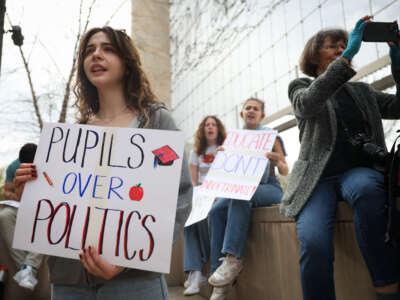
At the Tuesday rally at Harvard to kick off the strike, students read letters from Columbia University graduate students describing ICE’s detention of Mahmoud Khalil and Ellie Aghayeva, both students who were detained while at Columbia.
Despite the obstacles facing the students and the union, their organizing has strengthened. The HGSU’s membership and member participation have increased, and their general membership meeting before the strike was the largest in the union’s history.
“We have grown so much in the last several months, and especially since bargaining started a year and a half ago. We continue to get stronger. Harvard is not wearing us down,” Johns told Truthout.
“Our members are ready for a contract,” she went on. “They are fired up, they are angry. They are angry at Harvard. This is Harvard’s responsibility to end the strike. If Harvard wants us back teaching, if Harvard wants us back in the classrooms, and doing research, that’s Harvard’s responsibility.”
In addition to the Harvard graduate student workers, two other groups of workers at Harvard have voted to strike. The Harvard Academic Workers Union (HAW), representing non-tenure-track teachers, researchers, and staff, has set a November 10 strike deadline after two years of bargaining for a contract. In addition, Harvard dining workers represented by UNITE HERE Local 26 voted to authorize a strike last week.
“Although we have very different roles, this paints a bigger picture about how Harvard values its labor — or perhaps, how it doesn’t value its labor — and what it’s willing to extract from the people that work and serve the university,” Johns said.
At MIT — another Boston-area university with a multi-billion dollar endowment — graduate students are also preparing to strike, and may enter a joint strike with facilities workers. Their demands include contracts with increased wages and protections for immigrant workers.
Press freedom is under attack
As Trump cracks down on political speech, independent media is increasingly necessary.
Truthout produces reporting you won’t see in the mainstream: journalism from the frontlines of global conflict, interviews with grassroots movement leaders, high-quality legal analysis and more.
Our work is possible thanks to reader support. Help Truthout catalyze change and social justice — make a tax-deductible monthly or one-time donation today.







+ There are no comments
Add yours