







Truthout is an indispensable resource for activists, movement leaders and workers everywhere. Please make this work possible with a quick donation.
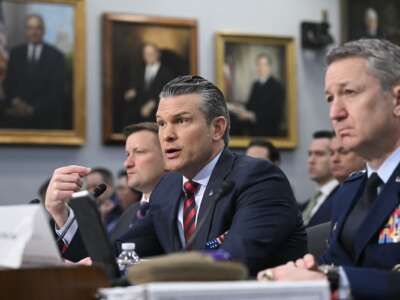
On Wednesday, Secretary of Defense Pete Hegseth announced a new policy aimed at increasing testosterone levels for servicemembers — a move that has been discouraged by health experts.
In a social media post announcing the policy, Hegseth stated that the most “decisive tactical advantage” the U.S. military has “will always be the individual warfighter.”
“We have a sacred duty to maintain that advantage, which is why we must constantly look for new ways to optimize your performance, your resilience, and your long-term health,” the Defense Secretary stated. “To meet that commitment today, I’m authorizing a new screening program for testosterone deficiency for our service members, ensuring you have the right testosterone levels to operate at your absolute best.”
The new policy aims to provide, as part of yearly screening, mandatory testosterone level testing for servicemembers over the age of 30, with those under that age being allowed to request it. Hegseth emphasized that what happens next is up to the individual.
“If treatment is recommended, it’s entirely your choice to receive testosterone replacement therapy,” or TRT, he said.
But the overall message from Hegseth was clear: The military wants and is prioritizing higher testosterone levels in its soldiers.
“The modern battlefield is brutal and unrelenting. It requires and demands maximum psychological and mental readiness, and by addressing these health markers early, we’re keeping you on the leading edge of lethality and giving you the same level of support that you give this nation,” he said.
Hegseth noted that it is “well-established science that as we age, testosterone levels often naturally drop.” While that is true, the “drop” in levels isn’t significant for most people, and certainly not for those of military age — levels drop by about 1 percent per year for people over the age of 30.
While the program appears to be voluntary beyond testing, some servicemembers may feel pressured to take medical supplements after their test results come in (especially since Hegseth’s video message was accompanied by the words, “The High-T Department of War”). Hegseth’s push could also prompt servicemembers to take testosterone supplements before their testing, without proper guidance.
Indeed, Hegseth’s message may feed into the current epidemic of online misinformation, tying masculinity to higher testosterone levels.
“This is a huge problem,” endocrinologist Channa Jayasena, of Imperial College London, told The Guardian in November. “Hospital specialists are seeing patients coming in after having private blood tests, often arranged through influencers, perhaps, and then being told by inexperienced doctors or a wide range of healthcare professionals that they should start testosterone. The advice they are giving is wrong.”
Notably, the Food and Drug Administration (FDA) advises against testosterone replacement therapy unless there is a specific medical reason for it.
Health experts questioned Hegseth’s new initiative.
“I used to do testosterone research — testing for T levels in troops doesn’t make sense without a medical reason,” public health scientist and epidemiologist Eric Feigl-Ding said in a post on X reacting to Hegseth’s announcement. “T level is not associated with higher cognitive function. T can drop because of stress or exhaustion — but TRT doesn’t always improve physical performance.”
The result of TRT is “mixed at best,” Feigl-Ding added.
Testosterone is a naturally occurring sex hormone, commonly associated with being the major hormone for men, though it is present in everyone at varying levels, including women. Benefits of the hormone include increasing muscle size and strength, as well as bone growth.
But according to Harvard Medical School, artificially high levels of testosterone have also been associated with a number of health problems, such as:
- Heart damage and a higher risk of heart attacks;
- High blood pressure and increased cholesterol levels;
- Higher risks for blood clots;
- Liver disease;
- Prostate enlargement;
- Headaches;
- Insomnia, mood swings, irritability, impaired judgment, and possibly overly aggressive behavior.
Hegseth’s announcement came with no similar statement of concern for the health of servicewomen, and is consistent with his past statements on (and apparent obsession with) creating a more “manly” military.
Last year, addressing all servicemembers, Hegseth said that troops will have to meet “the highest male standard” in order to stay. He claimed that the standard wasn’t purposely targeting women, but added that, “when it comes to any job that requires physical power…those standards must be high.”
Hegseth also instituted a standard disallowing facial hair. “The era of unprofessional appearance is over,” he said at the time. “No more beardos.”
Critics have alleged that the policy is racist, noting that Black men who shave too often are more likely to suffer from “pseudofolliculitis barbae,” an inflammatory skin condition commonly known as razor burn.
“If you have ever had them, they are unpleasant. When you have a bad case of razor bumps, it is absolutely terrible,” explained The Hill’s Jos Joseph, a former military servicemember who wrote an opinion piece opposing the policy last year.
More recently, Hegseth blocked the promotions of seven senior Navy officers, five of whom were women or people of color. The action means that it is unlikely that a female active-duty naval officer will be promoted to admiral this year — the first time that’s happened in over a decade.
An important fundraising appeal: 7 Days to raise $45,000
Truthout is one of only a few platforms for justice-oriented, grassroots journalism. Today, as political censorship from the right intensifies, we have no choice but to ask for your help.
We are fundraising right now to cover our basic operating expenses. If you can support Truthout with a one-time or monthly donation, you will make a significant impact on our work. Anything you can do makes a difference — we appreciate your support.










+ There are no comments
Add yours