






Honest, paywall-free news is rare. Please support our boldly independent journalism with a donation of any size.
Nvidia stock prices surged over 30% on Monday as the chip maker reinstated Jensen Huang as CEO. Huang had stepped down earlier in November amid reports he had multiple extramarital affairs, including with a woman accused of spying for China. Huang and Nvidia have been central to the AI boom, and the leadership turmoil had erased trillions in value from the U.S. stock market. President Donald Trump acknowledged he had encouraged the company’s board to bring Huang back.
“The fact that our markets are so over-indexed on the AI trade, that something like three-fourths of gains in the [S&P 500] this past year have been AI-related, is unsustainable,” says Aya Ibrahim, senior fellow for economic and national security at the AI Now Institute.
We also speak with organizer and researcher Tobita Chow, who says Huang’s “spy scandal” that led to his ouster is part of a larger effort by anti-China figures in the U.S. national security establishment to escalate tensions between the countries.
“The national security leadership in both parties in D.C. has been greatly frustrated with President Trump, who has over the past year pursued policies to maintain very warm relations with Xi Jinping,” says Chow, who notes that Secretary of State Marco Rubio is one of the “chief” frustrated China hawks in the administration.
TRANSCRIPT
This is a rush transcript. Copy may not be in its final form.
AMY GOODMAN: Jensen Huang is back as CEO of the chip giant Nvidia, after President Trump personally called into a company board meeting Sunday to push for Huang’s reinstatement. Huang had resigned less than two weeks ago, after news reports revealed he had an affair with a Chinese businesswoman who was allegedly in communication with China’s top spy agency. The woman worked with Megaspeed, a Singapore-based company suspected of buying advanced Nvidia chips, then diverting them to China in violation of U.S. export rules. On Monday, the Commerce Department added Megaspeed to its trade blacklist.
During an interview on CNBC, Trump was questioned about his role reinstating Huang.
EAMON JAVERS: Mr. President, did you give the board of directors an assurance that Jensen Huang would not be prosecuted at all for any of these —
PRESIDENT DONALD TRUMP: I didn’t use the word “prosecuted.”
EAMON JAVERS: — questions around export controls?
PRESIDENT DONALD TRUMP: But I said — I said that we believe — and I put out a statement. I think you probably saw that.
EAMON JAVERS: We did, yes.
PRESIDENT DONALD TRUMP: That we believe he’s fine, he’s absolutely fine. I gave them enough —
CARL QUINTANILLA: There was a —
PRESIDENT DONALD TRUMP: — assurance.
AMY GOODMAN: President Trump also admitted that falling stock prices played a role in his decision to push for Huang to be reinstated. After Huang resigned, Nvidia’s stock fell sharply, along with those of several other AI and technology companies with ties to Nvidia.
One major holder of Nvidia stock has been Cantor Fitzgerald. The Wall Street investment firm is run by the sons of Howard Lutnick, Cantor’s former CEO, who serves as President Trump’s commerce secretary. Cantor Fitzgerald held shares in Nvidia worth hundreds of millions of dollars. The New York Times reports Lutnick pushed to weaken chip export rules that overlapped with his family’s business.
The Financial Times reports President Trump personally made up to $15 million on Monday alone, after Nvidia’s stock soared 30% following Huang’s return.
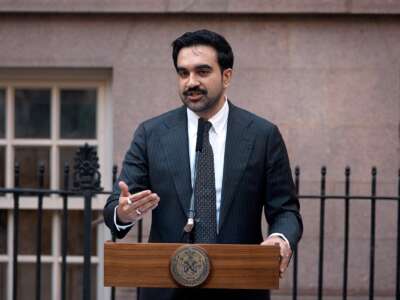
On Monday, New York Mayor Zohran Mamdani responded to the Nvidia news and its impact on working people.
MAYOR ZOHRAN MAMDANI: I do not think that working people across the country signed up for their pensions being tied to the question of Jensen Huang’s fidelity to his marriage. And yet, for many days, that had a massive impact. And what we’re also talking about here, speaking about Mr. Huang, we’re speaking about a divorce settlement that has been rumored to be around $81 billion. That would be the cost of providing universal childcare for every 3- and 4-year-old in the United States of America for an entire year.
And a lot of this just brings to mind what Justice Brandeis said quite some time ago, which is that we can have democracy, we can have great wealth concentrated in the hands of a few, we cannot have both. And when you look at our stock market and you look at how disproportionately dependent it is on artificial intelligence-related stocks, it cannot help but give you a sense of concern about just how — how much this technology is now dominant, not just in terms of the discourse that we are having around it on a day-to-day basis, but also the strength of the United States economy.
AMY GOODMAN: To talk more about Nvidia and the reinstatement of CEO Jensen Huang, we’re joined by two guests. In Chicago, we’re joined by Tobita Chow, an organizer there. His most recent article for The Nation is headlined “Why Jensen Huang’s Downfall Is No Victory for Progressives.” Aya Ibrahim is with us here in New York. She’s a senior fellow for economic and national security at the AI Now Institute. She previously served as a senior adviser on the secretary of state’s policy planning staff, the White House’s Office of Science and Technology Policy and on the National Economic Council. She also served as senior economic adviser to Massachusetts Congresswoman Ayanna Pressley.
We welcome you both to Democracy Now! I want to get your response to the resignation, and then the reinstatement at the behest of President Trump, of Jensen Huang, and also the comments of New York Mayor Zohran Mamdani, Aya.
AYA IBRAHIM: Thank you for having me, Amy.
You know, I think that the mayor’s comments really get at the heart of this issue, which is who is in control of our economy, who is critical to our national security, and who gets to decide the trajectory of both. For so long, we have had discussions that centered on the value of the free hand of the market, and now we have an economy where it seems to be the singular hand of President Trump. The fact that our markets are so over-indexed on the AI trade, that something like three-fourths of gains in the S&P this past year have been AI-related, is unsustainable. And that the president would feel the need to step in, and do so in a way that undermines serious concerns around national security, is a problem.
JUAN GONZÁLEZ: And, Aya, what about these concerns around national security? The Director of National Intelligence Jay Clayton said on Sunday that there’s an investigation into Alice Huang, one of the women with which Jensen Huang had a relationship with, and her firm Megaspeed, that that’s ongoing. But it’s still unclear that Alice Huang is an alleged spy for the Chinese government. Your thoughts about this?
AYA IBRAHIM: Well, whatever the conclusion or finding as to the exact nature of the relationship, I think, is ultimately irrelevant, to the extent that regardless of the nature of the relationship, the result was that Jensen Huang was sidestepping and circumventing export controls. Right? These are violations of the law. So, the relationship itself is beside the point.
The bigger issue here is that we have one man, one firm, that many people, including those in our government, now believe are indispensable both to our economic growth and financial stability and to national security. And there’s an emerging discourse of “separate the artist from the art,” but usually the artist doesn’t have an impact on my retirement. So, this is a very unique set of circumstances, but it’s also the result of decades of technology and national security exceptionalism that allows the rise for firms to have such singular power and influence.
JUAN GONZÁLEZ: Yeah, I’d like to bring Tobita Chow into the conversation. Your initial thoughts on the breaking news that Jensen was reinstated? And I also — I’m wondering if you could talk some, because most of Nvidia’s chips — I mean, sorry, all of Nvidia’s advanced chips are manufactured in Taiwan by the Taiwan Semiconductor Manufacturing Company, TSMC, and the the irony here of most of these most advanced chips being manufactured just 80 miles away from the Chinese mainland.
TOBITA CHOW: Yeah. Thanks for having me.
I would also lift up Mayor Mamdani’s comments on this issue as a real model. The fundamental issue here is that a handful of these AI oligarchs have seized total control of the future of the U.S. economy, enormous power over the jobs and welfare and pensions, and so on, of all of us without our consent. And the real solution is that we need to build a new economy that is not dependent on this AI industry as its sole source of growth.
Another thing that I admire about Mayor Mamdani’s comments is that he steered the conversation away from the whole issue of the U.S.-China relationship and national security. My read of this scandal and news cycle is that it has been a strategy led by China hawks in the national security establishment to accomplish two goals. One is to build greater political support for chip restrictions against China, and to build greater political support particularly within the Trump administration, because Trump has been inclined to ease these chip restrictions against China, which hurts the Chinese AI industry — the restrictions hurt the Chinese AI industry. The other goal that the China hawks had was to get rid of Jensen Huang, who has been the chief proponent within Silicon Valley of continued engagement between the U.S. and Chinese tech industries and very successfully lobbied the Trump administration around this issue of chip restrictions against China. So, I think there — we need to understand the role that these China hawks within the national security establishment have played in driving this whole news cycle.
As far as the role of TSMC within the global chip industry goes, yeah, it is located in Taiwan. It is critical to the global chip industry. But I think, like, you know, there are recurring concerns about China’s claims to — claims to have sovereignty over Taiwan and their talk of reunification between Taiwan and the Chinese mainland. This creates fears of some sort of Chinese military action against Taiwan that would disrupt the global chip industry. There are real concerns there, but I think that fears of imminent military action around Taiwan tend to be overblown in a lot of discourse.
AMY GOODMAN: Toby Chow, you talked about the rift in the national security establishment. Give it names — for example, Marco Rubio, a true China hawk, who is secretary of state. I think The Wall Street Journal has a piece today calling on him to step down so he doesn’t become this face of a failed foreign policy. And then you have Vice President Vance, and these two, Vance and Rubio, perhaps vying for the presidency in 2028. Explain the positions they’re taking here.
TOBITA CHOW: Marco Rubio is maybe chief among the frustrated China hawks within the Trump administration. So, the national security leadership in both parties in D.C. has been greatly frustrated with President Trump, who has over the past year pursued policies to maintain very warm relations with Xi Jinping, who he seems to admire as a fellow strongman leader. And so, his approach has been seen as way too, you know, soft on China by basically the entire national security establishment, and this includes a number of frustrated national security leaders within Trump’s own administration, Marco Rubio being chief among them. And yes, there are reports that Marco Rubio played a key role in leaking a report that drove this whole scandal around Jensen Huang.
JD Vance has taken a very different position. According to reports, he was instrumental in working with venture capitalists and other of Jensen Huang’s allies in Silicon Valley to pressure Trump to support the return of Jensen Huang to Nvidia, and which led to a very successful meeting where Donald Trump met with the board of Nvidia and got them to reinstate Jensen Huang.
There are splits within Silicon Valley on this key question of chip controls vis-à-vis China that are at play here. On the one hand, you have companies like Nvidia, which can profit off of the Chinese tech industry. You also have venture capitalists in Silicon Valley — and JD Vance was one of these venture capitalists — who are investing in companies that can make profitable use of cheaper Chinese AI models. So, this is a faction of Silicon Valley that supports Jensen Huang and his efforts to ease chip restrictions against China. This is opposed to a different faction of Silicon Valley, which includes the frontier AI labs of Anthropic and OpenAI. These companies do not have any opportunity to profit off of the Chinese tech industry. For them, the Chinese tech industry is only a severe competitive threat, and even an existential threat to their business models, and so they have consistently lobbied for stronger chip restrictions against China, which puts them in a natural alliance with the China Hawks. So, that’s the division that we’re seeing at play here, both within Silicon Valley and within D.C., and even within Trump’s own administration.
JUAN GONZÁLEZ: Yeah, I’m wondering also if you could talk, Tobita, about the — we hear a lot about the relationship between Chinese companies, especially these advanced companies, and the Chinese government. But what about the relationship of the major companies here in the United States to the U.S. government and the U.S. military?
TOBITA CHOW: Yeah, there is — among national security leaders and China watchers, sometimes you’ll see them talk in very concerned tones about this thing that is called military-civil fusion in China, which is this growing — this effort to increase the level of integration between civilian industries, particularly in the tech industry, and the Chinese military. I agree that’s a very dangerous trend.
But that trend is, I feel like, if anything, more advanced in the United States. We are seeing within Silicon Valley movement of greater convergence and integration into the national security state, moving into, you know, arms manufacturing, into Pentagon contracts. Many of these companies also see — increasingly see the national security establishment as allies in protecting them from rising populist anger at Silicon Valley, and also getting them favorable policies.
I mean, part of what we have seen in this Jensen Huang scandal is that it was good for Anthropic and OpenAI. It very coincidentally overlapped with Anthropic’s debut on the stock market. But Jensen Huang’s ouster at Nvidia suggested that the U.S. government might indeed move to strengthen these chip restrictions against China, thereby undermining the Chinese AI industry, which is a boon for both Anthropic and OpenAI. So, this is a demonstration of what national security leaders can provide to actors in Silicon Valley.
AMY GOODMAN: I want to go back to Aya Ibrahim. Apple still manufactures most of its iPhones in China. Tesla designs and sells electric vehicles plus energy storage systems in China. Google’s Android operating system runs on nearly 80% of smartphones in China. Can you talk about the significance of the focus on Nvidia shipping AI chips to China? Who benefits from Jensen’s ousting from the company? And ultimately, do you simply think he was too big to fail?
AYA IBRAHIM: So, no, nobody is too big to fail or too big to fire, and no one should be, again, this indispensable, whether to our economy or national security.
The question of companies that are operating in China, I mean, they’re — not all technologies are created the same. So, this is fundamentally a question about cutting-edge technology, advanced chips, that are necessary for defense and intelligence and national security purposes, and many view them as critical to our ability to maintain those systems. That is different than, you know, legacy chips that go into other products, like EVs.
I think that the focus on export controls misses a bigger issue. By all means, if there are loopholes, close the loopholes. But closing the loopholes is not an exhaustive solution, and it also does not get at the structural and systemic issues that allowed for the situation to come together in the first place. Right? Closing the loopholes in export control are not going to address the opaque financing that’s underpinning this ecosystem and its buildout. It’s not going to address the deep imbalances in our economy and financial markets, where one company’s IPO means that 5,000 people have more wealth than the bottom third of Americans. It is not going to address the lack of competition, such that we only have one company and we’re sitting here for weeks trying to figure out, well, how do we make sure that this company operates in a way that is consistent with national interest, ignoring the fact that at the end of the day, a company has commercial interests, and those are not always one and the same as national interest.
AMY GOODMAN: So, there is a huge change, the blue wave, with the incoming Congress. Both will be controlled by the Democrats. President Trump has made very clear that he doesn’t want AI regulated. What do you think should be the approach of this new wave?
AYA IBRAHIM: I think that AI and data centers specifically were an 80-20 issue for voters, and it really has scrambled our politics. So, it’s a cross-cutting and, frankly, a bipartisan issue. And we saw many Republicans shift, including Governor Abbott in Texas, who imposed a temporary moratorium. That is the level of frustration and anger, and to the degree that, again, even folks who are nominally very hands-off regulation-wise felt the need to respond.
I think that voters have made very clear the two big issues in this election were cost of living and corruption, and both of those issues are embodied fairly well in this larger debate about the AI buildout and who bears the cost and pays the price, and then who benefits. And it’s very clear that a handful of folks are benefiting at the expense of many people. The American people want us to regulate these companies. They want to see accountability for leaders that have made it very clear that they’re indifferent to what is in the interest of anyone but themselves or their share price.
AMY GOODMAN: We’re going to leave it there, but, of course, we’re going to continue to cover this issue. Aya Ibrahim is senior fellow for economic and national security at the AI Now Institute. And Tobita Chow, Toby Chow, organizer in Chicago, we’ll link to your recent piece in The Nation, “Why Jensen Huang’s Downfall Is No Victory for Progressives.”
Coming up, masked, unidentified, plainclothes ICE agents detain a father and daughter on the jetway at Sea-Tac Airport in Seattle as they’re trying to board a plane to attend a family baptism. Stay with us.
[break]
AMY GOODMAN: “Really Real” by Allison Russell and Ganessa James of Rainbow Coalition, performing in our Democracy Now! studio.
Media that fights fascism
Truthout is funded almost entirely by readers — that’s why we can speak truth to power and cut against the mainstream narrative. But independent journalists at Truthout face mounting political repression under Trump.
We rely on your support to survive McCarthyist censorship. Please make a tax-deductible one-time or monthly donation.


+ There are no comments
Add yours