






Did you know that Truthout is a nonprofit and independently funded by readers like you? If you value what we do, please support our work with a donation.
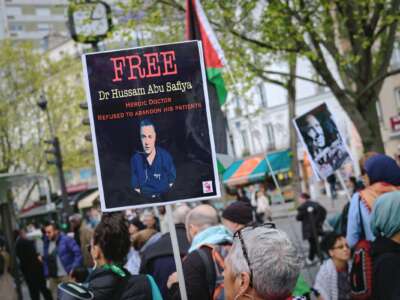
Dr. Hussam Abu Safiya is not only the director of Kamal Adwan Hospital in northern Gaza; he is one of the medical voices that brought the suffering of patients and the wounded to the rest of the world. He has dedicated his own life to saving the lives of others and caring for children and patients. He refused to leave Gaza even amid Israeli attacks, choosing instead to remain beside his patients and medical team.
But now Abu Safiya has been imprisoned by Israeli authorities since his arrest on December 27, 2024. International organizations, including Amnesty International, have called for Dr. Hussam Abu Safiya’s immediate release, while Physicians for Human Rights Israel has repeatedly raised alarm over his detention conditions and warned that his life is in imminent danger.
I first met Abu Safiya at the beginning of February 2024 when I visited Kamal Adwan Hospital. I entered the pediatric intensive care unit, where several premature babies were receiving treatment. Their health conditions were critical, and they were suffering from malnutrition.
I saw Abu Safiya moving between the hospital departments. He appeared anxious and exhausted as he asked one of the nurses to search for formula specifically needed for premature infants.
I asked him whether this milk was available in the markets. He told me that throughout northern Gaza, it was unavailable, and if found, it was extremely difficult to obtain and could cost more than 280 Israeli shekels (around 80 U.S. dollars at the time), a price beyond the ability of families and the Ministry of Health to afford under the circumstances.
At that time, I told him that a friend abroad — with whom I had worked before the war in writing, translation, and website management — wanted to provide $1,000 in aid, and he asked me to find those who needed it most.
Although all of northern Gaza was facing severe shortages of food, medicine, and humanitarian assistance, I decided to direct this support to the children suffering inside Kamal Adwan Hospital.
When I handed the money to Abu Safiya, he asked a nurse, Ahmed Al-Kahlout, to help distribute it. Al-Kahlout refused to take the money, and instead said he would accompany me personally to distribute it among the families most in need. He insisted that the parents should see who was providing the assistance and express their gratitude, and added that he would guide me to the families who needed it most.
Al-Kahlout spoke about the suffering of children due to malnutrition. “Because of the famine and the lack of available milk, we have been burying nearly eight children every day for the past month. But the limited media coverage means the world does not know about it,” he told me.
After distributing the assistance, I met Abu Safiya again. He told me that he documented the hospital’s situation daily, including the lack of medical supplies, the suffering of patients and the wounded, and the repeated attacks on the hospital. He said he continued trying to deliver these messages to the world despite the risks and direct threats he and the medical staff faced.
As the hospital came under repeated attacks and a prolonged siege, Abu Safiya became one of the few people documenting the collapse of health care in northern Gaza. Through frequent messages and statements shared with journalists, he described the growing number of wounded, the lack of essential supplies, and the danger facing patients and medical teams. His appeals were not only medical warnings but urgent calls for international action.
Months later, I returned to Kamal Adwan Hospital in September 2024 to interview Abu Safiya again. I saw him as he always was: walking through the departments wearing his medical uniform, with his stethoscope around his neck. I never saw him sitting in his office; he was always among patients and medical staff.
I asked him about the conditions of patients, the availability of medicines, and the hospital’s ability to continue operating. He answered all my questions and emphasized the importance of telling the world about what patients and medical workers were experiencing.
The last time I saw Abu Safiya, he was in good health. He was wearing his medical uniform, walking through the hospital corridors, and continuing his work without showing signs of exhaustion. Despite the severe famine, which had left visible effects of hunger and fatigue on almost everyone around him, Abu Safiya did not appear to show signs of the same physical decline. Instead, what stood out was his deep concern for his patients and their medical conditions.
Nurse Anwar Al-Masri said that on October 23, 2024, at around 10:00 pm, Abu Safiya was informed that the medical staff had to evacuate the hospital. She said that the medical teams, patients, and their companions were ordered to gather at the hospital’s reception entrance, where Israeli soldiers were positioned, while others spread throughout the upper floors.
According to Al-Masri, Abu Safiya was the link between the Israeli forces and the hospital’s medical team. She said that when soldiers called for him and he did not respond immediately, he was subjected to physical assault.
“Dr. Hussam was subjected to direct threats and pressure to evacuate the hospital, but he refused. Every time he was threatened or forced to leave, he insisted that the hospital was a medical facility whose purpose was to provide care for patients and the wounded,” she added.
Throughout this time, Israel continued targeting humanitarian workers, medical workers, and journalists; Dr. Abu Safiya and his staff were among them.
In late November 2024, Abu Safiya was injured after a quadcopter strike, which forced him to use crutches while walking.
In the weeks leading up to the raid during which Abu Safiya was arrested, Kamal Adwan Hospital was subjected to repeated shelling and fires. Despite the destruction, he and the remaining medical staff worked tirelessly to repair the damage and keep the hospital functioning.
The hospital had previously been stormed during a ground incursion in late 2023. After that attack, Abu Safiya led efforts to restore the hospital and resume medical services despite the immense challenges.
In the final raid, the one in which he was arrested, Abu Safiya was subjected to direct threats and repeated evacuation orders. He refused to abandon the hospital or his patients, choosing instead to remain alongside his medical team until Israeli forces detained him.
On November 29, 2024, nurse Al-Kahlout was killed inside the hospital while providing medical care to patients.
When I read the news of his death, I cried and asked myself: Why was he killed? Was his only “crime” that he was providing medical care to the wounded and sick?
Soon, even more attention would be drawn to the staff of Kamal Adwan Hospital. On December 27, 2024, Abu Safiya was arrested. A widely circulated image showed him walking alone over the rubble of the destroyed hospital, wearing his medical uniform and walking toward a military vehicle before his arrest.
The image was painful: a doctor walking in his medical clothing, a symbol of his mission to save lives, while surrounded by destruction.
To this day, Israel accuses Abu Safiya of being an “unlawful combatant,” a designation criticized by human rights organizations because it allows prolonged detention and limits detainees’ access to fundamental legal guarantees.
After his arrest, Abu Safiya was forced out of public view. The voice that had repeatedly appealed to the world to save patients and highlighted the lack of medical resources inside the hospital was silenced.
His lawyer, Nasser Ouda, stated that Israeli authorities transferred Abu Safiya to solitary confinement on June 3 of this year, describing it as a form of harsh treatment.
On June 10, 2026, an image of Abu Safiya appeared on social media showing him handcuffed, having lost weight and displaying signs of exhaustion. During a court hearing, he said:
I am a pediatric doctor. I provide medical care and services to patients and the wounded. I carried out my work according to humanitarian standards and laws. My detention is arbitrary and unjust, and I demand my immediate release.
Dr. Hussam Abu Safiya was arrested after refusing to abandon his patients and insisting on continuing his medical duties. Today, he remains imprisoned, separated from the patients he dedicated his life to saving.
Press freedom is under attack
As Trump cracks down on political speech, independent media is increasingly necessary.
Truthout produces reporting you won’t see in the mainstream: journalism from the frontlines of global conflict, interviews with grassroots movement leaders, high-quality legal analysis and more.
Our work is possible thanks to reader support. Help Truthout catalyze change and social justice — make a tax-deductible monthly or one-time donation today.






+ There are no comments
Add yours