







Truthout is an indispensable resource for activists, movement leaders and workers everywhere. Please make this work possible with a quick donation.
Anahkwet (Guy Reiter), a member of the Menominee nation and a longtime community organizer, remembers the counsel of his elders about what to do when times get thorny, tangled, and twisted. “If I’m struggling with something in my life, if I’m having a hard time, I was taught to go outside and walk,” Anahkwet told Truthout. “The earth will show me something that I haven’t seen before, or a way of reframing the way I’m looking at something, and I trust it. I trust that that’s the connection I have to our beautiful Mother and her reaching out to me, saying, ‘There now, it doesn’t have to be so hard.’”
The difficulties northern tribes are facing on their shared ancestral lands in the Porcupine Mountains of Michigan’s Western Upper Peninsula have recently become acutely thorny, as they stare down an industrial buildout in the last uncut old-growth forest in the region. Charlotte Loonsfoot, a tribal member of the Keweenaw Bay Indian Community (KBIC), told Truthout she had the same impulse: to go into the wilderness, build a sacred fire in community, and make offerings to the spirits.
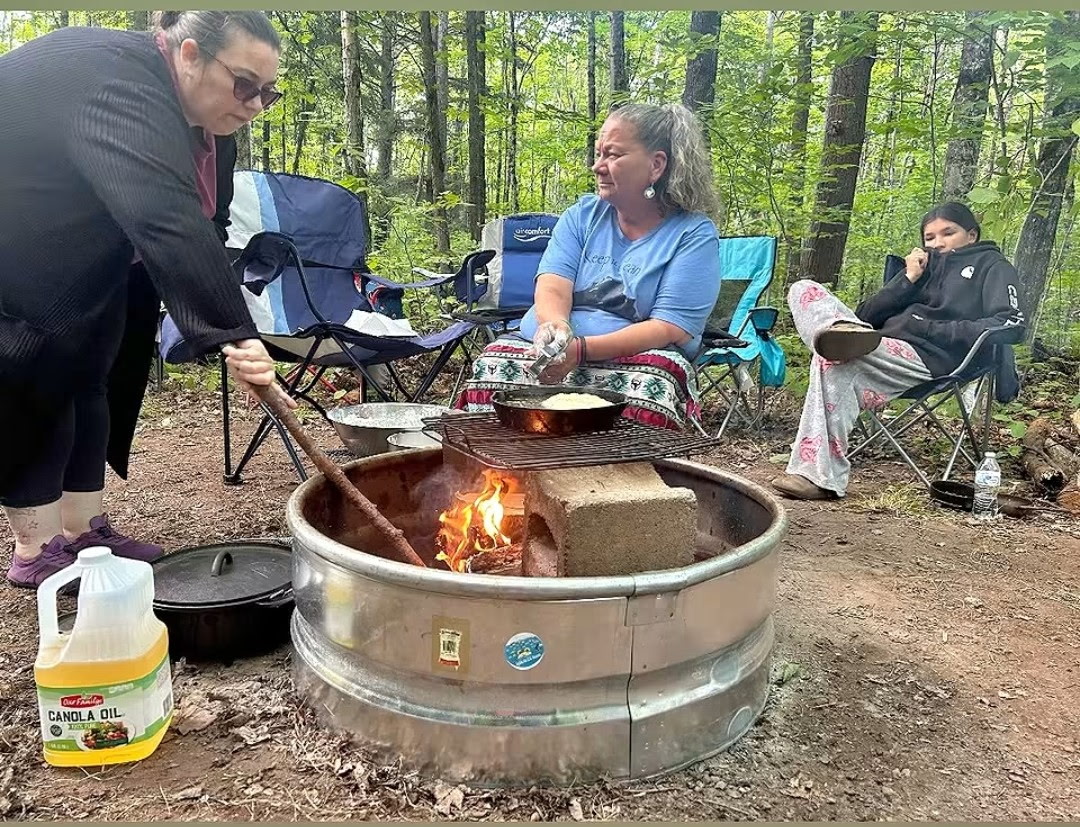
Camp Animikiiwadiswan, or Thunderbird Nest resistance camp, co-led by Loonsfoot and Anahkwet, is their inter-tribal, three-dimensional answer to a proposed copper sulfide mine that would generate copious amounts of toxic waste — an estimated 40 millions tons of mining tailings — in a high-risk location. The project, which Loonsfoot’s tribe has vehemently opposed, is set to be financed by a contentious $50 million taxpayer subsidy in the form of “site readiness” grants to Copperwood Resources Inc., a U.S. subsidiary of Highland Copper, a Canadian company. KBIC’s letter of opposition to the Michigan legislature detailed multiple harms Highland Copper had already caused to the area’s wetlands, calling its mining operations “irresponsible.”
The camp’s name, Loonsfoot said, was inspired by a petroglyph carved into the rock just below where the mine is planned — the rock carving depicts a diamond emerging from a lightning bolt. At its opening from August 14-16, Thunderbird Nest camp was attended by 20 people, and by the second weekend it had doubled in size. “We go out there and honor the life spirits with food, small gifts, and tobacco,” Loonsfoot said, “and we hope they’ll wake up and see that our people are coming in a good way.”
Loonsfoot is hoping for guidance to a better resolution than the current, distorted three-year political process, which devolved into a serious conflict that finds the Michigan Economic Development Corporation (MEDC) and Michigan Strategic Fund (MSF) coming under fire. On August 25, MSF’s board approved the grants for the mine despite the company’s failure to meet financing conditions it had imposed in 2024. Nor have the expenditures been approved by the state legislature: The Senate Appropriations Committee declined to vote on it in 2024 and twice more when it was proposed in 2025. MSF’s stark divergence from past practice prompted Michigan State Senator Jeff Irwin to call MSF’s action “wrong and possibly illegal.” Former MSF board member Cindy Warner also spoke out against the project, promising she “will follow as far as the trail can lead,” and explaining to the Michigan Advance that Copperwood Resources, Inc. didn’t have the requisite proof of financial viability in 2024, and it still doesn’t. In a recent PBS segment, Tom Grotewohl, founder of Protect the Porkies, a grassroots group mobilizing the opposition to the mine, described MSF’s action as “a coup d’etat.” Protect the Porkies is now seeking an official investigation by the state’s attorney general and appropriations committees.
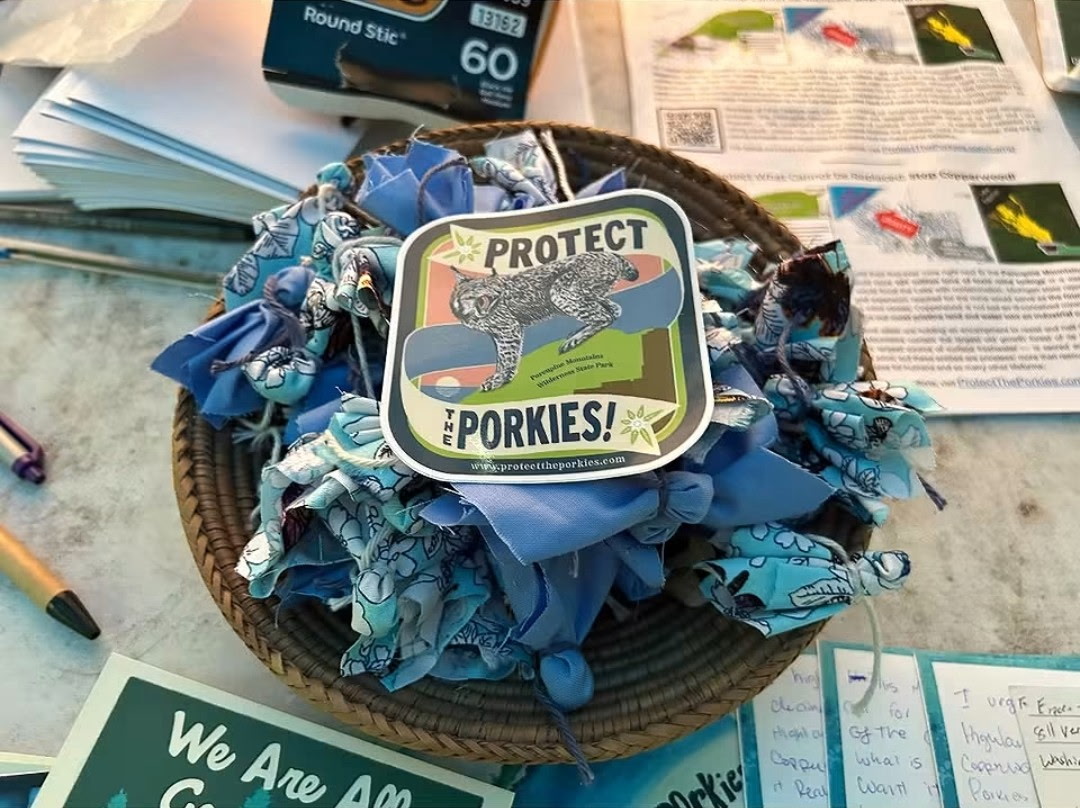
When Truthout asked about the authority the MSF board was relying upon and whether the previous conditions it had set for Copperwood in 2024 had been resolved, MEDC spokesperson Danielle Emerson offered the same accounting justification reported by multiple other outlets. “While the MEDC accounted for it internally, with the expectation of using it for projects in our pipeline, those projects did not ultimately move forward,” Emerson wrote.
Perhaps the most damning critique of the deal was leveled on August 28 by economist Scott Beaulier. Born and raised in Michigan’s Upper Peninsula, and now dean of the College of Business at the University of Wyoming, Beaulier published a detailed analysis, ultimately condemning the deal in toto as “the wrong way to think about economic development in Michigan’s Upper Peninsula.”
His conclusion is consonant with alternative development models promoted by the Economic Development Responsibility Alliance of Michigan (EDRA), a grassroots organization that has created a vision of the Agricultural Renaissance Community, a new model for sustainable, large scale, mixed-use development. Its founder and executive director, Marjorie Steele, told Truthout she drove over eight hours from Grand Rapids to attend Camp Animikiiwadiswan’s opening weekend, which she described as exhilarating.
“There was just a nonstop fire hose of mutual information sharing,” Steele told Truthout. On EDRA’s website, just under the “Bad Economic Development” tab, there’s another for AI Data Centers, which are characterized as “Next Level Water Destroyers.” Steele said MEDC and MSF’s maneuver around the mine is of keen concern because “MEDC is the agency slated to evaluate and dispense Governor Whitmer’s tax breaks for AI data centers that went into effect in April 2025.”
The proposed Copperwood Mine is to be situated near the boreal and hardwood forest of Porcupine Mountains Wilderness State Park and the southern shore of Lake Superior, a remote location without cellular service. So that’s where Thunderbird Nest camp will be too. Members from the Lac Vieux Desert Band and Bad River Band of the Lake Superior Chippewa Indians, urban Indians from the Twin Cities, water and land protectors from all over, and concerned Michiganders from Michigan’s Upper Peninsula and beyond, are rough camping on Ottawa National Forest land right next to the proposed mine site, 20 miles north of Wakefield, Michigan. Loonsfoot, who is also the co-executive director of Mukwa Miikana, a nonprofit devoted to Indigenous community empowerment and leadership development, said, “I feel like if we keep staying out there on the weekends, the spirits might help us.”
There Is More Than One Tradition of Copper Mining in Michigan’s Upper Peninsula
The archeological record shows that Anishinaabe people were soft-rock mining and using copper to make tools around the Great Lakes more than 8,000 years ago, up until about 1,500 BC. They pivoted back to stone tools because, archeologists contend, the purity of the unalloyed copper found around Lake Superior made the strength and endurance of copper tools equivalent to stone tools, which took far less time to make. “Our people used these areas creatively for thousands of years, and it’s never stopped,” Anahkwet said. “We’ve never lost that memory. This is our traditional homeland.”
The modern copper era began in 1845, with the opening of the Upper Peninsula’s first industrial mine, the Cliff Mine near Eagle River, and continued until 1997, when the last industrial mine, the White Pine Mine in Ontonagon County, shuttered its operation. It was during this period that the northern part of Michigan’s Upper Peninsula across four counties became known as “Copper Country.” Fueled by European settlers primarily from Finland, its economic history is one of boom then bust, with two consistent hallmarks: the extreme exploitation of miners, including the brutal and violent response to the Western Federation of Miners strike of 1913-1914, and irremediable ecological damage, most notably at the EPA Superfund Site at Torch Lake, a 19-mile long lake contaminated by 200 million tons of waste material — known as stamp sands — within its lake bed.
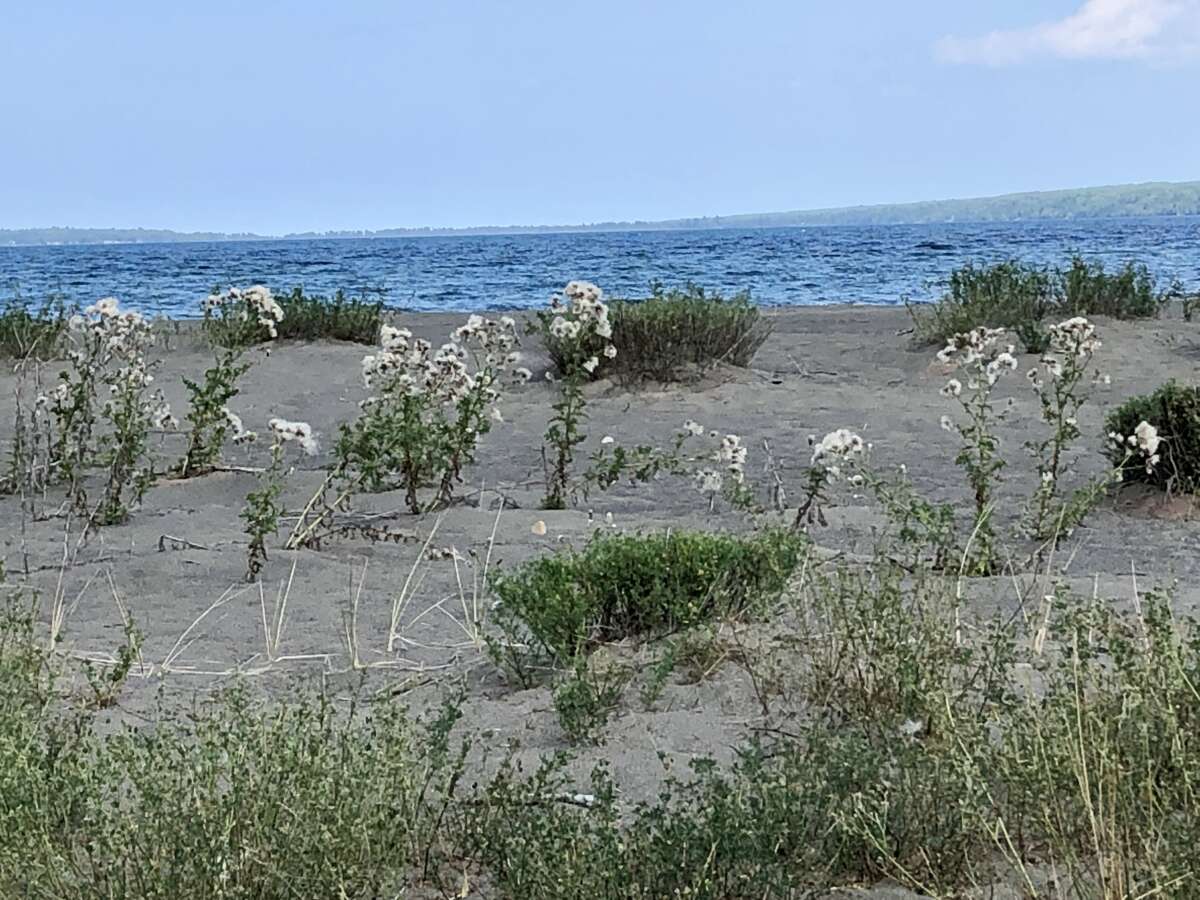
Thirty years later, industrial copper mining is central to the region’s “heritage tourism” brand, which is tinged with notes of nostalgia. The ghost of industrial mining remains an essential dramatic throughline to the experience of visiting the area. Hulking industrial relics punctuate the forested landscape, copper gift items fill its souvenir shops, and the National Park Service has dedicated an impressive multi-story museum to local mining history and lore. There’s also the Italian Hall memorial marking the site of a tragic event on Christmas Eve 1913, at what was meant to be a morale boosting party for the families of striking miners — a story so utterly bleak most locals refuse to relay it, referring visitors to a website or directing them to the Italian Hall itself.
Overall, the myth marketed to tourists as a coherent story uniting past and present, sacrifice and valor, associates industrial copper mining with a retrievable “good ole days” of economic and social coherence. But Grotewohl said there’s one enormous difference between then and now — the purity of the ore itself. Copper pulled out of the mines in the past was 95 percent pure, but that’s all gone. What’s now available to Copperwood under the Porkies is only 1.45 percent pure. The rest is waste containing heavy metals.
Loonsfoot and Anahkwet hope that spending weekends at Thunderbird Nest will help people perceive the present reality unclouded by the illusions of the past. “At camp, we live as a community with the natural world, we have these really close connections with the animals and the plants,” Loonsfoot said. “Because we’re in the same place at the same time, all these beautiful things happen; and people come back, they want more.”
Anahkwet said he finds himself amazed at the openness and willingness of non-Native people to understand their perspective in the camp setting. “We understand that we are of this land, that we are the physical manifestations of her. We truly believe that. We have the history and the knowledge to remember these sacred places that were given to us. Non-Natives who haven’t had the luxury to grow up with that sort of knowledge and that sort of understanding, they gravitate toward it. And who wouldn’t?” he said with a soft laugh.
Grotewohl, who lives near the camp and attends every weekend, worries that people with decision-making authority over these lands “don’t walk through the forest unless they’re counting up lumber.” He fears there’s a real lack of understanding. “The disconnect is that people are living in separate universes. We’re living in the real world with turtles and frogs; they’re living on computer screens with lots of calculations.”
On September 15, Protect the Porkies announced in a press release that it had filed a Claim of Appeal with the Ingham County Circuit Court against MSF, challenging its approval of the grants. It also announced that it is pursuing further litigation related to the funding.
Abby Newman, 23, has been driving the 2.5 hours back and forth every weekend from her home to camp because she doesn’t want to see Michigan go back to industrial copper mining. She told Truthout her family’s lives were built around the mining industry in Copper Country, and she’s grown up both benefiting from that legacy and seeing the scars left behind. “It’s considered safe, but still not recommended, to eat only one fish per year caught out of Torch Lake,” Newman said.
Though she organizes with the Keweenaw Socialists, she said the conversations at camp are not explicitly ideological. “But I don’t think you can separate the politics from the encampment. It’s inherently political for us to be out here, because land use is political.”
Anahkwet said his people are constantly learning from the porcupine they share the land with, called ketaemiw in Menominee language.
“It roughly translates to ‘the first to be eaten,’ and there’s an explanation,” he said. “The reason why it’s slow, and if you know a porcupine, you know they’re not fast runners, or they can’t scurry away really quickly. It’s because if you’re starving, or need something to eat, they will sacrifice themselves to you. That’s why they’re slow, so you could harvest them and eat them if you needed to.”
In the face of such a pointed example of generosity, he asks: “How could we pollute the land?”
Loonsfoot said they plan to close out the final camp with a jingle dress ceremony on October 4. “The jingle dress came from a vision that a lady had out in the snow when icicles started forming on her dress,” she said. “To dance wearing the jingle dress is a healing dance for people, land, and water.”
25 Years of Truthout: An important fundraising appeal
This September, Truthout is celebrating 25 years of publication. For over two decades, we have been a trusted source for fiercely independent journalism thanks to readers like you.
As we look to the next 25 years, we have launched a special fundraising campaign. Looking to a sustainable future for our publication, we have a fundraising goal of $63,000 in the next 4 days.
We are asking for your support at this juncture because we face greater threats than ever before in our organizational history. Trump and his MAGA allies are determined to control the information ecosystem, and movement-based organizations are subject to dangerous censorship and scrutiny.
If you can support Truthout with a one-time or monthly donation, you will make a significant impact on our work and our legacy. Anything you can do makes a difference!









+ There are no comments
Add yours