







Each year, hundreds of activists from Christians United for Israel (CUFI), America’s largest Zionist organization, descend on the Capitol for a marathon lobbying campaign. This time around, offices got a warning first.
“You may get a visit later on from people from CUFI,” Rev. Hannah Sachs, a pastor with the United Church of Christ, told staffers at one Senate office. While Sachs spoke softly, her flyers had a sharper tone. “Religious extremists want you to start Armageddon,” the text read, adding that CUFI is pushing an “Israel-first” agenda that would “further entrench U.S. military entanglement in the Middle East.”
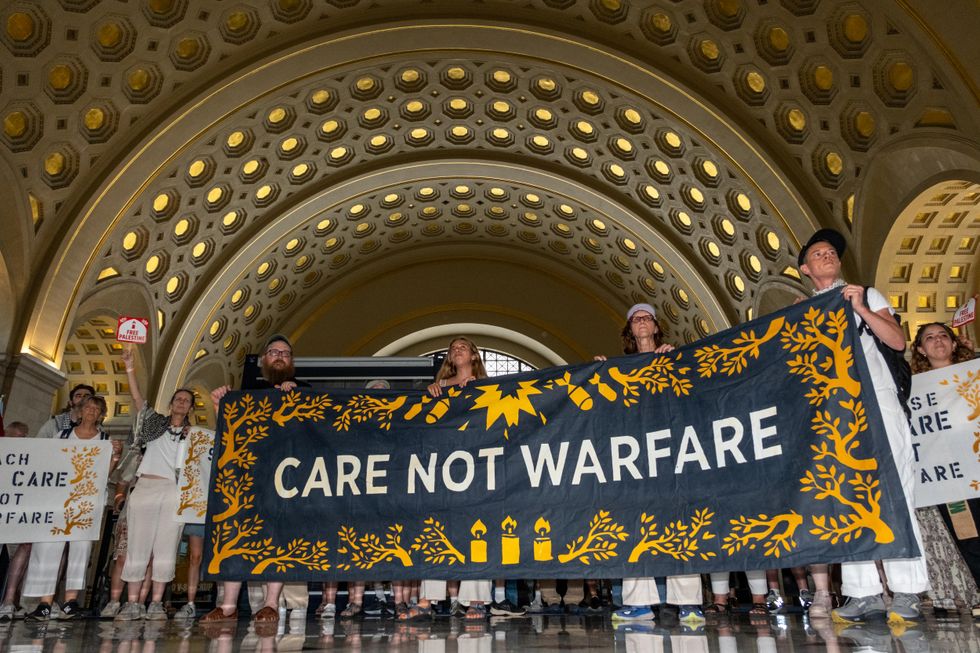
Sachs, who went from office to office alongside progressive Rabbi Abby Stein, was there representing Interfaith Action for Palestine, a group of religious organizations that represent roughly a million Americans. Like many pro-Palestine organizations, the group has grown rapidly as Israel’s war in Gaza has dragged on. Efforts to disrupt CUFI’s lobbying have become Interfaith Action for Palestine’s signature annual event; Stein was among dozens of the group’s activists who were arrested last year after shutting down a congressional cafeteria.
Their opponent is formidable. CUFI, which has a self-declared membership of more than 10 million people, has long been one of America’s most influential pro-Israel groups. Since CUFI relaunched in 2006, its annual conference has drawn a litany of prominent right-wing speakers, including members of Congress like Sen. Ted Cruz (R-Texas) and House Speaker Mike Johnson (R-La.). Their activism as well as that of other evangelical Zionists helped push President Donald Trump to launch a war with Iran and relocate the U.S. embassy in Israel to Jerusalem.
At this weekend’s conference, conservative radio hosts Glenn Beck and Mark Levin took the stage, as did Israel’s ambassador to the U.S., Yechiel Leiter. Even Prime Minister Benjamin Netanyahu addressed the crowd via video.
Leading CUFI is its founder, Pastor John Hagee, who is among the most prominent proponents of Christian Zionism in America. Hagee, like many evangelical leaders, argues that the Bible commands Christians to support the modern state of Israel, and he has maintained significant influence on the Christian right despite his myriad controversies, including his since-recanted claim that the Holocaust was part of God’s plan to return Jews to Israel.
Hagee still argues that “America’s solidarity with Israel has never been more important” and that “Israel’s enemies are our enemies.” But his message is rapidly becoming less popular among Christian Americans. A 2025 poll from the University of Maryland found that, while 51% of older evangelicals favored the Israelis over the Palestinians, only 24% of evangelicals under 35 years old said the same. The numbers are even starker among other faith groups: today, only 35% of American Catholics and 33% of Black Protestants say they hold a favorable view of Israel.
Indeed, only 37% of American Jews now identify as Zionist.
Sachs and Stein, alongside 50 or so other activists from Interfaith Action for Palestine, sought to press this message as they fanned out across congressional offices Tuesday morning. Unsurprisingly, the group was most at home in Democratic offices, which had largely already signed onto bills that would block weapons transfers to Israel or try to stop the war in Iran; “thanks for warning us” about CUFI, said one Democratic staffer.
But they also hoped to make inroads with Republicans. For Sachs, this came naturally. She grew up in an evangelical Zionist home and went to a church that made regular donations to CUFI. As a child, she was taught that you “could not truly be a follower of Christ and not support the modern nation-state of Israel,” she told RS. “Israel could do no wrong.”
Then, after leaving evangelicalism and joining a mainline Protestant church, she abandoned this point of view and came to see opposition to the current Israeli government as a “more faithful reading of Scripture.” As Sachs put it, “if you love your neighbor, you shouldn’t kill them.” Speaking to congressional staffers, she emphasized the plight of Palestinian Christians. “We do not believe that God would bomb children.”
 Rev. Hannah Sachs and Rabbi Abby Stein walk outside the Capitol after lobbying Senate offices on July 7, 2026. (Connor Echols/Responsible Statecraft)
Perhaps the most unusual aspect of the day’s proceedings was the relative calm that prevailed. For unclear reasons, CUFI scheduled its lobbying push during a congressional recess, meaning that the halls of Congress were largely empty and members were far from Washington. The subdued scene was a striking contrast to previous years, when Interfaith Action for Palestine verbally sparred with CUFI activists and even blocked CUFI buses leaving from a local hotel for Capitol Hill.
But loud protests are no longer the only way for anti-Zionist activists to make their voices heard. Increasingly, pro-Palestine advocates are finding allies in high places. Stein is a testament to this fact; she served on the transition team for New York City Mayor Zohran Mamdani, a leading socialist politician with a strong pro-Palestine perspective. And she is a close ally of three left-wing activists who recently won Democratic congressional primaries in New York while running on a pro-Palestine message.
As Sachs and Stein worked their way through the halls of Congress, it was hard to ignore the fact that their friends and colleagues would soon be sitting on the other side of the desk. Stein is hopeful that, if Democrats win a narrow majority of the House later this year, the growing group of strong progressives will have “a lot of power.”
“I really think it’ll be a different Congress,” she said.
From Your Site Articles
Related Articles Around the Web






+ There are no comments
Add yours