





Did you know that Truthout is a nonprofit and independently funded by readers like you? If you value what we do, please support our work with a donation.
As U.S. President Donald Trump publicly rejected Iran’s proposal for a ceasefire and reopening the Strait of Hormuz this weekend, the Iranian foreign minister reiterated that “there is no alternative to a negotiated solution.”
“There’s always hope for diplomacy,” though the Trump-led United States has been an untrustworthy negotiator, Foreign Minister Seyed Abbas Araghchi said during a Sunday appearance on NBC News’ “Meet the Press.”
“We are fully prepared for the war to be resumed… We stand firm in the face of any new aggression, even [if] it comes to a doomsday war,” the foreign minister added. “At the same time, we stand ready for diplomacy. It is up to President Trump to choose.”
Iran’s latest offer was “essentially the same bargain” as the June deal, “but with a very different sequence,” Sina Toossi, a senior fellow at the U.S.-based Center for International Policy, explained to CNN. Under the Iranian proposal, he said, “the U.S. takes concrete steps first, and only then does Iran ease its pressure over Hormuz.”
Araghchi and Iranian President Masoud Pezeshkian had pushed for the proposal this week while visiting the United Nations General Assembly in New York City — where Pezeshkian said in his UNGA speech that “we have been the victims of terrorism” and highlighted the civilians killed since the United States and Israel began bombing Iran at the end of February.
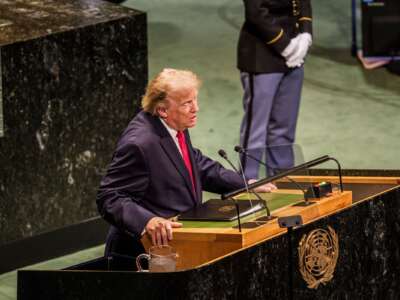
Trump — who launched the illegal war despite his own intelligence agencies concluding that Iran wasn’t pursuing a nuclear weapon — used his UNGA address to threaten to “annihilate” Iran. Then, The Wall Street Journal reported late Friday that he “has rejected Iran’s proposal for a seven-day ceasefire and has told aides he expects to resume bombing Iran after the November midterms.”
The U.S. president on Saturday confirmed to journalists that “I’m rejecting their deal,” adding: “They want to make a deal where they open the strait immediately because they’re losing so badly… We’re winning tremendously. We have total control of the Hormuz Strait… They want to make a deal, and I think that’s fine; I like making a deal, too. But that deal would not be acceptable.”
Despite Trump’s rejection, “U.S. official claimed ‘positive and constructive’ discussions are still ongoing between the U.S. and Iran through the mediators, including on nuclear issues,” Axios reported Saturday. Aided by Qatar, Trump envoys Steve Witkoff and Jared Kushner “held a new round of indirect negotiations” with the Iranian foreign minister on the sidelines of the UNGA.
In a lengthy Persian statement shared on Telegram this weekend, Araghchi said that “we have seen the first reaction from the U.S. president, but nothing has been conveyed to us from the mediators yet. Of course, the U.S. president has also said many contradictory things, which unfortunately we hear a lot from him. We are waiting for the definitive opinions to be conveyed to us by the mediators, and we will make a decision based on that.”
“In any case, our conditions are clear; any progress toward the opening of the Strait of Hormuz is contingent upon the fulfillment of these conditions, and we will not shrink from them,” he continued. “Only a negotiated solution can get them out of this deadlock.”
Such a solution must be “based on honor and justice that secures the rights of the Iranian people and fulfills their legitimate demands,” he argued. The diplomat added that “the people of Iran have demonstrated their strength across military, diplomatic, and economic spheres, as well as in confronting sanctions.”
Reporting on Araghchi’s remarks, Reuters noted:
The commander-in-chief of Iran’s army, Amir Hatam, said the war was at a critical and decisive stage, adding that Tehran would not accept a situation in which it was unable to trade while foreign powers used the region’s strategic waterways.
“If Iran cannot trade, if Iran cannot live, no one will be able to trade or live,” he said, in comments reported by state media.
It’s not just the Iranians pushing for an end to the Iran War; the U.S. public is also frustrated by its economic impacts, with prices soaring, particularly for diesel and gasoline. With the midterm elections less than six weeks away, and the president’s Republican Party trying to at least hold on to its narrow majorities in Congress, Trump’s approval rating has hit a record low.
After the president rejected Iran’s proposal on Saturday, National Iranian American Council (NIAC) Action policy director Ryan Costello responded by calling out his various moves regarding Iran, including exiting former President Barack Obama’s nuclear deal with the country during the first Trump administration.
“Art of the deal,” Costello wrote on social media. “Attack Obama for negotiating a successful deal. Tear up the deal, say you’ll get a better one. Start a war instead, blowing up the economy. Strike a deal to end the war, stick to it for a fortnight. Refuse to go back to the deal heading into the midterms.”
NIAC Action filed a federal lawsuit on Thursday, arguing that Trump’s war on Iran, which lacks congressional authorization, is unconstitutional. The group’s president, Jamal Abdi, declared that “no president should have the power to take this country into an indefinite war by himself.”
“Congress never authorized this war,” he stressed. “Yet Iranian families are being bombed, American service members have been killed, and communities on both sides are being forced to bear the consequences. This lawsuit asks a fundamental question: Can one person decide, on his own, to keep an entire nation at war?”
25 Years of Truthout: An important fundraising appeal
This September, Truthout is celebrating 25 years of publication. For over two decades, we have been a trusted source for fiercely independent journalism thanks to readers like you.
Looking to the next 25 years, we launched a special fundraising campaign. We still need to raise $16,000.
We are asking for your support at this juncture because we face greater threats than ever before in our organizational history. Trump and his MAGA allies are determined to control the information ecosystem, and movement-based organizations are subject to dangerous censorship and scrutiny.
If you can support Truthout with a one-time or monthly donation, you will make a significant impact on our work and our legacy. Anything you can do makes a difference!







+ There are no comments
Add yours