





Truthout is a vital news source and a living history of political struggle. If you think our work is valuable, support us with a donation of any size.
The networks of two major players who helped capture the U.S. Supreme Court — anti-abortion lawyer Leonard Leo and oil billionaire Charles Koch — have also long targeted state courts to advance their regressive agenda. One of their tactics, influencing the way that state justices are selected nationwide, is being borne out in Kansas.
OnAugust 4, voters in Kansas will decide the fate of a state constitutional amendment placed on the ballot by the Republican legislature. Four major groups involved in campaigns around the amendment have raised nearly $12 million, according to the Sunflower State Journal. If the amendment succeeds, it would replace Kansas’s historic merit selection process for selecting state supreme court justices with direct elections. Despite trying to convince voters that the amendment would be a win for democracy, dark money groups and their backers are supporting the ballot initiative as a way to further expand their own special interest influence and open the door to bigger spending in the state’s selection of judges.
Koch’s Americans for Prosperity (AFP) has heavily pushed the amendment campaign with digital ads and get-out-the-vote efforts in support of the amendment. A new front tied to Leo’s network has also been flooding the airwaves with ads, rewriting history by claiming that when Kansans elected their judges, “it worked well.” Their PR effort ignores the fact that Kansans originally voted to reform the appointment process to require merit-based selection as part of the state’s constitution because of widespread public outrage over an infamous court selection scandal in the 1950s.
Judicial Independence Under Attack
State courts often serve as a check on far right state legislative majorities captured by special interests — the last line of governmental defense against powerful political forces seeking to eliminate people’s rights and freedoms at the state level. Since the early 2000s, Leo has been attackingmerit-based judicial appointment systems, mounting a substantial assault next door in Missouri in 2005, as True North documented. Merit selection systems, like the one in Kansas, promote the selection of judicial candidates based on their qualifications, rather than their political views or support from special interests. Kansas has already seen a decade-long effort by the far right to chip away at the independence of the state judiciary in response to its rulings about how the Kansas constitution protects access to abortion and requires public school funding.
Currently, Kansas Supreme Court justices are appointed by the governor, who selects from a slate of three qualified candidates recommended by a nonpartisan nominating commission. The commission is composed of four attorneys selected by the state bar, four non-attorneys appointed by the governor, and one attorney selected by a statewide vote of legal professionals. This process is transparent and still depends on voters supporting the retention of a justice after their first year on the bench. The merit-based system is also widely considered effective in limiting politics from the appointment process and insulating judges from political backlash over rulings.
State voters enshrined merit selection for Kansas’s Supreme Court Justices in the Constitution in 1958 in response to the notorious “triple play” scandal, in which outgoing Republican Gov. Fred Hall devised a scheme to get himself installed as Chief Justice of the Kansas Supreme Court during his last few weeks in office. Until 2013, judges on the Kansas Court of Appeals were also selected via merit, but then-Republican Gov. Sam Brownback and his allies in the legislature repealed the law for the state intermediate appellate court; shortly after, Brownback appointed his former chief legal counsel Caleb Stegall to the Court of Appeals.
The national right-wing interests advancing this amendment have been cloaking their support with misleading claims that it would advance democracy in the Sunflower state. The reality is that this amendment has long been sought by right-wing billionaires and political operatives, because it will open the door to a wave of spending designed to capture the court, which has stood in the way of their agenda to criminalize abortion, defund public schools, and more.
Leo’s Network Is Behind Attacks on the Independence of State Supreme Courts, Including in Kansas
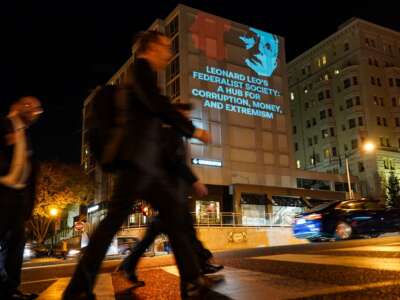
For decades, Leonard Leo and his allies have attempted to undermine judicial selection processes that emphasized candidates’ legitimate qualifications. In 2001, Leo’s years of lobbying against the American Bar Association (ABA) paid off when President George W. Bush ended the 50-year practice of using the ABA to pre-screen and rate potential judicial candidates before nomination. In place of that system, Bush gave the right-wing Federalist Society, where Leo was then employed as a leader and now serves as co-chair, a powerful informal role in the selection of federal judges. Leo led the umbrella group pushing for the confirmation of federal judicial nominees he approved, including Bush’s U.S. Supreme Court nominees.
On a parallel track, within weeks of the success of Leo spearheading the attack on the ABA to push it out of the federal pre-nomination process, Leo and the Federalist Society had already begun assailing state merit selection boards, as True North Research has detailed. Under Donald Trump, the Justice Department blocked its judicial nominees from cooperating with the ABA’s merit-based review process after a number of Trump nominees were rated “not qualified” or received partial “not qualified” votes.
In Kansas, a right-wing attorney from Indiana named James Bopp filed a suit in 2010 challenging the state’s Supreme Court nominating commission, which was supported by a Leo group. Bopp has spent nearly 50 years leading efforts to strike down limits on election spending and campaign finance disclosure requirements: He even orchestrated the Citizens United v. FEC litigation that the Roberts Supreme Court used to strike down key provisions of McCain-Feingold Act in 2010 and related law. That 5-4 ruling opened the floodgates for corporations and special interest groups to spend unlimited sums in elections. Although Bopp’s case in Kansas was dismissed, efforts to amend the state’s constitution in the past decade to undermine the independence of the court have not stopped there. In 2018, for example, the Chamber of Commerce led an initiative to pass an amendment that would strip the state Supreme Court of its authority on school funding.
State courts often serve as a check on far right state legislative majorities captured by special interests.
The handful of groups that are flooding the airwaves with recycled versions of these same claims to support the amendment this year include two groups backed by Leo’s network.
The leading spender backing the amendment is a mysterious dark money group calling itself “Kansans for Democracy (KFD)” which has already spent over $1.2 million on a media campaign. Until now, little was publicly known about the group, who is funding it, or even who is working there.
State filings submitted on July 20, 2026, however, disclose that the group received $1.7 million entirely from First Principles Action,a key group in Leo’s network. First Principles PAC has already been heavily deployed this year, spending in state court races in Louisiana,Georgia,West Virginia, and Wisconsin. It has also backed Republican attorneys general, including sending more than $250,000 to Kris Kobach’s PAC, which he calls “Defend KS.”
According to text messages obtained through an open records request by the Center for Media and Democracy, First Principles executive director Peter Bisbee was in direct contact with the office of Kris Kobach while the legislature was reviewing and voting on the amendment. On March 19, 2025, after it cleared the House, someone in Kobach’s office texted Bisbee “now time to run a campaign.”
In August 2024, Kobach also revived his long dormant Prairie Fire PAC as part of a broader effort to amend the constitution and replace merit selection. According to filings made with the Kansas Secretary of State’s office, Prairie Fire PAC appears to be nearly exclusively funded by groups tied to Leonard Leo, including $110,000 from the Concord Fund, $50,000 from First Principles, $30,000 from the Lexington Fund and $20,000 from the Republican State Leadership Committee (RSLC), which is a major recipient of Leo funding. This PAC is sending information to voters backing the amendment.
Koch’s Americans for Prosperity Is Also Backing the Amendment
Koch-backed groups are also behind the August 4th amendment initiative in Kansas. Charles Koch is one of the richest men in the world and his multinational oil conglomerate, now called Koch, is headquartered in Wichita. Charles Koch has a long track record of using his home state as a testing ground for his political agenda. In 1996, he launched an early effort to infuse dark money into his home-state elections through a secretly-funded election operation called “Triad,” targeting the congressional elections that year, which was investigated by the U.S. Senate.
Fast forward to 2012: then-Republican Gov. Sam Brownback worked closely with Koch’s AFP and the state Chamber of Commerce to oust moderate Republicans in the 2012 elections. Brownback then adopted the Koch-backed “Kansas experiment,” which slashed funding for public schools and was disastrous to the state’s economy. When the Kansas Supreme Court refused to ignore the state constitution’s guarantee of a public education, Brownback repeatedly targeted those justices by seeking to repeal merit selection, although that effort failed back then.
Koch has also invested heavily in Leo’s court-packing plans for decades through the Federalist Society. Like the Leo-funded First Principles PAC and Republican State Leadership Committee (RSLC), Koch’s Americans for Prosperity has spent heavily to influence state courts, including over $3 million in Wisconsin’s supreme court race in 2025, which saw over $100 million in total spending.
In late February 2025, AFP’s Kansas chapter (AFP-KS) launched its “take back the bench” campaign, including the website VoterNotLawyers.com. One of AFP’s unsubstantiated claims is that the amendment would somehow actually combat dark money in judicial elections, despite the inevitable dark money that passing the amendment would actually unleash. AFP of course also fails to mention its decades-long efforts opposing dark money disclosure.
Notably Koch GA Inc., an entity linked to Koch, Inc (the second largest privately-held corporation in the U.S., where Charles Koch is co-CEO and chairman of the board) has also reported spending in favor of the amendment. Koch also funds the Kansas Chamber of Commerce, which is backing the amendment.
Other Dark Money Fueling the Campaign in Kansas
Other prominent right-wing operatives have also been active in backing the August 4 amendment. For example, a group called Your Right to Vote Association (YRVA) has spent $675,000 on media backing the ballot measure. Its ads claim that the right to vote was “taken from us,” despite Kansans voting to embed merit-selection in the state constitution to limit corruption in judicial selection.
There is very little information available about YRVA, which was incorporated in June, but it is linked to operatives with Koch’s AFP and the Kansas Chamber. Both of those latter groups were subjects of a wide-ranging ethics investigation into illegal coordination and pass through contributions in the state, for which they denied any wrongdoing.
YRVA’s website says “Vote YES on August 4 to give Kansas voters the final say in choosing Kansas Supreme Court justices,” and it paints the judicial nominating committee as a secretive body of lawyers that control the candidates, even though YRVA provides almost no information about who is bankrolling its efforts.
According to a filing from July 20, the group paid Per Aspera Strategies for consulting. (It is not clear if this group is affiliated with Per Aspera Policy, a group that has previously been funded by Peter Thiel and that backed Kris Kobach in 2018.) Nearly all of YRVA’s funding, $700,000, is from a group calling itself the Impact Mission Fund, which is headquartered in Virginia. Its incorporation documents list Trajetta Matthews who recently incorporated two groups with an email address tied to Five Rings Law Group.
The managing partner of the Five Rings Law Group is Jenny Kim, the former deputy general counsel, political law and vice president of public policy at Koch Industries/Koch. Kim has also worked at Koch’s The Just Trust Action, a 501(c)(4). Notably, she was also on the board of the right-wing Institute for Free Speech, which was involved in litigation alongside Josh Ney (more on him below) challenging Kansas’s definition of Political Action Committees.
The only other known funder of YRVA is Justin Hill, former chair of the Kansas Chamber. YRVA’s board includes AFP-Kansas’s state director Elizabeth Patton.
Another entity called the Kansas Information Network (KIN),not to be confused with the non-partisan Information Network of Kansas, has also been running ads pushing voters to support the judicial amendment. A pair of organizations, KIN and Kansas Information Network Action (KINA), were registered in July 2025 by attorney Josh Ney.
KIN runs the website righttovoteks.com which claims that “8 of 9 Supreme Court Commission Members are Democrat Donors,” even though there is no mention of Ney’s deep connections to the state Republican Party. That site also does not mention the fact that he sits on the 2nd Judicial District’s nominating commission (chaired by Kansas Supreme Court Justice Caleb Stegall — more on him below). The site also makes no references to his many years trying to dismantle the judicial nominating commission.
Ney, who was nominated in 2013 by then-Republican Gov. Sam Brownback to lead the state securities agency, also has ties to the state Chamber of Commerce. Ney’s former partner at the Kriegshauser Ney Law Group firm he incorporated is Ryan Kriegshauser, Trump’s appointee who was confirmed to be United States Attorney for the District of Kansas in December 2025. Kriegshauser Ney Law Group’s clients, according to his financial disclosure, included a number of right-wing groups, including the Kansas Legal Network, the Kansas Chamber of Commerce, the State Financial Officers Foundation, the National Right to Life Committee, the Kansas Republican Senatorial Committee, Kansas Republican House Campaign Committee, and Lift Up Kansas PAC.
Notably, in 2023, Ney and Kriegshauser authored legislation that would undercut Kansas’s ethics commission as it was in the middle of a sweeping investigation into right-wing groups, some of which Ney’s firm was representing as clients. Ney later was involved in pushing bills to restrict and redefine the authorities of the commission, which was ultimately signed into law after a compromise. (Kriegshauser is married to Christine Kriegshauser, who is the VP of Political Affairs at the Kansas Chamber, and who is also on YRVA’s board.)
Previously, Ney was the listed officer of “The Ney Law Firm.” According to filings made with the Kansas Secretary of State, that firm was first incorporated in 2010 as “Stegall and Associates” by Caleb Stegall, who sold the firm to Ney. Ney is no longer affiliated with this firm. Stegall, the former counsel for Brownback as well as Koch’s AFP-KS, was appointed by the former governor to the Kansas Supreme Court in 2014, after just a year on the Kansas Court of Appeals.
Stegall’s rise to the state’s highest court was made possible by a 2013 change to the law that gave the governor unilateral power to nominate judges to fill Court of Appeals vacancies, subject to confirmation by the state senate. Former Republican Sen. Tim Owens told the Topeka Capital-Journal in 2015 that the goal of the changes to judicial selection was to clear the path to secure Brownback’s far right policy agenda: “Governor Brownback pointed his finger at me and said, ‘Tim, why can’t you go along with us on this judicial selection issue and let us change the way we select judges so we can get judges who will vote the way we want them to?’”
Beyond Kansas
A dark money PR campaign has attempted to make the amendment ballot in Kansas look like pro-democracy initiative designed to give Kansans more of a direct voice in their state judicial system, but the fact is that the amendment is being propped up by national and state political operatives and regressive billionaires with a longstanding interest in capturing state supreme courts and other courts.
If these special interests have their way, and the Kansas amendment passes, it will destroy merit selection in the state and open up the judicial selection process to even more special interest spending, undermining the ability of the state court to protect the rights and freedoms of Kansans.
Lisa Graves, True North’s executive director, and Alyssa Bowen, True North’s deputy executive director, contributed to this story.
Fundraiser Deadline: Missed
Truthout is one of only a few platforms for justice-oriented, grassroots journalism. Today, as political censorship from the right intensifies, we have no choice but to ask for your help.
We missed our fundraising deadline, but there’s still time to help us meet our basic operating expenses before the end of the month. If you can support Truthout with a one-time or monthly donation, you will make a significant impact on our work. Anything you can do makes a difference — we appreciate your support.






+ There are no comments
Add yours