







Did you know that Truthout is a nonprofit and independently funded by readers like you? If you value what we do, please support our work with a donation.
On Wednesday, CNN obtained and published the details of a memorandum of understanding (MOU) between the United States and Iran, meant to halt the war between the countries for at least the next 60 days.
The 14-point MOU calls for an “immediate and permanent end to the war on all fronts” — including in Lebanon. The document also alludes to reaching a “final agreement” within the next two months, indicating that the MOU likely functions as more of a temporary ceasefire agreement than a lasting peace deal.
The MOU indicates that the 60-day deadline isn’t final and can be extended “by mutual consent” if needed.
In addition to an end to hostilities, the MOU also demands that both Iran and the U.S. “respect each other’s sovereignty and territorial integrity, and … refrain from interfering in each other’s internal affairs.” It lifts naval blockades imposed by both sides in the Strait of Hormuz, with the promise to restore exports through the waterway (including oil) to “pre-war volume” within 30 days.
The memo also requires sanctions on Iran to be lifted, and for the United States to create, with its regional partners, “a comprehensive plan agreed upon by both parties for the rehabilitation and economic development of the Islamic Republic of Iran, while ensuring financing of at least $300 billion.” More details on how that fund will operate are to be discussed during the upcoming 60-day negotiating period.
Such agreements are not uncommon at the end of military conflicts. Indeed, after World War II, the United States created agreements to help restore the infrastructure of both Japan and parts of Germany. The U.S. and Israel’s war has caused an estimated billions of dollars worth of destruction to Iran’s civilian infrastructure, including transportation, internet and communications, and energy and oil production sites.
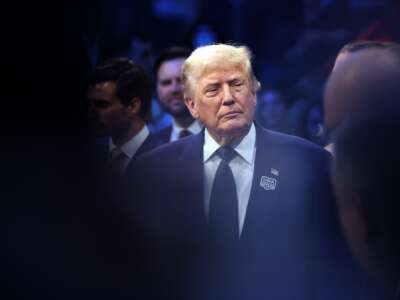
But even as members of his own administration appeared to confirm rumors of that provision earlier this week, Trump has denied that the U.S. would create such a fund, calling the idea “Fake News” in a Truth Social post. Trump also dismissed the idea of a $300 billion fund being partially created by the U.S. at a G7 meeting in France on Wednesday.
“We’re not investing, we’re not putting up 10 cents,” Trump said.
The refusal to abide by any portion of the MOU could threaten the temporary ceasefire.
Trump also indicated that the MOU wasn’t yet final, and that he could “go back to shooting” if he doesn’t like what’s in it.
“If I don’t like it, if they don’t behave, we’ll go right back to dropping bombs right smack in the middle of their head,” Trump said at the G7 meeting.
Per the MOU, Iran is required to reiterate “that it will never produce nuclear weapons.” The agreement also requires continued discussions on its possession of “enriched material.”
Yet Iran had already made that kind of promise before the war started, during negotiations in February. The Trump administration largely ignored these promises, continuing to insist that Iran was pursuing such ambitions in public statements.
As rumors swirled earlier this week about what was contained in the deal between the U.S. and Iran, several commentators blasted the president for launching the unauthorized war in the first place.
“The United States is left weaker” for Trump having started this war, The Atlantic’s Jonathan Lemire wrote in a Wednesday morning column, adding that the U.S. is “diminished militarily, strategically, economically, and perhaps morally.”
Trump failed to accomplish any of his listed goals, including substantial regime change or ending Iran’s nuclear capacities, MS NOW’s Rachel Maddow said in commentary on Monday evening.
“Donald Trump started a war with Iran, and he then lost the war,” Maddow opined.
Americans overall are deeply critical of Trump’s handling of the war. In an Economist/YouGov poll published last week, just 29 percent of Americans said he’s handled the war effectively, while 62 percent said they disapprove of how he’s managed the conflict.
Since the U.S. and Israel launched their unprovoked war on Iran, at least 3,468 people have been killed in Iran, with more than 26,500 people injured. Thirteen U.S. soldiers have died in the war, with another 381 service members injured.
In an op-ed for Truthout in May, peace activist Christine Ahn condemned Trump’s war on Iran as yet another example of the devastation wrought by the U.S.’s imperialist aggression, citing past interventions in Korea, Vietnam, Laos, Cambodia, Afghanistan, and Iraq.
“The United States faces a genuine choice. It can continue to reach for airpower each time it confronts a government it dislikes, perpetuating a cycle in which bombs kill civilians, harden regimes, destroy internal movements, and leave behind unexploded ordnance for generations of children to find,” she wrote. “Or it can reckon honestly with what 75 years of this doctrine have produced, and begin building a foreign policy grounded not in the fantasy of force, but in the reality of what peace actually requires.”
An important fundraising appeal: 7 Days to raise $44,000
Truthout is one of only a few platforms for justice-oriented, grassroots journalism. Today, as political censorship from the right intensifies, we have no choice but to ask for your help.
We are fundraising right now to cover our basic operating expenses. If you can support Truthout with a one-time or monthly donation, you will make a significant impact on our work. Anything you can do makes a difference — we appreciate your support.









+ There are no comments
Add yours