







Support justice-driven, accurate and transparent news — make a quick donation to Truthout today!
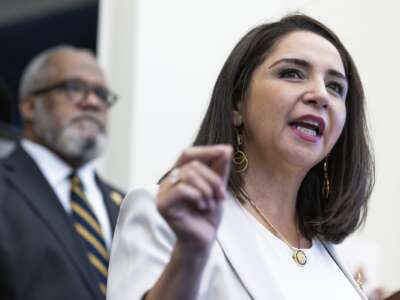
Kimberly Guilfoyle is out as U.S. ambassador to Greece. Mainstream media focused on Donald Trump Jr.’s former fiancée’s credit card bill and her penchant for extravagant partying and fashion. The next ambassador might not share those particular foibles, but the real significance of Guilfoyle’s appointment will last. She was what Dexter Filkins, writing in The New Yorker, calls “a new kind of Washington figure, for whom public office serves as a means to extraordinary wealth.” Donald Trump’s almost daughter-in-law was following in the footsteps of his son-in-law.
Jared Kushner does diplomacy and business simultaneously, and he’s getting really rich from it. While Kushner is dispatched to work on Iran and Ukraine, with meetings on the side to recruit billions to his investment funds, Guilfoyle was sent to Greece as the de facto ambassador for liquefied natural gas (LNG). In other words, her job was to shove LNG down the throats of Southeastern and Central European countries. Her refrain was U.S. energy dominance.
A more diplomatic diplomat might have noticed that one country’s dominance means, logically, another’s subservience. But tact was not Guilfoyle’s strong suit, and, according to the Wall Street Journal, another of her gaffes was not-so-subtly telling Greece’s energy minister that the U.S. could change the government of any country it wants.
Guilfoyle denies any intimidation took place, but threatening or forcing regime change for the sake of oil is not far-fetched. (See: Venezuela.)
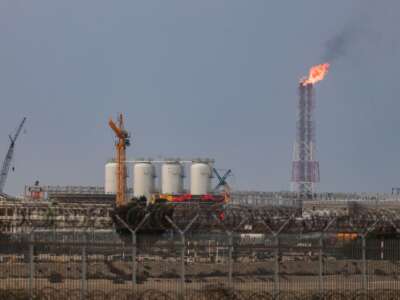
In Southeast and Central Europe, the U.S. government is pushing something called the Vertical Gas Corridor (VGC), an opaque infrastructure initiative stretching from Greece through Bulgaria, Romania, Hungary, Slovakia, Moldova, and ultimately Ukraine. As stated by the U.S. Energy Association, the VGC “opens access to Europe’s largest underground gas storage system, located in Ukraine.”
Publicly, the U.S. is framing the project as a strategic corridor that strengthens regional energy security and reduces Russian influence. In practice, it is becoming a way to trade dependence on Russia for dependence on the U.S. Greece will be the entry point and collaborator in the plan. U.S. LNG exporters stand to make huge profits, especially when there are high prices, as has been the case during the Iran War.
Why is the U.S. going to the mat for the Vertical Gas Corridor? The fossil fuel industry sees LNG exports as the lifeboat for the sinking ship of the conventional oil industry. For U.S. LNG, as with crude oil, it’s export or die. Those were Ambassador Guilfoyle’s marching orders.
A Massive Gas Project Searching for Demand
An inconvenient reality for the industry is that market enthusiasm for the VGC appears remarkably weak. Repeated capacity auctions linked to the corridor, in which gas companies bid for the right to use pipelines and other infrastructure, have attracted limited commercial interest. Several auctions failed outright, while others generated only modest bookings concentrated in specific segments of the network.
Infrastructure projects backed by robust commercial fundamentals typically attract customers on their own merits, without the need for lobbying and strong-arming. Massive terminals require long-term contracts, and the U.S. is determined to get both — whether or not it makes any economic sense.
Greece at the Front Line
For Greece, the stakes are particularly high.
The country is being positioned as the southern gateway for American LNG entering Southeast Europe. While this positioning promises geopolitical visibility, it also risks tying the Greek economy to fossil fuel infrastructure whose long-term viability remains deeply uncertain. Investments in LNG terminals, pipelines, and associated facilities are dependent on future gas demand that may never materialize as Europe accelerates its clean-energy transition.
At the same time, communities and ecosystems in Greece bear the environmental costs, just as surely as the Texas and Louisiana communities where the methane gas originates. From the Sea of Thrace to other sensitive marine areas, new infrastructure developments are proceeding despite growing concerns over climate impacts, methane emissions, and ecological damage.
An Age of Appeasement
The Greek government’s response appears less like strategic energy planning and more like appeasement of the U.S. Greece assumes the financial risk of costly LNG terminals, pipeline expansions, and related infrastructure while being encouraged to lock itself and the wider region into decades-long gas contracts. The plan not only deepens dependence on a very unreliable and fickle U.S., but it exposes Greek citizens to long-term economic, geopolitical, and climate risks — all in service of U.S. exports.
Last year, during trade negotiations, the U.S. insisted that the EU buy a preposterous $750 billion in energy from the U.S. to avoid punishing tariffs. The EU capitulated. The U.S. is among the interested parties pressing the EU to delay its methane regulation, which is designed to reduce greenhouse gas emissions by excluding the dirtiest fuels from the EU market. The EU is capitulating on that as well.
In the U.S., for all the coverage of Guilfoyle’s clumsiness, there has been almost no attention to her true mission in Greece. It’s hidden, perhaps, because the take-our-gas-or-else approach is working on Capitol Hill as well. The permitting reform bill known as the Bipartisan American Affordability and Jobs Act of 2026 (BAAJA), meant to streamline permitting for both dirty fuels and clean energy, is one of the few pieces of legislation with supporters on both sides of the aisle. Yet the climate benefits of the bill are nil, because even though it will help the siting of wind and solar, it will help fossil fuels even more.
More clean energy doesn’t address climate change unless it replaces the burning of fossil fuels. In other words, the bill is likely to make emissions worse. Some proponents will rationalize that emissions will rise even more without the bill than with it. But playing to “lose by less” may not even work, because BAAJA will not only ease the way for fossil fuel permits but, in the name of certainty, will impede future U.S. administrations from transitioning off fossil fuels.
Even though it’s obviously a policy to lock in long-term commitment to oil and gas, some Democratic senators, and even climate champs, including Sen. Sheldon Whitehouse of Rhode Island and Sen. Martin Heinrich of New Mexico, are supporting the bill. What’s maddening is that these senators surely understand that the only known method for addressing climate change at a large scale is to reduce the burning of fossil fuels. In the name of compromise, they are essentially giving up their cause — as if the floods, fires, storms, landslides, diseases, and other miseries caused by global heating will understand the need to accommodate a militantly pro-oil, anti-renewables government that does not negotiate in good faith. And they are doing so at a moment of minimum leverage, because their bargaining position is likely to be stronger after the next Congress is seated.
The United States is in a period of authoritarian rule, and Buy-Our-Gas-Or-Else is high on the agenda. The next U.S. Ambassador to Greece will understand the job is to communicate the demand for subservience, even if they pay their own credit card bills. The question is whether Greece, or the EU as a whole, or the Democrats in Congress, will stand up to it.
An urgent fundraising appeal: We still need to raise $12,000
Truthout is one of only a few platforms for justice-oriented, grassroots journalism. Today, we face an existential threat.
Due to Google’s launch of AI search, we’ve seen a drastic plunge in our site traffic and, as a result, our revenue. We lost 15 percent of our readership overnight. This was a readership we painstakingly built over decades, and it vanished because Google chose corporate greed over a healthy democracy.
We are fundraising right now to meet our basic operating expenses. If you can support Truthout with a one-time or monthly donation, you will make a significant impact on our work. Anything you can do makes a difference — we appreciate your support.







+ There are no comments
Add yours