






The pro-Palestine activist says the Trump administration is infringing upon his free speech rights.
Support justice-driven, accurate and transparent news — make a quick donation to Truthout today!
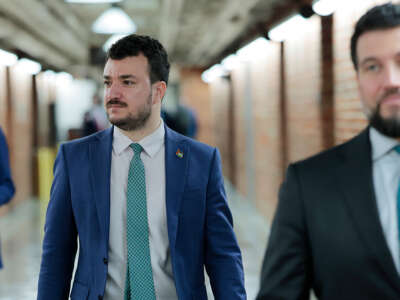
Former Columbia University graduate student and pro-Palestine activist Mahmoud Khalil has filed a request to the Supreme Court, asking it to overturn an appellate court’s ruling that could lead to his being detained and deported by the Trump administration in the near future.
Khalil is a legal U.S. resident, and his spouse has citizenship status, making the administration’s attempt to deport him last year an extraordinary move. In March 2025, shortly after he graduated, he was detained by immigration officials, with Secretary of State Marco Rubio utilizing scarcely used powers of his office to do so despite Khalil’s legal residency, citing unfounded claims that the activist was involved in “antisemitic protests and disruptive activities” while studying at Columbia.
Khalil was kept in a Louisiana immigration jail, but was released in June 2025 after a federal judge found Rubio’s actions were likely unconstitutional. The administration appealed, and in January 2026, a 2-1 decision from the Third Circuit Court of Appeals overturned the lower court’s decision, stating that Khalil’s claims couldn’t be addressed at that level of the judicial system, and had to be moved to an immigration court, which is managed by the executive branch.
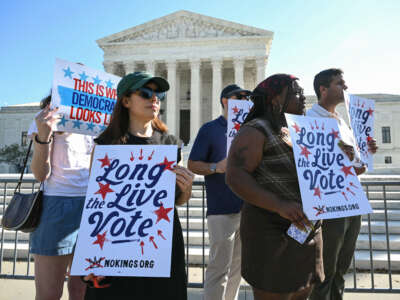
On Monday, Khalil and his lawyers announced that he was appealing that decision to the Supreme Court, hoping that they will overturn it, allowing him to remain protected from being detained again for the time being. He called the continued efforts by the administration an assault on his free speech rights.
“If the Trump administration can punish someone for their pro-Palestine speech, this or any future administration can punish anyone for any speech, whether it’s pro-Palestine, pro-Israel, or anything,” he said in a statement announcing his appeal.
Khalil will still have legal avenues available to him to challenge the Trump administration’s attempts to deport him, but his options to thwart the White House’s actions would be much narrower if the Supreme Court doesn’t take his case. For a case to be heard, at least four of the nine sitting justices must agree to the writ of certiorari that Khalil submitted to them. Afterward, it would likely be a few months before oral arguments begin, and then it would likely take until the end of the current term — around May or June 2027 — for a decision to be rendered.
Khalil’s case has been rife with irregularities, including being pushed by the Trump administration to proceed at a faster tempo than other similar cases. Khalil also detailed last spring the horrors he faced while he was detained in Louisiana, decrying how his rights were being infringed upon.
“I think about the breakneck speed with which my case was heard and decided, running roughshod over due process,” he wrote in his piece for The Washington Post. “On the flip side, I think about those I am locked up with, many of whom have been languishing for months or years waiting for their ‘due process.’”
“Why should protesting Israel’s indiscriminate killing of thousands of innocent Palestinians result in the erosion of my constitutional rights?” Khalil stated, adding that, “A democracy for some — a democracy of convenience — is no democracy at all.”
An urgent fundraising appeal: 48 Hours to raise $25,000
Truthout is one of only a few platforms for justice-oriented, grassroots journalism. Today, we face an existential threat.
Due to Google’s launch of AI search, we’ve seen a drastic plunge in our site traffic and, as a result, our revenue. We lost 15 percent of our readership overnight. This was a readership we painstakingly built over decades, and it vanished because Google chose corporate greed over a healthy democracy.
We are fundraising right now to meet our basic operating expenses. If you can support Truthout with a one-time or monthly donation, you will make a significant impact on our work. Anything you can do makes a difference — we appreciate your support.




+ There are no comments
Add yours