







Truthout is a vital news source and a living history of political struggle. If you think our work is valuable, support us with a donation of any size.
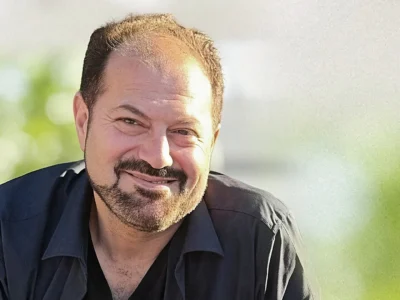
We speak with Palestinian activist Mahmoud Khalil about his new memoir, No Land to Stand On: Notes from Detention. It details his 104 days of detention inside a Louisiana ICE jail after he was targeted for arrest and deportation by the Trump administration over his pro-Palestine campus advocacy at Columbia University. Khalil missed the birth of his first child, Deen, while he was separated from his wife, Noor Abdalla, who is a U.S. citizen. The administration is still trying to deport Khalil, who has launched civil rights lawsuits against the government and Columbia University over his treatment.
“Eighteen months after my arrest, this administration has never charged me with any crime or even presented any evidence that I committed any crimes, yet they are able to get away with this because I’m Palestinian,” Mahmoud tells Democracy Now!
Khalil’s memoir also looks beyond his own case, recounting the people he met behind bars and what their stories taught him about the broader human cost of the U.S. immigration detention system. “This book is about a story of so many incredible men, fathers and workers who came here seeking safety and a better future, only to be snatched off the street,” he says.
TRANSCRIPT
This is a rush transcript. Copy may not be in its final form.
ANJALI KAMAT: No Land to Stand On: Notes from Detention. That’s the title of a searing new memoir by the first pro-Palestinian campus protester to be jailed by the Trump administration: Columbia University graduate and Palestinian student protest leader Mahmoud Khalil. On March 8th, 2025, Mahmoud was detained by plainclothes police officers who did not identify themselves in the lobby of his apartment building in Columbia University housing. His wife, Noor Abdalla, who was eight months pregnant at the time, filmed this video of his arrest as Mahmoud was being taken away. Her voice is heard in the clip.
DR. NOOR ABDALLA: Can you — can you please specify what agency is taking him, please? Excuse me. They’re — nobody — they’re not talking to me. I don’t know. Excuse me, the lawyer would like to speak to somebody. Oh my god, they’re literally running away from me.
AMY GOODMAN: That was March 8th, 2025. Mahmoud was taken into immigration detention, ultimately transported more than 1,300 miles away, to Louisiana. He spent over a hundred days in jail and was denied permission to attend the birth of his first child, Deen. He could only listen on the phone.
Mahmoud Khalil’s new memoir also looks beyond his own case, recounting the people he met behind bars, including immigrants who had lived in the United States for years and parents who were separated from their children, and what their stories taught him about the broader human cost of the U.S. immigration crackdown.
Mahmoud Khalil was released in June of last year and spoke outside the detention facility, the ICE jail, in Jena, Louisiana.
MAHMOUD KHALIL: No one is illegal. No human is illegal. That’s the message. The message is: Justice will prevail, no matter what this administration may try to portray.
ANJALI KAMAT: More than a year after Mahmoud Khalil’s release, the Trump administration is still seeking to deport Khalil. The Board of Immigration Appeals has approved his removal, and this week the board denied Khalil’s request to end his removal proceedings. His lawyers are pursuing further appeals, including seeking review by the Supreme Court.
In his new memoir, Khalil takes on not only the Trump administration, but also Columbia University, which he sued earlier this month, alleging it failed to protect pro-Palestinian students, instead retaliating against them when they reported harassment. Khalil writes in his new memoir, quote, “Rather than protecting its doxxed students, Columbia leaned into the intimidation campaign.”
In his memoir, Khalil describes the moment, just days after his arrest, when he came to see himself not simply as an individual facing deportation, but as a test case. He writes about his decision to take on the Trump administration and fight for his freedom, saying, quote, “My case was the blueprint they wanted to set, and the one we had to tear up.”
AMY GOODMAN: Well, for more, we’re joined now by Mahmoud Khalil to discuss his new memoir, No Land to Stand On: Notes from Detention. It was just released this week.
Mahmoud, thanks so much for being with us. Can you start off by talking about the title, No Land to Stand On? What does that mean to you?
MAHMOUD KHALIL: Thank you so much, Amy, for having me.
No Land to Stand On is really, to me, is a realization that this country, that promised me at least safety and stability, was not there, and also it talks about my experience. You know, I was born and raised in a Palestinian refugee camp in Syria, and then I had to flee the country at the age of 18 to Lebanon. And then I had also to leave Lebanon to come here to this country, only to be surprised that the promise that I was seeking was not there. So, it was really a realization, but also it’s my family’s story, where they are also now scattered around the world with no — with no place to go back to or, really, no land to stand on.
ANJALI KAMAT: Mahmoud, you write in your memoir, quote, “Today, Palestine is the exception to those rights the world claims as universal. In reality, it is a warning. The rights we are denied were never only ours to lose.” Can you talk about what you mean by that?
MAHMOUD KHALIL: Absolutely. You know, Palestinians are the canary in the coal mine. They start everything, the test case with Palestinians. For example, this deportation campaign, the Trump administration deportation campaign, started with me as a Palestinian to chill the speech of others. It’s not only chilling the speech of those speaking out for Palestine, but really anyone who’s speaking out against this administration, in essence. You know, when they started with me, they went right after to the universities, threatening them with federal funding, but also with journalists, you know, going after nonprofits and organizations that does anything that this — that do anything that this administration deem to be a threat, a threat to them. So, that’s why I feel why, like, when we talk about Palestine, it is really the warning.
And what happened now is a result of so many years of dehumanization against Palestinians, whether in the media or even in the political institutions or any institution in this country. That’s what made my targeting possible. You know, like, now 18 months after my arrest, this administration has never charged me with any crime or even presented any evidence that I committed any crimes, yet they are able to get away with this because I’m Palestinian, because, you know, a lot of politicians, whether they are Democrats, whether they are Republicans, they don’t care about Palestinians. So, this country, when it comes to Palestine, it’s really a one-party system, that everyone is just against Palestinians.
ANJALI KAMAT: You write, “I am Palestinian. That is not a complication of the story, it is the story. Everything else follows from it.” And this remarkable memoir, it’s not just, you know, your experiences. It’s an indictment of the entire system of American democracy. And you compare the failures of American democracy to growing up under the Assad regime in Syria.
MAHMOUD KHALIL: Yeah, exactly, because what happened to me, you know, I fled forced disappearance and arbitrary detention in Syria, only to be surprised that this happens to me here in a country that supposedly champions human rights, liberty and justice, rule of law. So, I wrote this book really to raise the alarm. You know, what’s happening behind ICE detention walls is a stain on the U.S. consciousness. So is the Palestine exception, the fact or the idea that free speech, rule of law and basic dignities are denied to Palestinians.
ANJALI KAMAT: And, Mahmoud —
AMY GOODMAN: Mahmoud Khalil, if you can share your experience growing up in Syria? You were, in fact, shot. You lost your friends. Explain what happened and how you ended up coming to the United States.
MAHMOUD KHALIL: Absolutely. You know, in 2011, when the Syrian people revolted against the Assad regime, and Egyptians and Tunisians, as well, the Arab Spring, Palestinians felt also the urge and the earn to their homeland. So, we decided to march to Palestine, to the borders. And I was one of thousands of Palestinians who wanted to march back to Palestine. And while, you know, we peacefully marched to Palestine, I was shot by Israeli soldiers while trying to cross the border.
And then, you know, when also in in Syria, I was helping out with relief, and also I couldn’t just stay silent while my Syrian neighbors were being killed and kidnapped by the Assad regime. So we started to organize, as well, to help out our Syrian brothers and sisters. And that’s when, you know, Assad cracked down on any sort of civil organizing and kidnapped two of my friends on January 9, 2013. And in a day, I had to leave the country to flee to Lebanon. So, I only had that one day really to flee the country to Lebanon.
And in Lebanon, I lived, you know, in Shatila camp, one of the largest Palestinian refugee camps in Lebanon, where the situation was also so, so bad in there. But I got to teach myself English there, get into school, and eventually get work in Lebanon. And that’s how sort of like my journey from Syria to Lebanon, and eventually to the United States.
But my story is only one story of the Palestinian story, really, how, you know, it’s all a result or a consequence of the Nakba of the 1948 that we had to go through all of this. You know, my grandparents had to live in tents. They had to upgrade it to mud houses, and my father was born into a tent. And then, when we built houses, you know, the Syrian revolution happened, and my family had to leave everything behind and leave.
ANJALI KAMAT: Mahmoud, you were a green card holder, and you write about how, you know, for many immigrants, the green card is the promise and the finish line. And yet you were detained. You know, all these months later, as you’re still fighting this case in the courts, you know, give us an update on what’s happening with your case and why you believe you were chosen to have — you know, to be detained, why you’re going through all of this.
MAHMOUD KHALIL: Yeah, so, you know, this case or this fight is not only about whether I get to stay in this country. It is really about whether anyone in this country get to speak out for Palestine, against this administration, and not punished for it.
Right now the Trump administration is really putting the full weight of the Justice Department to deport me. They’re trying it through the immigration system, as you’ve mentioned in your introduction. The Immigration Board of Appeals, which is fully controlled by the Trump administration, refused to open, or reopen, my case, because — you know, New York Times reported that there were a lot of, I would say, like, a lot of corruption, really, like, in my case, where a judge was appointed to look into my case, and that judge was the chief judge, but also over — many other individuals also intervened to make sure that there is a certain outcome in my case. So, we know that we wouldn’t get justice from the immigration kangaroo courts in this country. That’s why we’re turning to the federal court.
But also there, the Trump administration is blocking us from seeking — from seeking a neutral judge or a federal judge, Article III judge, from there. So, they are claiming that we should first go to the immigration court, and once it’s that done, we can go to a federal court in Louisiana, which is known to be one of the most right-wing or, you know, favorable to this administration in particular.
And for that, we’re going to the Supreme Court. We hope that next month — or, this month, in the 19th of October, we are petitioning to the Supreme Court to take my case, because, you know, our ask is very simple, that no federal agent or no government should have the power to detain anyone over constitutional claims or over their freedom of speech. So, it’s very simple.
And if you could remind me of the last question? I know there was a part of that question.
ANJALI KAMAT: Oh, you know, you write about how, you know, there was a moment in detention when you realized your detention wasn’t arbitrary or a mistake or accidental, and, you know, the president himself was tweeting about you.
MAHMOUD KHALIL: Exactly. I think that was the moment. You know, the first couple of days in detention, it felt to me that this was a mistake, that there’s no way they would come after me. I was a permanent resident — I’m still a permanent resident — never committed a crime. But when I saw that the president was actually tweeting about me, and the language of that tweet or even of the officials, it seemed to me that this is — this was way bigger than me, that that was a very calculated measure or a very calculated, I would say, targeting to chill the speech of others. They wanted someone who they can make an example out of, so that the hundreds and millions of American citizens and non-American citizens would fear speaking out against the U.S. support to Israel. So, that was the point where I was like, you know, to me, this is way bigger than just like me, my ability to stay in this country. It is really about the ability of so many people to speak out for Palestine.
AMY GOODMAN: We’re talking to Mahmoud Khalil. His book is just out this week. It’s called No Land to Stand On: Notes from Detention. Mahmoud, I want to go back to that day that you were detained. It was actually International Women’s Day, March 8th, 2025. Just before your detention, you wrote to Columbia’s interim president at the time, Katrina Armstrong, appealing directly to her and to the university for protection. You wrote, quote, “Interim President Armstrong, Since yesterday, I have been subject to a vicious, coordinated, and dehumanizing doxxing campaign … they have falsely labeled me a security threat and called for my deportation. Their attacks have incited a wave of hate, including calls for my deportation and death threats. I have outlined the wider context below, yet Columbia has not provided any meaningful support or resources in response to this escalating threat. I haven’t been able to sleep, fearing that ICE or a dangerous individual might come to my home. I urgently need legal support, and I urge you to intervene and provide the necessary protections to prevent further harm,” unquote.
Again, that letter on the day that you ultimately were detained, just before. You were then held by ICE for 104 days. And earlier this month, you filed a federal civil rights lawsuit against Columbia University, accusing the school of failing to protect you and other pro-Palestine student activists from harassment. You’ve denounced Columbia’s, quote, “deliberate indifference” and “discrimination aimed at intimidating Palestinian students.” Can you explain exactly what this lawsuit is about?
MAHMOUD KHALIL: You know, Amy, Columbia laid the groundwork for my targeting by the Trump administration by their not only, you know, indifference to our pleas, but also for participating in vilifying us as a movement. As you’ve mentioned, Columbia did not reply or answer any of my emails. Instead, you know, Columbia fueled a very dangerous rhetoric against Palestinian students and their allies on campus. They harbored these actors who smeared and doxxed me and other Palestinian students, as well. And in fact, just recently, they settled with some of these students, and giving them money for harming — for harming us.
And I was very shocked when I joined Columbia by the level of anti-Palestinian bigotry that’s institutionalized within every department in that school. You know, I was in the School of International and Public Affairs, SIPA, and its dean, Dean Yarhi-Milo, was also very indifferent to Palestinian concerns, and her only, really, concern was how to — how to protect Israel, how to do more events and more events about Israel. Like a day after October 7, she immediately called for a webinar, inviting Hillary Clinton, to assess Israel’s next steps. And these next steps, of course, included the killing and genociding of the Palestinian, the Palestinian people.
So, Columbia was not only an idle actor in this, or that they did not do anything; they, in fact, helped fuel this campaign against me. And in one of our cases, or the cases of these students who were detained by the Trump administration, the Rubio determination, in fact, quotes what Columbia said about the protests — falsely said about these protests, because the ideologues on the Board of Trustees, it was more important for them to protect Israel than actually protecting freedom of speech, than protecting academic freedom, than protecting the students.
You know, Columbia missed an opportunity to be an institution that would respect the human rights law, that would respect just basic dignities and would, you know, be a place to have a difficult conversation. Instead, it chose to surveil its students, to bring the police more than four times to brutalize its own students, expel and suspend over 100 students. Just imagine 100 students, over 100 students, between the ages of 17 and 20, whose their future now in limbo just because they dared to protest a genocide. So, that’s why I’m bringing this lawsuit, because no student, regardless of their background, regardless whether they were Palestinians or anything — no students should go through the hell that Columbia put us through over the past three years.
ANJALI KAMAT: Mahmoud, you write, “Had Columbia possessed the power to deport me, I have little doubt it would have done so.” I want to ask you about another lawsuit you filed in July, a federal lawsuit against several top Trump administration officials, two pro-Israel groups and a conservative think tank, accused of conspiring to suppress your criticism of Israel and constitutional rights to free speech. Can you talk about this lawsuit?
MAHMOUD KHALIL: So, you know, the White House, when they arrested me, they touted about a blueprint. They said this arrest would be a blueprint to go after everyone who speaks for Palestine. And that blueprint is called Esther, the Esther Project. It’s a document or a policy document produced by the Heritage Foundation, and in that — it was produced in 2024. And what they said, that to implement this project, we need an administration that’s favorable to us, that would work with us. And as part of that project, it was detaining and deporting international students to chill the speech of other students who dare to speak out about Palestine.
So, we’re suing now government officials also in their personal capacity, because that’s — we’re suing them under the KKK Act. It’s a civil rights act that was, you know, brought during the Reconstruction era to really — you know, after the abolition of slavery and to protect the rights of Black Americans, this law was brought because there were actors conspiring together to deprive Black people from their rights. So, we’re bringing this lawsuit under that law. And, you know, a judge in Massachusetts, a Reagan appointee, confirmed what we are alleging right now, which is that government officials conspired with themselves to deprive these noncitizen students, so they can — to make an example out of them. And that judge, you know, like, in his proceeding, said, “I’ve never seen such a flagrant, just, like, assault on the Constitution or assault on the — just the rule of law.”
And I’m suing because I’m seeking accountability. I’m suing because no one should go through this, whether — you know, if they were able to deport a Palestinian for his views, they would be able to deport anyone else for their views, whether this administration or any other administration.
AMY GOODMAN: Mahmoud Khalil, you were in that Jena ICE jail for 104 days, during which time your son Deen was born. In your audio book, you do not read that chapter; you have someone else read it. And I’m wondering if you can talk about why and talk about what that meant. And you tell the story not only of missing your own baby’s birth, but of other people in that jail, another man in the same situation. And that’s also part of the power of this book, the other stories that you tell, Mahmoud.
MAHMOUD KHALIL: You know, missing the birth of my child, of Deen, was one of the most difficult times in detention. And it’s something I really — you know, it brings so many emotions to me that I was stripped that very, I would say, divine moment, like to be with my wife Noor at a moment where every couple, like, wish to be together. And as you’ve mentioned, this is not only about me. This book is about a story of so many incredible men, fathers and workers who came here seeking safety and a better future, only to be snatched off the street.
You know, I write about Alexander, the young man who was begging for safety in this country, only to be deported, only to be denied the ability to stay in safety here. And then I learn a few months later that he was killed when deported to Honduras.
I talk about the — you know, my fellow inmates, who also were not able to see their families. You know, I would go — when I would go to the visitation room in Jena, Louisiana — the detention center housed over 1,200 detainees. But when I go to the visitation room, it’s empty, because their families were frightened to come and visit them, because it was in the middle of nowhere, that — it’s in the middle of a swamp. So, their families would fear. Like, I had to tell someone that your mom shouldn’t come visit you, because she’s also undocumented. So, just imagine that you have to tell that to an 18-year-old, that your mother shouldn’t visit you because they may arrest her.
So, that was the terror, the cruelty in these detention centers. And they were designed also, like, to make people give up immediately. So, the conditions, the bad conditions in these detention centers, like the constant light, the low temperature, the bad food, it’s all designed so that you give up your case and sign your deportation order immediately, because if you want to fight, you need to be able to stay in that detention center for minimum of six months, but that could go up like a few years. You know, in only 104 days, I lost over 15 pounds. So imagine, like, staying for a year there.
AMY GOODMAN: Mahmoud Khalil, we want to thank you so much for being with us, author of the new memoir, No Land to Stand On: Notes from Detention. All safety as you travel the country talking about your book. You’ll be in Somerville, Massachusetts, tonight. You’re going to be at Seattle Town Hall and all over the country.
Coming up, German human rights lawyer Wolfgang Kaleck of the European Center for Constitutional and Human Rights. He’s usually here in Berlin, but he’s in New York, and we’re going to talk to him there. Stay with us.
[break]
AMY GOODMAN: “World Keeps Spinnin’” by Sol Reliqs.
Media that fights fascism
Truthout is funded almost entirely by readers — that’s why we can speak truth to power and cut against the mainstream narrative. But independent journalists at Truthout face mounting political repression under Trump.
We rely on your support to survive McCarthyist censorship. Please make a tax-deductible one-time or monthly donation.




+ There are no comments
Add yours