







Honest, paywall-free news is rare. Please support our boldly independent journalism with a donation of any size.
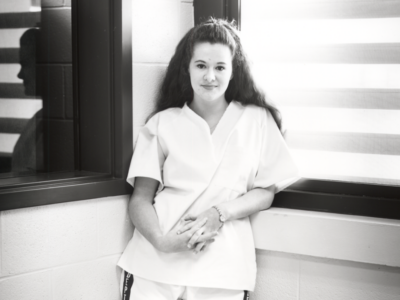
Lisa Jo Chamberlin’s life has always been a tangle of drug use, abuse, and extreme violence. Her mother drank and used Sudafed heavily during her pregnancy. As a result, Chamberlin was born with Fetal Alcohol Spectrum Disorder (FASD), a group of medical conditions, including poor reasoning and judgment skills, learning disabilities, and intellectual disability, that occur when a fetus is exposed to alcohol.People with FASD are more vulnerable to manipulation by others. For Chamberlin, that vulnerability led to a death sentence.
The 45 women on death row across the country make up 2 percent of the total number of Americans sentenced to death. The vast majority of women behind bars have experienced abuse before arrest. Ninety-six percent of women on death row had experienced gender-based violence before arrest, 80 percenthave intellectual or psychosocial disabilities, and 90 percent have no prior conviction for a violent felony. Chamberlin checked all of these boxes.
As a child, she suffered constant physical and sexual abuse from her father, her mother, her stepfather, her brother, and even her fourth-grade teacher. Her mother beat her with whatever was on hand, sometimes whipping her with a wooden spoon until it broke. When she was six, her 11-year-old brother put her into a closet with three neighborhood children, instructing them to touch her sexually. He also sexually abused her for years. Chamberlin told her mother, who dismissed her complaints.
When she was 12, Chamberlin began using drugs to numb the constant violence and abuse.
As an adult, her boyfriends used her substance dependency to exert control. They also physically and sexually abused her. Roger Gillett, who would become her co-defendant, strangled her, attempted to drown her, and raped her. He ordered her to move with him from Oregon, where her family lived, first to Kansas and then Mississippi in 2004. That was where Gillett killed two people.
Now 53, Chamberlin is the sole woman on Mississippi’s death row. If her appeals fail, she will be the first woman the state executes since 1944.
“In capital cases, women who have experienced some of the most extreme forms of gender-based violence and oppression are also among those who have received the least support from the legal system, from their communities, from their families, and from society,” Sandra Babcock, founder and director of the Cornell Center on the Death Penalty Worldwide, told Truthout. “There are two dynamics: One is that these women are among the most damaged and vulnerable survivors to become involved in the criminal legal system. But their experiences of violence and trauma go unrecognized by the legal system when they are charged with a capital crime.”
A Trial Rife With Gender Stereotypes
In Mississippi, Chamberlin and Gillett stayed with Gillett’s cousin, Vernon Hulett, and his cousin’s girlfriend, Linda Heintzelman. At first, they all got along. Then, after an auto accident between the two couples, they hatched a plan for Heintzelman to report the accident, collect insurance, and split it with Gillett and Chamberlin.
Heintzelman never filed the insurance claim, leading to tension between the two couples. When their hosts suggested that they move out, Gillett tortured and killed them. He and Chamberlin then placed their bodies into a freezer, loaded it into Heintzelman’s truck, and drove to an abandoned Kansas farm owned by Gillett’s grandfather.
There, police conducted a drug raid, arresting both. They later found the freezer and charged the couple with the deaths of Hulett and Heintzelman.
The pair were tried separately. Both were convicted and sentenced to death.
Chamberlin’s trial was marked by demonizing gender stereotypes. The prosecutor painted her as the mastermind behind the murders. He introduced testimony about Chamberlin’s sex life, including testimony from two jailhouse informants. Jailhouse informants’ testimonies, commonly motivated by law enforcement, are inherently unreliable and have been the leading cause in 46 percent of death row exonerations. Even the Mississippi Supreme Court recognized the problematic nature of relying on jailhouse informants, stating in 1989, “The testimony of jail-house informants, or ‘snitches,’ is becoming an increasing problem in this state, as well as throughout the American criminal justice system.”
“It is much easier to conclude that this is simply an evil person, that this is not someone who is herself damaged, who is herself a crime victim.”
Nonetheless, the informants’ testimony was not contested. One of the informants, Marsha Petrofsky, already on probation for five fraudulent checks, had been jailed for arson. A year after she testified, she pled guilty to first-degree arson and was sentenced to five years’ probation and $4000 restitution even though Mississippi law requires a 5-to-20-year sentence and restitution of triple the amount of damages. The other, Vanessa Stringfellow, was contacted by the state in 2006, the year of the trial. She testified that she overheard Chamberlin tell other women that she and Gillett had sex in front of the corpse and it was the best sex she ever had.
Their testimonies painted Chamberlin as an immoral and hyper-sexualized woman, a portrait that the prosecutor drew upon to inflame the jury. Additionally, Chamberlin’s attorney did not present testimony about FASD and how it made her more easily dominated by Gillett.
A psychologist for the defense testified about her abuse history, but the prosecutor dismissed her testimony, suggesting that Chamberlin was not a victim of repeated gender-based violence but instead a “sociopath” or “psychopath.” The jury believed his version and sentenced her to death.
That’s not unusual, said Babcock. “Prosecutors will minimize, distort, dismiss women’s accounts of sexual violence, whether they come via women’s testimony or through an expert.”
During the penalty phase, the prosecution painted Chamberlin not only as a sexually promiscuous woman, but also a bad mother, stating that she “abandoned [her children] like a reptile.”
In Mississippi, the jury, not the judge, makes the decision on whether to impose the death penalty. Chamberlin’s jury returned a sentence of death.
“When somebody is charged with a capital crime, particularly offenses that make people recoil, it is much easier to conclude that this is simply an evil person, that this is not someone who is herself damaged, who is herself a crime victim, but that [her actions] are attributable to her depraved character,” said Babcock.
Will the Courts Allow a Confession?
It is a tragic irony that it often takes a death sentence appeal for a person to receive better legal help — help that in many cases could have prevented the sentence in the first place. In Chamberlin’s case, that help came in the form of the Mississippi Office of Capital Post-Conviction Counsel. The office also representedGillett when he appealed his death sentence. The Mississippi Supreme Court vacated his sentence because the jury heard inadmissible evidence of an invalid sentencing factor (a previous felony for escaping from a Kansas jail). In 2018, he was resentenced to life without parole.
In 2022, the Mississippi Office of Post-Conviction Counsel began representing Chamberlin. None of her legal team had represented Gillett, avoiding any conflict of interest. They found three experts to attest to the effects of FASD. They also approached Gillett who, in 2023, submitted an affidavit admitting that he had “complete control over her.” He also stated, “When my attorney told me Lisa was painted as the mastermind behind the homicide, I almost didn’t believe him. It is laughable to think that Lisa is the mastermind behind anything. Her involvement was minor, and she would not have participated had I not clearly been in control.”
Chamberlin has been the only woman on Mississippi’s death row for the past decade. The isolation has impacted her mental health — in 2025, she was placed on suicide watch at least twice.
The Mississippi Supreme Court ruled that this new evidence was time-barred (or not filed within a certain timeframe) and was contradicted by evidence presented at trial. The court denied her appeal.
In 2025, the U.S. Supreme Court ruled in Andrew v White that the Due Process Clause forbids the introduction of evidence that is so unduly prejudicial as it renders a criminal trial fundamentally unfair. In the case of Brenda Andrew, sentenced to death in Oklahoma for her husband’s death, the prosecutor’s inclusion of her sex life, her dress and demeanor (complete with holding her lacy bra and thong up in court), and closing comments painting her as a bad mother were so prejudicial that they violated the Due Process Clause. The court sent her case back to the Tenth Circuit Court, which declined a re-hearing. Andrew remains on death row while her legal team plans to appeal to the U.S. Supreme Court.
Given that ruling, Chamberlin’s attorneys again appealed to the Mississippi Supreme Court for a rehearing. The court denied it.
“In 2006, Lisa Jo’s jury only heard one side of the story,” her attorneys told Truthout. “They did not hear that Lisa Jo was born with FASD, and organic brain damage. They did not hear that Lisa Jo’s actions are shaped by Battered Woman Syndrome. They did not hear that Roger Gillett was primarily responsible for the crime and that Lisa Jo believed Roger would kill her if she did not participate.”
Should the state supreme court strike her petition, she can petition the U.S. Supreme Court. Should it decline to hear her petition, she can turn to the federal district court, which has already granted a Rhines stay (or a pause on the strict timeline for federal filing). Should that court deny her petition, Mississippi will set an execution date. If the state-sponsored killing is carried out, Chamberlin will be the first woman executed since the state executed 23-year-old Mildred Johnson in 1944.
Chamberlin has been the only woman on Mississippi’s death row for the past decade. The isolation has impacted her mental health — in 2025, she was placed on suicide watch at least twice. At one point, she considered signing papers allowing her execution to proceed but later decided against it. After she spoke about her conditions with Mississippi Today, prison officials retaliated. She spent up to 48 hours confined to her cell, was denied access to showers, and was given less outdoor time than men on death row. Friends, family, and Chamberlin herself told Mother Jones that her communication with the outside world was blocked for months.
Media Scrutiny Stopped Mississippi’s Last Attempt to Execute a Woman
In 1999, Michelle Byrom’s husband was found shot at home with a pistol that was a family heirloom. Byrom was medicated and recovering from pneumonia at a local hospital when the sheriff questioned her. She said that she was responsible for the murder.
Her son, Edward Byrom Jr., testified at trial that Byrom had hired his friend Joey Gillis as a hit man. Both Edward Byrom Jr. and Gillis were convicted of lesser charges and were released from prison in 2013 and 2009, respectively.
Michelle Byrom was convicted and sentenced to death. When the U.S. Supreme Court declined to hear her case in 2014, Mississippi set an execution date. But media scrutiny into her conviction uncovered a pretrial confession from Edward Jr. to his mother, a letter that she had never seen. That attention sparked outrage. People called the governor, demanding he halt the execution.
The Mississippi Supreme Court — the same court where Chamberlin is now appealing — vacated Byrom’s conviction after her new legal team presented evidence that jurors had never seen, including the confession letter and a separate confession by Edward Byrom Jr. to a court-appointed psychiatrist. Gillis submitted an affidavit admitting that Byrom did not hire him to kill her husband.
Opposition to Chamberlin’s execution has also come from an unexpected source — Vernon Hulett’s mother
The court granted her a new trial.
Byrom was taken to the local jail to await a new trial. In 2015, she agreed to an Alford plea, which allowed her to maintain her innocence while accepting a felony charge on the record. The judge sentenced her to time served and Byrom, after 16 years behind bars, left the courthouse. She moved to Tennessee, where she died in 2019 at age 62.
“Mitigating evidence and new evidence can really put a case in a different light and a different perspective,” Krissy Nobile, one of Chamberlin’s attorneys, told Truthout. “In this post-conviction process, we are now learning of the new evidence,” she said. “Anyone and everyone that has seen her case, especially after Roger’s affidavit, has been outraged. The more the public knows, the more outraged people will be about [her death sentence].”
Opposition to Chamberlin’s execution has also come from an unexpected source — Vernon Hulett’s mother, Caroline Hester.
In 2019, Hester sent a letter to then-governor Phil Bryant. “As I told our local DA for years, I do not need for Lisa Chamberlin to be put to death,” she wrote. Hester clarified that she does not want Chamberlin freed, but said that life imprisonment was enough. She ended her letter stating, “I need for this to be over!”
“Lisa Jo Saved My Life”
In 2022, Chamberlin connected with a sister she never knew she had. Yvonne, born 10 years earlier to the same father, had been abandoned by her biological parents at eight months old. She was adopted by what she described as a loving family. But she never stopped searching for her history. (Yvonne asked that only her first name be published to protect her privacy.)
In 2022, an organization that helps adoptees connected her with her oldest sister, who told her about Chamberlin. She wrote her a letter. “Now, we talk on the phone once or twice a month,” Yvonne told Truthout.
“The life she had could easily have been my life,” Yvonnereflected.
Yvonne has watched true crime shows about her sister. But, she said, Chamberlin is not the monster they portray. The sister she knows is warm, compassionate, and, at times, funny. She cares for baby birds that fall out of trees. She ministers to others in the prison. Once, during a cold night, she gave her only blanket to a woman who had none. Knowing her has also pushed Yvonne to become more active in fighting for her beliefs.
“She has profound remorse for her participation,” noted Chamberlin’s attorneys. “She found faith in prison and stopped using drugs. Now she seeks to help other women in prison struggling with addiction. Lisa Jo can be a force for good in prison if she is no longer under a sentence of death.”
Even with execution hanging over her head, Chamberlin has helped others in the prison. Laykin Bordelon met Chamberlin when she was 19 years old and placed in the behavior modification unit at Central Mississippi Correctional Facility. Chamberlin, as the only woman on death row, was also on that unit.
“Lisa Jo saved my life,” Bordelon, now 36, told Truthout. “I spent 13 years incarcerated. I felt so forgotten.”
She and Chamberlin talked through the tray slots of their cells, never having the opportunity for face-to-face or physical contact. After Bordelon was transferred to general population, she would sometimes go on suicide watch just to talk to Chamberlin. “That was laying butt naked on a concrete floor, no clothes, no blanket, nothing, just so I could talk to her.”
Bordelon is now home, but she hasn’t forgotten the woman she calls her godmother. Earlier this year, she attempted to draw official attention to Chamberlin’s extreme isolation, sending letters to legal organizations and the Department of Justice’s Office of Civil Rights Division requesting an investigation into her godmother’s conditions.
“I have completely turned my life around,” Bordelon reflected. She’s a manager at a local business and plans to get involved with advocacy for incarcerated people. “It’s because of her.”
“I have always been against the death penalty,” Yvonne said. “Now that it’s personal it brings a deeper perspective into my feelings on the subject.” She has offered to help Chamberlin’s attorneys in any way possible. She’s also become involved in advocacy to stop the execution of Christa Pike, whose lifetime of abuse mirrors Chamberlin’s.
On September 30, which was Chamberlin’s 54th birthday, Pike survived the horrific experience of Tennessee’s attempt to execute her. After two doses of lethal pentobarbital, Pike was still breathing and sent to the hospital.
“I’m hoping that this leads other states to change their death penalty sentencing. There are so many things that can go wrong and these two cases are so similar,” Yvonne said. “When I see [Christa Pike’s] case, my mind is on her.”
This story has been updated to note that the Mississippi Supreme Court denied Chamberlin’s latest motion for a rehearing on October 8.
Press freedom is under attack
As Trump cracks down on political speech, independent media is increasingly necessary.
Truthout produces reporting you won’t see in the mainstream: journalism from the frontlines of global conflict, interviews with grassroots movement leaders, high-quality legal analysis and more.
Our work is possible thanks to reader support. Help Truthout catalyze change and social justice — make a tax-deductible monthly or one-time donation today.









+ There are no comments
Add yours