







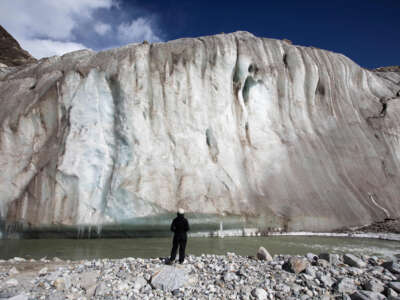
“What happened yesterday is unfortunately the new normal,” one geoscientist said of the devastating floods.
Did you know that Truthout is a nonprofit and independently funded by readers like you? If you value what we do, please support our work with a donation.
Preliminary investigations into the massive floods in Nepal earlier this week indicate that the cause of the disaster was likely glacial collapse, a phenomenon wherein a glacier or part of one disintegrates, resulting in a rush of water being released.
The impact of the collapsing glacier was so monumental that it was initially but incorrectly identified as an earthquake, registering a 5.2 rating on the Richter scale.
So far, at least 389 deaths have been counted from the devastating flooding that took place on Wednesday near the Lhende Khola and Bhote Koshi River in the Rasuwa district of Nepal. More than 1,300 individuals remain missing, among them at least 700 tourists (including around 90 Americans) who were visiting the region.
While the exact cause of the flooding can’t technically be attributed quite yet, a rapid analysis of the area by a team of geoscientists from satellite monitoring company Planet Labs suggests glacial collapse was to blame. According to before and after images, a glacier that was near the region was reduced by around 2 million square feet after the event occurred.
Witness accounts of the devastation offer a horrifying glimpse into what happened.
“Nepal authorities are telling us entire villages are wiped out with waves of 8-10 meters. It’s shocking,” said Tommaso Della Longa, a spokesperson for the International Federation of Red Cross and Red Crescent Societies (IFRC) in Geneva. “The scale of devastation is immense. There are areas that simply don’t exist anymore.”
Collapsing glaciers are sometimes a natural phenomenon, but as the planet continues to warm due to the fossil fuel-driven climate crisis, their rapid retreat and collapse have increasingly become a major threat to communities around the world.
“What happened yesterday is unfortunately the new normal. It’s going to get worse from here onwards,” said Jakob Steiner, a geoscientist at the University of Graz in Austria, speaking to The Associated Press about the situation.
Simon Cook, a glacier expert with the University of Dundee in Scotland who also works with Planet Labs, agreed that the climate crisis was largely to blame for the disaster and possibly other future flooding events, telling the BBC that:
The logic is that with a warming planet, you will see shrinking glaciers, lots of snow melt. The permafrost that is partially holding some mountainsides together is warming and thawing and degrading. So you are going to get more landslides, debris flows, glacial meltwater, lake outbursts, glacier collapses, because climate warming ultimately destabilizes these high mountain environments.
Aakriti Dotel, National Network Coordinator for Nepalese Youth for Climate Action, described the floods as “another painful reminder of the growing climate crisis facing Nepal and the Himalayas.”
“As our glaciers melt and extreme weather events become increasingly unpredictable, communities living downstream are bearing the devastating consequences,” Dotel explained in a 350.org press release.
“We mourn the lives lost and the livelihoods affected and call for urgent global climate action. There must be stronger support for vulnerable mountain communities, and accountability from those most responsible for the climate crisis,” Dotel added.
Media that fights fascism
Truthout is funded almost entirely by readers — that’s why we can speak truth to power and cut against the mainstream narrative. But independent journalists at Truthout face mounting political repression under Trump.
We rely on your support to survive McCarthyist censorship. Please make a tax-deductible one-time or monthly donation.










+ There are no comments
Add yours