





Support justice-driven, accurate and transparent news — make a quick donation to Truthout today!
Israel has killed over 260 journalists and media workers in Gaza and 29 in Lebanon since October 7, 2023. Irish filmmaker Seán Murray investigates Israel’s killings of journalists in his new feature documentary Journacide: The War on Truth. He says the term “journacide” applies to Israel’s military actions because of the “explicit nature of the targeting and killing of journalists” as a way to silence the truth. Murray calls it “the Gaza doctrine that is now being applied in Lebanon.”
TRANSCRIPT
This is a rush transcript. Copy may not be in its final form.
AMY GOODMAN: This is Democracy Now!, democracynow.org, The War and Peace Report. I’m Amy Goodman. We are broadcasting from Belfast in the North of Ireland. Here at Docs Ireland, the film about Democracy Now!, Steal This Story, Please!, premiered last night at the Queen’s cinema here in Belfast on the first night of the film festival.
We turn now to Lebanon, where an Israeli drone on Monday struck a journalist with the Iranian outlet Press TV while he was reporting from southern Lebanon. Hadi Hoteit was reporting on camera at the time of the attack.
HADI HOTEIT: I’m in the center of Kafr Tebnit right now, the entrance of Kafr Tebnit from this side. An artillery strike just targeted the area behind me, as you can see. There is heavy drone activity in the vicinity. And, of course, the destruction, the amount of destruction, is very strong. There is — the Israelis did try to destroy the entire area.
AMY GOODMAN: The journalist Hadi Hoteit survived the attack but was hit by six pieces of shrapnel.
Over 260 journalists and media workers have been killed by Israel in Gaza since October 7th, 2023. With Israel’s latest and ongoing assault on Lebanon, the death toll of journalists there has reached 29.
Irish filmmaker Seán Murray investigated the killings of four of those journalists. On March 28th, journalists Ali Shoeib and brother and sister Fatima and Mohamed Ftouni were killed, all together, in an Israeli drone strike on their car. On April 22nd, Amal Khalil was injured in an airstrike and died from her injuries after waiting for hours inside a bombed building as rescuers awaited clearance from Israeli forces to reach her. Seán Murray’s new feature documentary, premiering here in Belfast at Docs Ireland, is called Journacide: The War on Truth. This is a clip from the trailer.
SEÁN MURRAY: This is not a film about war, but rather a decree to bear witness. It’s a film about friendship, love and the indomitable will of the human spirit. As Lebanon burns, silence has now become the greatest weapon of oppression. This is a tale of those that fought different, the story of the gatekeepers of truth.
AMY GOODMAN: That’s a clip from the film Journacide: The War on Truth by director Seán Murray, who joins us here in the Belfast studio.
Seán, it’s great to have you with us. Very painful times. You know, we started with this latest targeting of a journalist, Hadi Hoteit in Lebanon. You knew him?
SEÁN MURRAY: Yeah, well, Hadi Hoteit works for Press TV. I think, inadvertently, that Hadi is maybe featured in the documentary. He was there in Sour, which is Tyre, in the media compound when I was there, as you’ll see in the film. But yeah, he’s just one of many who have to live with the targeting every day in Lebanon.
AMY GOODMAN: So, talk about your film and why you chose to call it Journacide.
SEÁN MURRAY: Well, I think Journacide effectively gives the explicit nature of the targeting and killing of journalists. I think that it fits perfectly. I think we — not only do we see the targeting of journalists, but it’s the double-tap strikes that we see with the Gaza doctrine, that is now being applied in Lebanon. So, in the case of Ali, Fatima and Mohamed, the original strike killed Ali and Mohamed, and it was a double tap then that killed Fatima, Mohamed’s sister, in the second strike. So, this is a deliberate targeting of journalists. The reasons behind that is to, of course, silence what is happening in Lebanon, the ethnic cleansing that’s going on, the mass war crimes that’s being committed. But Lebanon is a little bit different. Israel does not have the geographical repressive abilities that they did in Gaza. And we see that now playing out, and hopefully we see this week that something might be changing, or we’ll see the ceasefire. All we could do is hope.
AMY GOODMAN: I want to go to a clip of Ali Shoeib. I’m going to see if we have it.
ALI SHOEIB: [translated] Because the whole event now revolves around us, I film myself, since the photographer who was accompanying me day and night for months has now become a martyr. I miss him, just as I miss my colleagues at Al Mayadeen, the martyrs Mohammad Reda and Ghassan Najjar. In this place, the martyrs fell this dawn. This was an area dedicated solely to journalists’ accommodation. Here, we used to live. We would leave in the morning for the front and return in the evening to this place, a place that everyone now knows is being dedicated to journalists. The Israeli enemy carried out a raid at dawn with its warplanes on this place. It destroyed several accommodation facilities. It killed three martyrs, and a number of journalists were wounded. There are no weapons here, no military presence and no one affiliated with the military.
AMY GOODMAN: “And no one affiliated with the military,” Ali Shoeib says. Talk about what happened to him, and then how the Israeli military tried to destroy his reputation. On March 28th, Ali Shoeib would also be killed by an Israeli drone strike, along with, as you said, the reporters, brother and sister, Fatima and Mohamed Ftouni.
SEÁN MURRAY: Well, this original clip is with the media compound inside Lebanon where Ali and his colleagues were staying. Ali describes them — it’s the first attempt to kill him. Ali was staying there himself and survived the attack. And not long afterwards, he himself was killed.
But as we have seen being applied the same principles that are applied in Gaza, these lies and these slanders came very quickly with Israel regarding Ali Shoeib. So, we have seen almost immediately a photo of Ali in a Hezbollah uniform, where half of the photo is cut between his press uniform and a Hezbollah uniform. And the statement that was put out by IDF was that Ali was a member of the elite Radwan Forces of Hezbollah. Now, very strangely, it was Fox News in the U.S. that questioned the veracity of the photo of Ali Shoeib, and after being quizzed by Fox News, the IDF, the Israelis, then said that the photo was photoshopped.
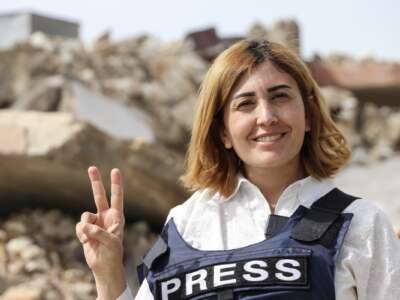
AMY GOODMAN: So, I want to go to another of the journalists who you profile. On April 22nd, the prominent Lebanese journalist from south Lebanon, Amal Khalil, a correspondent for the daily newspaper Al-Akhbar, along with her colleague, photographer Zeinab Faraj, attempted to seek shelter from Israeli drone strikes, which prevented rescue and medical workers from rescuing them both. Six hours later, by the time rescuers were able to find Amal, she was dead. I want to turn to another clip, Seán, from your film Journacide. This is Amal Khalil’s niece.
AMAL KHALIL’S NIECE: Amal is my aunt. and she is also the bravest person I know. Whenever she talked, people would silence themselves. And she always — she was never scared. She received threats. She put smiles on everyone’s faces whenever she walked in, in any room. I am very proud of Amal.
AMY GOODMAN: So, that was Amal Khalil’s niece. Seán Murray, talk about who Amal Khalil was, and the horror of that day when she and Zeinab took refuge. Well, explain what happened to them.
SEÁN MURRAY: Well, first of all, Amal was a much beloved journalist in south Lebanon. She, in many ways — on the 20th of November, when Ali Shoeib was killed with Fatima and Mohamed, she had picked up the mantle of Ali, in the sense that she was the go-to journalist for other international journalists and those in south Lebanon to contact regarding information they needed in the south. She, like Ali, knew every blade of grass in the south. But also, she was so well received with many organizations, as I said, much beloved. What had happened to Amal that day was that she was traveling to a village in south Lebanon.
AMY GOODMAN: Can I ask: Had she already been warned by the IDF, getting calls?
SEÁN MURRAY: Oh, yes, yes. So, beforehand, maybe a number of weeks beforehand, she was told — and I quote the IDF themselves — that her head would be removed from her shoulders if she continued to document what was happening in the south. So, that’s exactly what Amal was doing that day. She was documenting the war crimes in the south, the destruction of villages. She was in a convoy of two cars. The car in front was hit with a drone. A number of journalists were killed there, who Amal knew. Amal and her friend got out of the car, Zeinab Faraj, got out of the car. They hid under a tree and phoned family members and colleagues. They then moved very quickly to a house across the road. By this stage, the president of Lebanon had been contacted by her colleagues.
AMY GOODMAN: President Aoun.
SEÁN MURRAY: President Aoun. He effectively made calls to the mechanism, which is a committee that’s set up between the Lebanese Army, the Israeli army and an American mediator. And that committee was set up to effectively deal with issues around peace between Lebanon and Israel. So, pretty early on — and I mean in the first 10 minutes — everyone was aware that Amal Khalil — Amal and Zeinab were in that house. Attempts were made to rescue both them, but the Israeli army then bombed the road as the Lebanese Army were approaching. The fire did not stop, and the car that Amal was in was then droned after all this. So, not very long later, the Red Cross, along with the Lebanese Army, were then — then gained access, sorry, to the house after the house had been hit. So, eventually, the house was hit, and there was no more contact from Amal. Zeinab was rescued. Then the Israeli fire started again, so they had to stop the search of Amal. And it wasn’t ’til a number of hours later, maybe 11:00, after this original incident began at about 20 past 2:00 in the afternoon, that they found Amal’s lifeless body on the basement of the house.
AMY GOODMAN: I want to ask you about the solidarity between people in Northern Ireland, in the North of Ireland, and the people of Palestine and also Lebanon. I saw you yesterday near your house, near the mural, or murial, as it’s called in Irish, of Bobby Sands, the famous hunger striker who died of starvation, but during his hunger strike ran for the British Parliament and won. And his was one of many murals, now a number of them images of Gaza. I mean, you have the poet Refaat Alareer, killed in an Israeli military strike in Gaza. His poem “If I Must Die” is written out on the wall. And why you did this film, and that solidarity that you feel, the significance of these two movements?
SEÁN MURRAY: It was very pertinent you had mentioned the mural of Bobby Sands. I mean, the thread that runs through my work is how we — I mean, just to give a bit of context to the conflict here, we, the community that I came from, there was kind of a monopoly of victimhood, so the media was used to vilify the community that I come from. So, I come from a — what would be widely known as a Catholic Irish Republican community, where we had a — what you would say, a low-intensity civil war for over 30 years here, where many civilians were killed and many combatants were killed, members of the IRA, members of the British soldiers, members of the British paramilitary police. So, we had that over three-and-a-half thousand people killed in the conflict for over 30 years. And you have to remember, as you walk through Belfast streets, you know, every corner that you turn on that short tour, there were many people killed in those streets. So —
AMY GOODMAN: I should warn you, we have 30 seconds.
SEÁN MURRAY: OK. So, yes, so, it’s very, very important that the murals were — and the thread that runs through my work is that we need to reclaim historical memory. And murals are a very, very important part of that, as well as the work that I do now.
AMY GOODMAN: And the solidarity with Palestine?
SEÁN MURRAY: Yes, and that, of course, encapsulates the solidarity with Palestine, because we see that on the murals, along with the politics that we have suffered ourselves here.
AMY GOODMAN: I want to thank you, Seán Murray, for coming in to Northern Vision community television here in Belfast. Seán Murray is a documentary filmmaker, new feature film premiering at Docs Ireland festival Thursday called Journacide: The War on Truth.
Thanks to everyone here at Northern Visions TV: Dave Hyndman, Dean Hagan, Dave Caskey, Jamie Finlay, Ciaran Ó Brolcháin, Eamonn Higgins, Shauna Lawson, Simon Goligher and Ailbhe Lynch and Geoff Williams.
That does it for our show. I’ll be in Vermont for the weekend with Steal This Story, Please! I’m Amy Goodman, from Belfast.
An important fundraising appeal: 7 Days to raise $44,000
Truthout is one of only a few platforms for justice-oriented, grassroots journalism. Today, as political censorship from the right intensifies, we have no choice but to ask for your help.
We are fundraising right now to cover our basic operating expenses. If you can support Truthout with a one-time or monthly donation, you will make a significant impact on our work. Anything you can do makes a difference — we appreciate your support.




+ There are no comments
Add yours