



Support justice-driven, accurate and transparent news — make a quick donation to Truthout today!
A unique kind of relief comes from standing at the edge of the ocean. For generations, New York and New Jersey’s public beaches have offered exactly that: a free, open shoreline where people come to breathe, grieve, celebrate, fall in love, or simply exist without needing money or permission. For many, the beach is not a luxury. It is medicine.
Beneath that same water, a fight is unfolding that could put all of it at risk.
The Williams Northeast Supply Enhancement pipeline, known as NESE, has been fought, defeated, and revived more times than most New Yorkers realize. It has outlasted three formal environmental denials, a pandemic, and a change in presidential administration, only to return with the same basic promise: that it is necessary, that it is safe, and that someone other than the company building it will benefit. For nearly a decade, a coalition spanning environmental groups, immigrant families, LGBTQIA+ beachgoers, and conservative homeowners who agree on little else has fought to prove otherwise.
A Decade-Long Fight, Reopened
The current fight traces back to 2011 and 2012. After Superstorm Sandy, then-Representative Michael Grimm quietly authorized legislation allowing a gas pipeline through the Gateway National Recreation Area, the federal parkland including Jacob Riis Beach. “No community outreach was done,” said Kim Fraczek, director of Sane Energy Project, who has organized against Rockaway-area pipeline infrastructure since 2011. “When the community finally caught wind of this proposal, it was already approved.” Grimm, who later threatened a reporter and served federal prison time for tax fraud before receiving a pardon from Trump in 2025, set the precedent for the top-down decision-making that would define the fight to come.
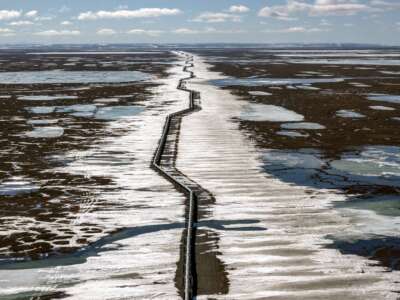
That earlier pipeline, the Rockaway Lateral, became the entry point for a much larger project: NESE. Williams first applied to federal regulators in March 2017 to build roughly 37 miles of new pipeline, including a 23.5-mile underwater segment through Raritan Bay. New York Department of Environmental Conservation cited threats to hard clam habitat, unverified sediment-loss estimates, and an unjustified burial depth that could disturb the seafloor. The 2020 denial followed a public comment period that drew more than 16,000 responses. “We thought we beat it,” Fraczek said. “It was sort of a closed book at that time.”
The Reversal
In 2025, the project came roaring back. Following a stop-work order the Trump administration placed on New York’s Empire Wind offshore project, Gov. Kathy Hochul entered private negotiations with the White House. Within days, the administration publicly claimed Hochul had agreed to advance gas pipelines including NESE in exchange for allowing Empire Wind to proceed, a characterization Hochul disputed. In November 2025, her Department of Environmental Conservation (DEC) reversed course, granting Transco, the Williams subsidiary behind the project, a conditional water quality certification.
The reversal rested on a striking detail: Transco’s revised application corrected what it called a math error in its original hard clam density estimate, from 69.6 clams per square foot down to 3.7, a nearly twentyfold reduction that made the project’s ecological footprint appear dramatically smaller. Transco also revised its sediment-loss projections and offered new justification for burying the pipeline four feet below the seabed rather than the traditional six.
The decision carried an added layer of scrutiny: Hochul’s husband left his role as General Counsel at Delaware North in 2023 to join Davis Polk & Wardwell, a major corporate law firm, where he now earns between $850,000 and $950,000 annually advising clients on government investigations.
Suzanne Mattei, an attorney and former DEC regional director, has authored three reports on the pipeline’s finances since 2019: False Demand: The Case Against the Williams Fracked Gas Pipeline (2019), Proposed NESE Gas Pipeline in New York: A Bad Bargain For Ratepayers and Taxpayers (2020), and The Williams NESE Gas Pipeline is Not Better the Second Time Around (2025). She said the timing of the reversal raised its own questions.
Williams initially justified the pipeline’s urgency by pointing to Winter Storm Elliott, which struck the Northeast in December 2022. But according to Mattei’s research, the storm’s disruptions stemmed from existing infrastructure that hadn’t been properly winterized, not insufficient pipeline capacity. Texas, which endured the same storm after a catastrophic grid failure during Winter Storm Uri the year prior, fared significantly better in Elliott, she said, “because they learned the lesson and weatherized their systems.” Building a new pipeline, she added, “is not the reason. That’s a problem that occurs one day of the year or two days out of the year. There are more targeted solutions.”
It wasn’t the first time Williams’ stated justification for the pipeline didn’t hold up to scrutiny. In her original 2019 report, Mattei found that Williams had claimed the pipeline was needed to support a wave of building boilers converting from oil to gas under city law. Using New York City’s own public boiler registration database, she found that most of the affected boilers had already converted, with or without the pipeline. In the three years before her report, Williams had added more than twice the boiler-conversion capacity it had projected the pipeline would be needed for.
A Legal Defeat
On August 21, 2026, the U.S. Court of Appeals for the Second Circuit denied a petition brought by Earthjustice on behalf of Raritan Baykeeper, Food & Water Watch, Sierra Club, Surfrider Foundation, and the Natural Resources Defense Council, seeking to overturn the certification. The court found that NYSDEC had adequately explained its reversal and that its decision was not “arbitrary and capricious,” a highly deferential legal standard that does not require an agency to justify a reversal with more evidence than it needed to adopt the original position.
“We’re still reviewing the opinion,” said Saylor Pochan of Surfrider Foundation, a Rockaway resident. That review became more complicated days later: On September 8, the Third Circuit Court of Appeals vacated New Jersey’s water quality approval for the project, ruling the state’s Department of Environmental Protection had unjustifiably reversed its own prior rejections. One challenge remains active, in the D.C. Circuit, over FERC’s reissuance of Transco’s previously vacated certificate.
Williams had a groundbreaking ceremony at Floyd Bennett Field in April 2026, months before the ruling, but as of July, actual digging had yet to begin, according to Clean Ocean Action, which filed suit to block the project’s New Jersey permit.
Who Actually Profits
The pipeline’s economics reveal who benefits from its construction, and it isn’t the ratepayers who will fund it. According to Mattei, National Grid does not profit from selling gas itself; regulators require gas to move through the system “at cost.” Instead, the utility earns money by building infrastructure, receiving a guaranteed rate of return at roughly 14 percent on construction costs, Mattei estimates.
That structure helps explain why National Grid kept pushing the project after three formal denials. “They only get paid if they build more infrastructure,” Fraczek said, describing National Grid’s practice of constructing “anticipatory infrastructure” in expectation of the pipeline’s eventual approval. The utility holds a monopoly on gas service across Brooklyn, Staten Island, and Long Island, turning residents into what regulators call “captive ratepayers,” customers with no ability to shop for a competitor.
Even the pipeline’s promised job creation doesn’t hold up: Only about 9 percent of construction jobs would be based in New York, with most occurring underwater or across state lines, and even the New York-based jobs would only be temporary ones.
Advocates have also raised concerns the pipeline may ultimately serve data center and AI expansion, though Williams cites National Grid’s residential customers as its purpose. Separately, Williams has struck major deals in other states funding data center infrastructure through partners including Blackstone, Apollo, and KKR, raising questions about the company’s broader priorities even as Rockaway families shoulder the cost of this pipeline.
According to the Natural Resources Defense Council, the pipeline will trigger a projected rate increase of at least 3.5 percent on the average National Grid customer bill, with total billing impacts projected to reach $3.2 billion over 15 years. Forty-two percent of New Yorkers have already fallen behind on utility bills in the past five years.
The Human and Environmental Cost
The health risks extend beyond construction. Methane, the primary component of natural gas, is roughly 86 times more potent than carbon dioxide as a greenhouse gas over a 20-year period. Communities near National Grid’s existing and proposed peaker plants, including the South Bronx, Brownsville, and Astoria, already report elevated rates of childhood asthma, a pattern Fraczek said the pipeline would deepen. “That’s where a lot of this gas is getting burned,” she said, “and that’s what is affecting the health of the people in targeted communities.”
There’s also a health cost hidden inside people’s own homes. Mattei’s research points to growing evidence that burning gas indoors, in stoves without any pollution control equipment, releases contaminants, including benzene, throughout a household, a particular risk for infants. “Their indoor air quality will improve tremendously if they switch,” she said.
Construction itself poses a distinct ecological threat. New York Harbor, once considered a “dead zone” for most of the twentieth century, has recovered significantly since the Clean Water Act of 1972, as seen in the current existence of whale-watching tours off the Rockaway coast. Trenching the harbor floor risks disturbing sediment that has spent decades settling, along with legacy industrial contamination.
Cleaner Alternatives Already Exist
Advocates argue New York doesn’t need a new pipeline to meet winter demand. Cold-weather heat pump technology has advanced considerably, including a federally funded testing program that developed effective cold-climate heat pumps in states like Alaska, Maine, and Michigan. Modern cold-climate heat pumps extract heat from outdoor air and can operate efficiently even below -13°F. The federally funded Cold Climate Heat Pump Challenge tested this in Alaska, Maine, and Michigan specifically to prove the technology could handle harsh winters. Paired with efficiency upgrades and demand management, they can meaningfully reduce reliance on gas fired at peak capacity like NESE.
Demand management programs, targeting the small number of annual peak-demand hours, offer another path, alongside continued investment in solar and battery storage.
What Comes Next
The fight to protect coastlines from pipelines is not isolated to NESE. Williams is simultaneously reviving the Constitution Pipeline, a 125-mile project through Pennsylvania and upstate New York that FERC approved in 2014, only for the company to abandon it in 2020 and see its approval vacated by the same Second Circuit that just ruled against NESE’s opponents. In August 2026, FERC released a new environmental assessment finding the revived project would not significantly affect the environment, clearing a path toward construction as early as this fall.
Advocates remain focused on the remaining legal challenges and public pressure, including Sane Energy Project’s monthly “Energy 101” teach-ins and walking tours.
“Everybody loves having access to the waterfront, and everybody hates this pipeline.”
What unites the opposition, Fraczek said, cuts across the peninsula’s political divides. “Everybody loves having access to the waterfront, and everybody hates this pipeline,” she said. “That is some of the touch point where you can meet the neighbors.” Whatever their differences, she added, everyone shares an experience of climate vulnerability living so close to the water. “No matter if you’re from Neponsit or Far Rockaway, you are the front line of climate change, and everybody knows that.”
None of this is contained to one stretch of coastline. From the Rockaways to Pennsylvania, the same company is reviving projects communities already fought and defeated. The real question isn’t whether one pipeline can be stopped, it’s whether the public’s right to say no still means anything.
25 Years of Truthout: An important fundraising appeal
This September, Truthout is celebrating 25 years of publication. For over two decades, we have been a trusted source for fiercely independent journalism thanks to readers like you.
As we look to the next 25 years, we have launched a special fundraising campaign. Looking to a sustainable future for our publication, we have a fundraising goal of $100,000 in the next 10 days.
We are asking for your support at this juncture because we face greater threats than ever before in our organizational history. Trump and his MAGA allies are determined to control the information ecosystem, and movement-based organizations are subject to dangerous censorship and scrutiny.
If you can support Truthout with a one-time or monthly donation, you will make a significant impact on our work and our legacy. Anything you can do makes a difference!





+ There are no comments
Add yours