






| Updated:
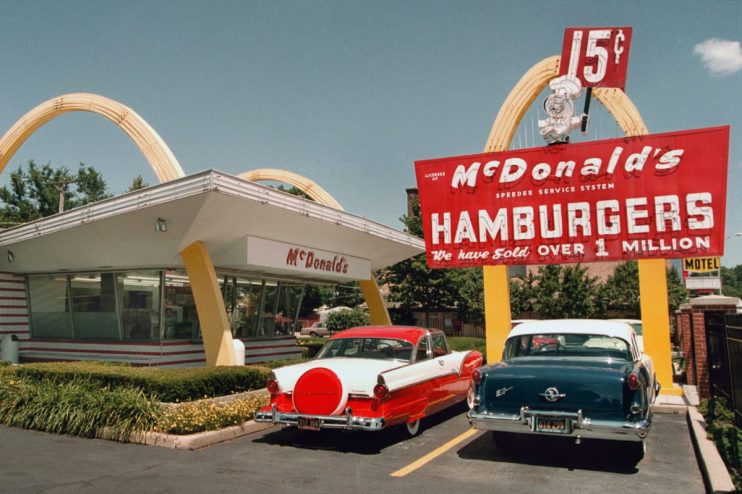
On this day in 1940, Mac and Dick McDonald opened a strange octagonal kitchen in San Bernardino and changed food forever, writes Eliot Wilson
Perspective is everything. On today’s date 86 years ago, in 1940, Winston Churchill was tackling his fifth full day as Prime Minister of the United Kingdom. The Dutch armed forces surrendered that day to Hitler’s forces, while German Army Group A smashed a French counter-attack at Sedan, leaving the route to the English Channel open. Within five weeks, France would have fallen and Britain would have pulled off the heroic retreat from Dunkirk.
The world looked very different 5,500 miles away in San Bernardino, California. What had been a town of 6,000 at the turn of the century was now a city with a population of nearly 44,000 and a thriving citrus fruit industry. The dustbowls of the Depression had brought migrant labour from Oklahoma and Arkansas and the annual National Orange Show Festival showed off the region’s produce.
Maurice McDonald, 37, and his younger brother Richard, 31, had been born in Manchester, New Hampshire, to Irish Catholic immigrant parents. The family had moved west in the late 1920s, and the brothers were restlessly ambitious. But these were hard times after the Wall Street Crash of October 1929: in the three years that followed, the stock market lost 90 per cent of its pre-crash value; in June 1930, against the advice of many economists but under duress from his own Republican Party, President Herbert Hoover signed into law the Smoot-Hawley Tariff Act which, crudely attempting to protect American industry, exacerbated the country’s financial difficulties.
Car-hops and kerbside service
Mac and Dick McDonald had first tried their hand in the film industry. After working as stagehands in Hollywood studios, they opened a cinema in Glendale but in four long years never managed to break even. But they remained sharp-eyed, always looking for new entry-level business opportunities, and in 1937 they saw potential in the burgeoning number of drive-through restaurants springing up across California.
As early as the 1920s, some outlets on the East Coast experimented with a kerbside service, waitresses delivering sandwiches and drinks to customers who chose to park outside the restaurant and eat in their own space. When it reached California, the idea was flipped: instead of a niche service for those who wanted or needed it, some restaurants made kerb service the core of their offering. Full-time car-hops shouldered the burden of taking orders and delivering food, and owners realised the degree to which this was efficient and therefore cheap and therefore productive.
In 1937 the McDonald brothers opened a small drive-through hot dog stand near Santa Anita Park in Arcadia, California’s first formally established racecourse when it opened on Christmas Day 1934. As well as cooking the hot dogs and mixing the milkshakes, Mac and Dick looked after the customers seated at a dozen canopy-covered stools; at the same time, three car-hops would take and fulfil orders from patrons parked outside. The concept was simply: reduce costs and overheads, and turn a bigger profit.
The innovation of the McDonald brothers
The ability to innovate is important but true success requires it to be married to the ability to develop and expand. The drive-in at Santa Anita Park was a stepping stone, a proving ground. Three years later – 10 weeks after fan favourite thoroughbred Seabiscuit won his last race, the Santa Anita Handicap, before retirement – Mac and Dick moved on to a new site at 1398 North E Street and West 14th Street in San Bernardino.
McDonald’s Barbecue Restaurant, opened on this day in 1940, was unprepossessing. Just 600 square feet, it was octagonal, and there was no seating inside but a number of stools ran the length of the side counter outside. That, in a way, spoke to its purpose: customers parked in the lot, ate their food and then went on their way. It was not a leisurely experience to be savoured. The menu featured 25 items, with beef and pork sandwiches and ribs cooked over hickory chips, and 20 car-hops attended to what quickly became a powerful drumbeat of trade.
The drive-in became a popular destination for a demographic which had barely even been definitively labelled at that stage: teenagers. On weekends there could be 125 cars packed into the McDonald’s lot, and Mac and Dick were splitting profits of $50,000 a year (around $1.1m today). They were financially on a par with San Bernardino’s plutocracy: the Guthries who owned The San Bernardino Sun, Cleo and Leo Stater, of Stater Bros. Markets, the German-American Harris family and its chain of department stores.
Dick McDonald would later say, “Our whole concept was based on speed, lower prices and volume. Guy comes in, you ask him what he wants on his burgers; he says, ‘I got to go back to the car to ask my wife’. Wouldn’t work.”
Streamlining the McDonald’s product
They were still refining their business model. In 1948, the restaurant closed for three months, and when it reopened, it had become the distilled essence of the fast food revolution. The “Speedee Service System” dispensed with the bell-hops, cut the 25-item menu to nine and exchanged silverware and crockery for paper plates and cups. It ruthlessly prioritised profit: when receipts showed that 80 per cent of the turnover came from hamburgers, they became the star attraction and the barbecue sandwiches were sidelined.
Today in 1940, the fast food revolution had not yet reached its zenith, as it would after 1948 with mechanised kitchens and sandwiches broken down to satisfyingly straightforward components. The fortunes and global dominance of McDonald’s were forged when they began selling franchises and Ray Kroc joined as President in 1955 before buying out the McDonald brothers in 1961.
Opening the San Bernardino branch was a major step. For the first time, Mac and Dick put deep thought into the way in which fast food was delivered. It worked. There are now 45,000 restaurants around the world, 150,000 employees and annual revenue of $27bn. That journey began in a tiny, strange octagonal drive-in restaurant in southern California 86 years ago.
Eliot Wilson is a writer and historian. He is a senior fellow for national security at the Coalition for Global Prosperity and a contributing editor at Defence on the Brink.







+ There are no comments
Add yours