



Truthout is an indispensable resource for activists, movement leaders and workers everywhere. Please make this work possible with a quick donation.
The prominent journalist Abed Abu Shehadeh, a Palestinian citizen of Israel, has been released from Israeli custody after five days in detention. He was arrested on Wednesday by armed police and Shin Bet agents who conducted a nighttime raid on his home in the Israeli city of Jaffa. Abu Shehadeh’s detention was related to his reporting on the October 27 Israeli election and the role of Palestinian political parties. Ahead of the election, he interviewed Azmi Bishara, a Palestinian intellectual and former member of the Israeli Knesset who has lived in exile in Qatar since fleeing Israel amid allegations that he aided Hezbollah during the 2006 Lebanon war. Israeli authorities detained Abu Shehadeh on suspicion of “contacting a foreign agent,” in connection to his interview with Bishara.
“Men with ski masks knock on your door at 11 at night. They tell you that they have an arrest warrant. They raid the house. They wake your wife, your children,” says Shehadeh. “It tells how messianic and dangerous the extreme right in Israel has become, willing to use this unprecedented power against journalists.”
TRANSCRIPT
This is a rush transcript. Copy may not be in its final form.
AMY GOODMAN: This is Democracy Now!, democracynow.org. I’m Amy Goodman, with Juan González.
The prominent Palestinian journalist Abed Abu Shehadeh has been released from Israeli custody after five days in detention. He was arrested last Wednesday when armed police and Shin Bet agents conducted a nighttime raid on his home in the Israeli city of Jaffa. His detention was related to his reporting on the Israeli elections and the role of Palestinian political parties. Ahead of the October 27th election, Abu Shehadeh traveled to Qatar, where he interviewed Azmi Bishara, a prominent Palestinian intellectual, former member of the Israeli Knesset. Israeli authorities detained Abu Shehadeh on suspicion of, quote, “contacting a foreign agent,” unquote, in connection with that interview. Azmi Bishara has lived in exile in Doha since being accused of aiding Hezbollah during the 2006 Lebanon war.
The legal rights organization Adalah, which represents Palestinian citizens of Israel, said, quote, “The message to Palestinian citizens is unmistakable: a public conversation with a political figure can land you in a cell. This is political persecution carried out through criminal law,” they said.
Abed Abu Shehadeh hosts the Arabic-language podcast Al-Midan and writes for several publications, including +972 Magazine. He recently came here to New York to speak at an event hosted by Jewish Currents.
We thank you so much for being with us as you join us from Yaffa, from Jaffa. If you can start off by saying what happened? Describe what happened to you. It was after also you got back from New York from this Jewish Currents conference.
ABED ABU SHEHADEH: Yes. So, first of all, thank you for having me, Amy. And before I start, if I may, I want to say two things. The first thing is, and this is the slogan that I’ve been using for the past several weeks: We can’t be afraid, and we have to be brave. And I think we’re living in historical times, and we need brave people to be strong and not be afraid, because they want us afraid and alone and individualistic as possible. And I think to counter this, we have to work together.
And the other thing is, I have to thank my friends, international friends, American friends, U.S. congressmen, who sent letters asking for my release. And I’m truly humbled. And I think it’s a good opportunity to talk about broad coalition of democrats around the world who believe and understand how important it is to work together. And I really, really, really appreciate this. And I think we should use this momentum, because I do feel that we are living in times of change.
Concerning my arrest, it’s as you could imagine. Armed men with ski masks knock on your door at 11 at night. They tell you that they have an arrest warrant. They raid the house. They wake your wife, your children. My son is a a year and a half. He woke up seeing skied — seeing armed men with ski masks in our living room. Luckily, my daughter was — she’s a deep sleeper. And I think this is just absolutely crazy. And I think it tells how messianic and dangerous the extreme right in Israel has become, willing to use this unprecedented power against journalists.
And what’s even more interesting, even though I did everything they asked — I didn’t resist arrest. As soon as they asked for my journalist equipment, my camera, my microphone, my laptop, my notebook, I cooperated. And then you understand that they didn’t even recognize me, and they weren’t willing to accept the fact that I was a journalist, even though I’ve been working in this occupation for the past eight years. I have hundreds of articles, more than 250 podcasts that I have conducted through my Al-Midan podcast at Arab48. And it just shows that they’re trying to build new systems of oppression. And I think to counter this, we have to think of new coalitions and not be afraid.
JUAN GONZÁLEZ: And, Abed, I wanted to ask you: In terms of the impact of these election results, especially the growing strength of the Palestinian parties, the Joint List and Ra’am, in terms of their growth in seats, what’s been the — what’s been the effect on the extreme right in Israel?
ABED ABU SHEHADEH: I think what the Palestinian citizens of Israel saw in the past three years made them understand how important it is for us, for them, to utilize all our legal powers to confront the extreme right in Israel and how messianic it is.
And just to understand the numbers, for the audience who don’t know the specific details, up until the last election, the Palestinian citizens and the Palestinian Arab parties in Israel, they had 10 seats in the Knesset. After the last election, it went up to 19. Now, this is important, because it stopped Netanyahu from reaching the 61 mandate he needs to stay in power. Now, if you take the Palestinian citizens out of the equation, out of the 120 seats in parliament, Netanyahu has the majority. He has 52, 52 or 53, seats, mandates, and the opposition has 50 — 48. And it’s for the first time that Netanyahu not only loses in the election, he loses because the Palestinian citizens of Israel.
And it’s a direct outcome from what we’ve been through in the past three years. We know the Hebrew language very well. We know the Israeli political culture very well. And we saw the genocide, and we understood the language of the genocide. And we understood that, unfortunately, the international — the international world order wasn’t able to stop Israel from doing what it did, even though there were millions in the streets in different continents around the world. And it made us take our citizenship very serious. And we went to the polls. And from 54% Arab voters turnout in 2022, last election it was almost 80%. This is like international. This is like very high numbers.
And it made the extreme right in Israel and Netanyahu’s camp be very afraid. And what we’re seeing now, that they’re using extreme measures to stay in power. One of them is what led to my arrest, but not only that. They’re using intimidation tactics. They’re trying to get us scared and afraid and isolated. And I think we should see it as a sign of weakness, not a sign of strength, and the power that the Palestinian citizens in Israel have in order to lead for a change.
JUAN GONZÁLEZ: And what do you sense from your reporting now will occur as Gadi Eisenkot tries to form a governing coalition? What are the debates and discussions among the Palestinian Arab groups in terms of this potential new government, which is still a right-wing government?
ABED ABU SHEHADEH: Yes. So, I’m going to say two things about this. The first, there is a vibrant discussion concerning whether Arab Palestinian parties should join the coalition or not. My views on this is we can’t and we shouldn’t join any coalition as long as there is a genocide in Gaza, the occupation, what’s happening in Jerusalem and Masjid al-Aqsa, because as soon as you’re part of the coalition, you bear responsibility. This is the first thing that you have to sign up in the coalition: You are responsible of what this government does.
But there are other options. And in politics, there is bad, and there is worse. What we’re seeing in the extreme right in Israel is absolutely messianic. It’s like people talking about the destruction of Masjid al-Aqsa, talking about using unprecedented power, endless wars, transfer of people, destruction, building settlements even next to Palestinian towns inside of Israel. The idea of transferring people has turned into a mainstream discussion in Israel. So, as responsible people, you have to take into consideration there is bad, and there is worse.
And even though Gadi Eisenkot is not our cup of tea, is not someone we agree with — we understand, we know his background — but we have to look at it as a package. Who are the people with Gadi Eisenkot? Who are the people with Netanyahu? And sometimes you have to take the difficult, difficult decision, which means — and for me, it’s very important to highlight this — not joining the political coalition, utilizing your power, your parliamentary power, in order to start a change that maybe eventually would give us space to breathe, stop the ethnic cleansing in the West Bank, and maybe, and maybe, maybe in the future, we can go back talking about peace and reconciliation, something I believe in as a father who wants his kids neither to kill or to die, and want them to live on this land without having to hurt anyone and without having to be hurt themselves.
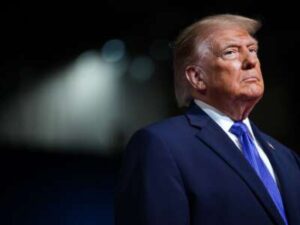
AMY GOODMAN: I wanted to ask you, Abed — you were just here in New York. In a letter written by newly elected Jewish Democratic Congressmembers Brad Lander, Daniel Biss and Scott Wiener, they wrote to Israel’s ambassador to the U.S., saying, “Mr. Abu Shehadeh’s arrest came amid reported efforts by senior Israeli officials to cast doubt on the participation of Palestinian citizens in Israel’s recent general election.” And, of course, they were objecting to what happened to you. But also, I wanted to, most importantly, ask: At this point, with this blue wave and a new generation of congressmembers and senators coming in, to the point where you had President Trump on Election Day responding to Dr. El-Sayed by saying the U.S. will cut off all aid to Israel, $4 billion, by the end of the year, that it should be used in the United States, not given to Israel, what your message is to the U.S. Congress and how important is it in what’s going on in Israel and the Occupied Territories?
ABED ABU SHEHADEH: Allow me, Amy, just to thank U.S. congressmen for the letter. I think this is important, and I think especially U.S. congressmen as being the leading power in the world. And I truly believe that many of them, especially from the Democrats, truly believe in democracy, truly believe in equality.
I think they have also responsibility not only for the U.S. They have responsibility for the world and leading new ideas in this craziness that we’re living in, in these crazy ideas of AI dystopias and what writer Naomi Klein described as anti-fascism, when you’re seeing big corporations pushing really crazy ideas. I think to counter this, they have the responsibility of leading global coalitions pushing ideas of a better future.
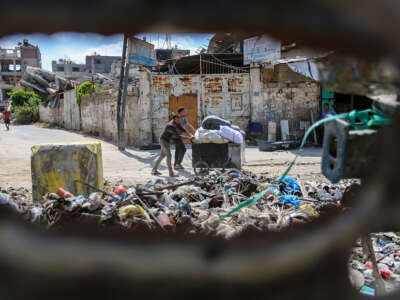
And the connection between Israel and the United States should come with also clear and brave terms that puts equality and puts democracy and puts the end of an occupation and the end of genocide as a strong pillar for this, for this connection, and to understand that Israel can’t do what it does without the American support. And at the end of the day, I truly believe this is the best obstacle — the best path for the two people who live here. At the end of the day, there are Palestinians, and there are Israelis. And we need new ideas that say and give hope for both people, because we need to understand that there is children, and there is working-class people, and there are people right now in Gaza who are paying the price of the destruction of the infrastructure in Gaza, who are drowning under the winters, and there’s people being ethnically cleansed in the West Bank.
And people should be held accountable for what’s done, but we do need new ideas and new hope. And I really, really believe that this is the way forward. And I really hope that newly elected congressmen, congresswomen, obviously, could also be part of this movement and even bringing new ideas to it.
AMY GOODMAN: Abed Abu Shehadeh, we want to thank you so much for being with us, journalist, community organizer, just released after five days in Israeli detention.
Coming up, we’ll speak with the winner of one of the midterms’ most expensive House races, Democratic Congressmember-elect Will Lawrence of Lansing, Michigan, co-founder of the Sunrise Movement. He’s in Washington for orientation. Back in 20 seconds.
[break]
AMY GOODMAN: Zeshan B performing “A Change Is Gonna Come” at Democracy Now!
An important fundraising appeal: 9 Days to raise $50,000
Donations are down for Truthout at a time when media is under immense pressure. Google’s AI search has driven our traffic down by 15 percent, Trump is arresting journalists, and many independent media organizations face heartbreaking cutbacks and closures.
At the same time, movement media is vital in the fight against Trump’s authoritarian reign. Our mandate to tell the truth, share strategies for resistance, and speak against fascism is ever more urgent in this deluge of political censorship and misinformation. Yet, we are struggling to meet our publishing costs when our work is so urgently needed.
We are fundraising right now for those basic operating expenses — we need $50,000 in the next 9 days. If you can support Truthout with a one-time or monthly donation, you will make a significant impact on our work. Anything you can do makes a difference.

+ There are no comments
Add yours