





Part of the Series
Struggle and Solidarity: Writing Toward Palestinian Liberation
Truthout is a vital news source and a living history of political struggle. If you think our work is valuable, support us with a donation of any size.
This week a judge dismissed all the charges brought against a group of Stanford students for occupying the university president’s office in June 2024 to protest Stanford’s complicity in Israel’s genocide in Gaza. The judge also reduced the amount of restitution to roughly $52,000 total, which ended up being paid by an anonymous source.
The September 21 decision came down despite the strenuous efforts of Stanford University and the Office of the District Attorney of Santa Clara County, California.
The charges against the Stanford protesters were the most severe of any imposed on pro-Palestine student activists in the United States. Their dismissal is a cause for celebration, but it also gives us an opportunity to better understand how universities attempt to suppress activism for Palestine.
Students Charged at Stanford
The students took over the office of Stanford University President Richard Saller after the university refused to act according to its own standards for ethical investments — it was not a sudden, impetuous act.
There were three different protests for Palestine at Stanford that took place between October 2023 and June 2024. Shortly after October 7, 2023, a group of students took over White Plaza, an outdoor campus space designated as a free speech zone. When I visited at the start of the protest, they had set up three large tents and some tables, and dug in. They called the encampment the Sit-In to Stop Genocide, and they used the space they had claimed to hold public events, speeches, and rallies. They stayed there 24/7, even over the winter break. As the encampment grew exponentially, students created communications networks and mutual support with the greater Palo Alto community.
At one point, university administrators told participants in the sit-in to bring the action to an end, but within four hours, a huge crowd of community members formed a circle around the encampment to defend it. Students sat on pieces of cardboard to do assignments on their laptops, shared food, and danced overnight. When university administrators indicated that they would begin talks with the student activists, the sit-in ended. The university removed the tents and all materials in February 2024.
A report by the Stanford Muslim, Arab, and Palestinian Communities Committee recounts how, months later, in April 2024, dismayed by the lack of progress in the negotiations, “a group of pro-Palestinian students organized a rally that then resulted in a second sit-in known as the People’s University for Palestine.”
The rally drew a huge crowd that marched through the campus.
Afterward, protesters turned the grassy space into “People’s University” — an encampment that held classes, hosted speakers, showed films, and organized morning breakfasts and evening prayers.
When talks with the university completely broke down in late May, a group (including those who are now known as the “Stanford 11”) took over the university president’s office. This occupation was short-lived: Within hours, the police had broken into the building and hauled the protesters to jail.
This is when Stanford, one of the wealthiest universities in the world, went into high gear. It tore down the encampment and started disciplinary proceedings. Stanford went so far as to initially push for the prosecution of a Stanford Daily reporter who was in the building to report on the event. As the Columbia Journalism Review noted, “Even as the case languished for months, Stanford wanted prosecutors to pursue it.”
Disciplinary hearings began. Students lost housing and were removed from campus. Eventually, District Attorney Jeff Rosen charged them with felonies and conspiracy. At their trial, which I attended, the district attorney’s office repeatedly claimed that the Stanford 11 had “f***ed it up” for the peaceful protesters, who were civilly obedient.
Before and during the protests, Stanford students had followed the required steps and passed divestment resolutions asking that Stanford follow its own policy on investments, which states:
The Trustees recognize that many issues of broad social and political concern raised by members of the University community are worthy of debate and study. Consistent with the University’s educational mission and its commitment to academic freedom, facilitating campus programs and processes by which these issues can be discussed and thoughtfully debated within the campus community is the most appropriate channel for most broad social and political issues to be addressed in the University context.
The Trustees recognize that very rare occasions may arise when companies’ actions or inactions are so abhorrent and ethically unjustifiable as to warrant the University’s dissociation from those investments. Such activities include apartheid, genocide, human trafficking, slavery, and violations of child labor laws. These instances may be reviewed on a case-by-case basis and must meet the very high bar articulated above.
In April 2024, both the undergraduate and graduate wings of student government at Stanford issued a statement on divestment that passed by 73 percent and 75 percent, respectively, of voters. With that backing from the combined student body, on May 6, Students for Justice in Palestine petitioned Stanford’s Board of Trustees.
Despite the explicit language regarding apartheid and genocide in Stanford’s policy on investment, the response to the students’ petition was met with corporate-speak that completely skirted the issue. The Board of Trustees refused to “discuss and thoughtfully debate.” Its official statement — entitled “Trustees’ committee declines to take action on divestment request” — simply lays out its reasoning. It states that its decision “aligns with” its similar rejection of students’ 2015 divestment proposal, completely sidestepping the historical reality of the 2023 genocide.
It refuses to acknowledge that the consensus of the international human rights community — including organizations such as Amnesty International, Human Rights Watch, and the United Nations special rapporteur on the occupied Palestinian territories — is that Israel is an apartheid state.
Meanwhile, the International Court of Justice (ICJ) has declared that Palestinians have a right to protection from acts of genocide. According to UN News, the ICJ “has called on Israel to ‘take all measures within its power’ to prevent such actions and allow the entry of desperately needed humanitarian aid into the war-shattered enclave.”
The ICJ also determined that all states “are also under an obligation not to render aid or assistance in maintaining the situation created by Israel’s illegal presence in the Occupied Palestinian Territory.” “Aid and assistance” include being involved in any business transactions that normalize the occupation.
Specifically relevant to the issue of divestment, Francesca Albanese, the UN’s special rapporteur on the situation of human rights in the Palestinian territories occupied since 1967, has issued a damning critique detailing how businesses reaped huge profits off the genocide. This confirmed the students’ charges that universities have been placing greed above ethics.
In her July 2025 report, Albanese writes:
In the past 21 months, while Israel’s genocide has devastated Palestinian lives and landscapes, the Tel Aviv stock exchange soared by 213 percent (USD), amassing $225.7 billion in market gains — including $67.8 billion in the past month alone. For some, genocide is profitable.
The Office of the UN High Commissioner on Human Rights noted:
Albanese found that these entities have failed their most basic legal responsibilities to exercise their leverage to bring an end to the violation at stake or terminate relations and disengage. Instead, they have treated Israel’s illegal enterprise in the occupied Palestinian territory as ordinary economic activity — wilfully ignoring documented, systemic abuses, even as atrocities mounted after 7 October 2023.
And even if Stanford’s trustees want to ignore apartheid and genocide, a simple financial calculation would remind them that investing in Israel is a dangerous business proposition.
Stanford’s complicity took many forms, including filing wildly varying claims for property damage (including damage to a door and doorframe, repairs to a grandfather clock, and addressing stains from fake blood) — from $10,000 to $700,000. This off-scale prosecution should be seen in the context of prior disciplinary actions — when we do this, we see exactly how ardently Stanford wished to appear tough on antisemitism.
Compare this punishment and prosecution to the last time the university president’s office was occupied by protesters in 1989. That takeover had to do with Stanford’s handling of racist incidents on campus and the lack of education on race and ethnicity. Hundreds of supporters passed food and water through windows and prevented police cars from reaching the building. The result: Stanford required those arrested to perform community service. Ironically, at the very same moment police were handcuffing and hustling student activists to jail, just a block away, at Stanford’s main library, there was an exhibition memorializing that 1989 takeover of the president’s office.
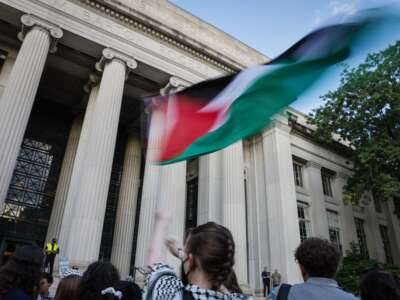
Another example: In January 2015, on MLK Day, more than 100 took over one of the main arteries of the San Francisco Bay Area — the San Mateo-Hayward Bridge (here is one of their memories of that moment). Sixty-eight of them were arrested. One subset of students unfurled a massive Palestinian flag, a moment captured by TV cameras aboard helicopters. Students who were involved told me that after this action, Stanford again simply asked that the students take a class on civil protests and do community service.
Stanford’s ardor in prosecuting the Stanford 11 can thus reasonably be attributed to the atmosphere created by Joe Biden, Donald Trump, and Congress’s intense repression of student protests for Palestine, and other acts of retribution, including the cutting of federal funds. However, all that energy came to naught.
In February 2026, the jury came back with a verdict: Its members could not reach the unanimity required — it was a hung jury on both counts. Rosen immediately declared he would retry the case. But shortly after, it was reported that he had been using the prosecution of the Stanford students for property damage as a platform to campaign for office under the banner of being tough on antisemitism. According to Bolts magazine:
Back in February, Bolts was the first to report that Rosen was using his personal campaign website to showcase the Stanford prosecutions as an example of “fighting antisemitism.” Upon learning this, Santa Clara public defender Avi Singh, who represents [undergraduate student German] Gonzalez, filed a motion to recuse the DA’s office from retrying the protesters, which in the process uncovered further evidence of Rosen using the ongoing prosecutions to fundraise for his reelection.
Santa Clara County Superior Court Judge Kelley Paul demanded that his entire office be prevented from prosecuting the case. According to Palo Alto Online, “While Paul reaffirmed Rosen’s right to free speech and noted passion for fighting antisemitism, she said ‘caution and care’ must be taken when using active litigation for fundraising purposes.”
The case then rested with California Attorney General Rob Bonta, who finally dismissed the charges.
The prosecution of the Stanford 11 was not an aberration, but rather completely consistent with Stanford’s treatment of those who protest a genocide. It also is reflective of the systemic corruption at our universities.
The Stanford 11 paid an enormous cost — nothing can restore the time, energy, education, prospects for employment, and the physical and mental health they lost, nor all the sacrifices of their loved ones.
But the fight for Palestine is not over — we start the new academic year ready again to petition, rally, and protest.
25 Years of Truthout: An important fundraising appeal
This September, Truthout is celebrating 25 years of publication. For over two decades, we have been a trusted source for fiercely independent journalism thanks to readers like you.
Looking to the next 25 years, we launched a special fundraising campaign. We still need to raise $16,000.
We are asking for your support at this juncture because we face greater threats than ever before in our organizational history. Trump and his MAGA allies are determined to control the information ecosystem, and movement-based organizations are subject to dangerous censorship and scrutiny.
If you can support Truthout with a one-time or monthly donation, you will make a significant impact on our work and our legacy. Anything you can do makes a difference!



+ There are no comments
Add yours