





Honest, paywall-free news is rare. Please support our boldly independent journalism with a donation of any size.
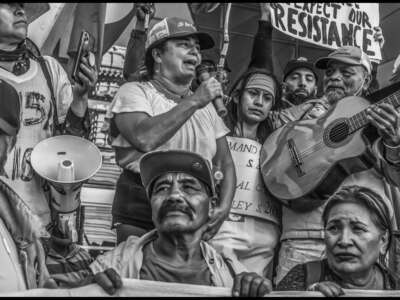
Immigrant rights and labor icon Dolores Huerta died Wednesday at the age of 96. Huerta co-founded the National Farm Workers Association in 1962 and then the United Farm Workers of America, working with Cesar Chavez. From 1965 to 1970, the union organized the historic Delano grape strike, which ended in major gains for farmworkers’ labor rights.
In the years that followed, Huerta became heavily involved in the women’s liberation and immigrant rights movements and became a major supporter of the Democratic Party. In March, The New York Times published an investigation into Cesar Chavez’s history of sexual abuse of women and girls in the farmworkers’ movement, prompting Huerta to reveal that she, too, had been raped by Chavez. Huerta said the assaults led to the births of two of her children.
Dolores Huerta appeared on Democracy Now! many times over the years. We remember her legacy with Pulitzer Prize-winning journalist Maria Hinojosa, who says, “Dolores was not only a labor organizer, a civil rights organizer, a feminist, committed, always optimistic about the possibilities of this country, but she loved life, and I want people to remember that.”
TRANSCRIPT
This is a rush transcript. Copy may not be in its final form.
AMY GOODMAN: This is Democracy Now!, democracynow.org, The War and Peace Report. I’m Amy Goodman.
The legendary labor organizer, feminist and civil rights activist Dolores Huerta has died at the age of 96. She was co-founder of the National Farm Workers Association in 1962 and then the United Farm Workers of America. She worked with Cesar Chavez at both groups. The United Farm Workers grew out of a merger between the National Farm Workers Association and the Filipino-led Agricultural Workers Organizing Committee.
Dolores Huerta coined the phrase ”¡Sí se puede!,” “Yes, we can!” It became a rallying cry for farmworkers, a lasting slogan for social justice movements.
Dolores Huerta appeared on Democracy Now! many times. We’ll hear her in her own words later in the broadcast, but first let’s turn to the trailer of the 2017 documentary Dolores, which featured interviews with Angela Davis, Gloria Steinem, Hillary Clinton and Nancy Pelosi.
SPEAKER NANCY PELOSI: Dolores is an icon.
CURTIS ACOSTA: She’s a civil rights hero.
CESAR CHAVEZ: She’s the first general that I followed into war.
HILLARY CLINTON: She’s not afraid to speak truth to power.
ROBERT F. KENNEDY: Dolores Huerta, who is an old friend of mine.
ANGELA DAVIS: The FBI knew how dangerous Dolores was. Dolores came up with the slogan ¡Sí se puede!
SEN. BARACK OBAMA: Yes, we can.
INTERVIEWER: You were a young girl growing up in America in the ’40s. You must have had a dream.
DOLORES HUERTA: After I had seen the miserable conditions of farmworkers, Cesar Chavez said, “We have to organize a union.” You had this ambiance all around you that you could really change the world.
REPORTER: It’s, beyond question, the largest gathering on behalf of farmworkers in California history.
PROTESTER: I wish they all go back to where they came from. We have no labor trouble troubles.
UNIDENTIFIED: She wasn’t asking for permission. She just did what needed to be done.
ELISEO MEDINA: She has such a firm belief in what she’s doing —
DOLORES HUERTA: We’re never giving up.
ELISEO MEDINA: — that she infects you with it.
Dolores Huerta.
DOLORES HUERTA: Ninety thousand people were poisoned in the fields of the United States of America.
RANDY SHAW: The farmworkers founded the whole idea of environmental justice.
UNIDENTIFIED: Men were threatened by her power.
UNIDENTIFIED: She’s a very volatile individual.
UNIDENTIFIED: She’s an insult.
UNIDENTIFIED: People wanted to see her in a more traditional role.
DOLORES HUERTA: I left a couple of my children behind.
MARIA ELENA CHAVEZ: That’s part of the sacrifice that we made and that we had to make.
DOLORES HUERTA: And it still pains me when I think about it.
CURTIS ACOSTA: People in power have no idea of the true heroes of this country.
GLORIA STEINEM: I would not have been able to see what’s hidden in the fields of our country without Dolores.
CURTIS ACOSTA: We’re knee deep in sexism when it comes to why she isn’t studied and why people don’t know her.
UNIDENTIFIED: Latina girls need to see statues of you.
JUANITA CHÁVEZ: We were trying to set the record straight. I mean, women cannot be written out of history.
DOLORES HUERTA: Down with violence! ¡Abajo! Down with racism! ¡Abajo! Down with sexism! ¡Abajo!
AMY GOODMAN: The trailer to the documentary Dolores, directed by Peter Bratt.
We’re joined now by Maria Hinojosa, the Pulitzer Prize-winning journalist and founder of Futuro Media, host of Latino USA.
Maria, you have covered Dolores Huerta for decades. Just last year, you interviewed her for — after a New York Times investigation exposed the sexual abuse and rape allegations against the UFW co-founder Cesar Chavez. Dolores Huerta herself publicly disclosed that Chavez had raped her decades earlier. You talked to her about that, and we’ll talk about that later. But first, let’s talk about Dolores Huerta’s legacy. Who was Dolores Huerta, born in 1930, died at the age of 96?
MARIA HINOJOSA: She was a fighter. She also — Amy, one of the things that I love talking about is Dolores was not only a labor organizer, a civil rights organizer, a feminist, committed, always optimistic about the possibilities of this country, but she loved life. And I want people to remember that. Like, when I would be with Dolores, and it would be kind of wrapping up a night of being out doing an event, and I’d be like, “Well, I’m going to the hotel. I’m going to sleep,” she’s like, “Really? We’re going to go out. We’re going to go out and go dancing. We’re going to listen to music.” And I’m like, “What?” And she’s like — this was Dolores. And I think it’s important to remember that as much as she fought for people, the most vulnerable, she also fought to love life and to love her kids, her kids, her grandkids, her great-grandkids, great-great-grandkids, still here.
So, I don’t know. She was always so optimistic. Like, when I would ask her, “Things are looking bad,” she’s always like, “There’s always an opportunity to organize and make things better.” And I’m like, “OK, Dolores, let’s keep it like that: positive.”
AMY GOODMAN: So, let’s hear Dolores Huerta in her own words. In 2017, she came into our studio to talk about her life and the documentary that had just been named about her, Dolores. She talked about her childhood.
DOLORES HUERTA: Well, I was born in the state of New Mexico and moved to Stockton when I was 6 years old. My parents divorced, and my mother took us to Stockton. And that’s where I was raised, and that’s where I started my initial organizing, in that area.
AMY GOODMAN: And how did you, as a teenager, decide that organizing was going to be the path of your life, and specifically working with farmworkers?
DOLORES HUERTA: Well, that was kind of accidental, as where I grew up, Stockton, California, is an agricultural community. And as a youngster, I was a Girl Scout for 10 years of my life, and I was in a lot of different social clubs. But when I met Mr. Ross and he showed us what we could actually do by coming together and organizing and taking direct nonviolent action, then I was really — I thought, “Oh my goodness! This is what I want to do with my life.” And so, I became a schoolteacher, then I left teaching to go to Delano to start the union there.
AMY GOODMAN: And farmworkers themselves, the grape boycott that you helped to lead, the worker strikes, talk about how you organized them. What was the strategy? And then talk about your response to the impact that it had.
DOLORES HUERTA: Well, the thing is that when people think about the strike and the — it’s very dramatic, colorful. But what they don’t see is like the three years before the strike, where we organize workers in house meetings. And this is the method that Fred Ross taught us, by meeting in people’s homes, you know, one family at a time, and then bringing them all together. And this is the same kind of a method that we use today with my foundation, the Dolores Huerta Foundation, where we’re working on ending the school-to-prison pipeline, working on environmental issues, on economic issues and, you know, inspiring people that they — and motivating them that they have power, but that they can make the changes, but that they have to make the changes. No one can do it for them. And this is the kind of work that we do, using that same organizing method, one family at a time, one family at a time. And it’s very tedious, and it’s very time-consuming, but then the results are really wonderful.
We recently settled a lawsuit with our current high school district in California, in Bakersfield, for the expulsion and suspension of African American and Latino students. And now they have to change their policies, and they have to change their procedures, to keep the students in school. And so, we’ll go out there, and we organize the parents, and then the parents are the ones that take on the — they become the leaders of making sure that some of these policies are changed.
AMY GOODMAN: When was the grape boycott?
DOLORES HUERTA: It was in 1968. We started the boycott in 1968.
AMY GOODMAN: And explain what it was. What was the strategy you took?
DOLORES HUERTA: Well, the strategy was that we had farmworkers come out from California, and again using those same methods of meeting people in their homes and organizing groups throughout the United States and asking people to come and support, number one, to get people to picket the stores and ask people not to buy grapes. And at the end of the day, we had like 17 million people that were not eating grapes. And this is what brought the growers to the bargaining table.
AMY GOODMAN: What about Robert Kennedy’s role? How significant was it? And how did you and Cesar Chavez reach out to him?
DOLORES HUERTA: Well, Senator Kennedy had been a supporter early on. He came to California. He had a hearing right in the middle of the strike. And there’s a very dramatic moment in the movie, Dolores, where Robert Kennedy tells the sheriff of Kern County and the district attorney to read the Constitution of the United States, because they were continuously arresting us, and so that we wouldn’t be — you know, we wouldn’t be able to picket. And so, he was a great supporter. And then, of course, we helped him very much in his campaign, when he was running for the presidency, by going out there and getting people out to vote.
AMY GOODMAN: I wanted to turn to a clip of your film, Dolores.
AUDIENCE: ¡Sí se puede!
ARTURO RODRIGUEZ: ¡Sí se puede!
AUDIENCE: ¡Sí se puede!
ARTURO RODRIGUEZ: For Cesar, ”¡Sí se puede!” wasn’t just a slogan.
DOLORES HUERTA: When people in Arizona said — they told me, “No, Dolores, no se puede. You can’t do this in Arizona. Only in California,” my response to them was ”¡Sí se puede!”
¡Sí se puede! ¡Sí se puede!
MICHELLE MILLER: Hers was the rallying cry that would later come to define the presidential campaign of candidate Barack Obama.
SEN. BARACK OBAMA: Yes, we can.
ORGANIZER: Have you heard President Obama say, “Yes, we can”? It came from Cesar Chavez: ”¡Sí se puede!”
ANGELA DAVIS: Dolores Huerta came up with the slogan ”¡Sí se puede!” And we all attribute that to Cesar Chavez, even Barack Obama. Of course, when he gave her the Presidential Medal of Freedom, he had to correct himself.
PRESIDENT BARACK OBAMA: On a personal note, Dolores was very gracious when I told her I had stolen her slogan, ”¡Sí se puede! Yes, we can!” Knowing her, I’m pleased that she let me off easy, because Dolores does not play.
AMY GOODMAN: That was a clip from the documentary Dolores. So, ”¡Sí se puede!” was your phrase.
DOLORES HUERTA: Mm-hmm, yes.
AMY GOODMAN: When did you come up with it?
DOLORES HUERTA: In Arizona, actually, in 1972, when Cesar was fasting, was doing a 25-day water-only fast, kind of to take the hatred out of the hearts of the growers. That’s the way that he put it. And so, we were trying to organize people to come and to join us, and speaking to a group of professional Latinos, asking them to come and join us. And they said, “No, you can’t do this in Arizona. Only in California. No se puede. No, you can’t.” And my response to them was “Yes, we can. ¡Sí se puede!, in Arizona, the way that we organized in California.”
AMY GOODMAN: I wanted to turn to another clip of the film that’s now out in theaters around the country. This is Dolores, and the clip begins with the feminist icon Gloria Steinem.
GLORIA STEINEM: I didn’t really know Dolores before New York. But I think I was scared of her. I don’t think that Dolores thought I was worth the trouble, until I got Huntington Hartford to picket the A&P, which of course got press, because the heir to the A&P fortune was boycotting the A&P. After that, we became partners.
EMILIO HUERTA: My mother was raised a Catholic and very traditional. And prior to going to New York City, she really didn’t speak of feminism.
DOLORES HUERTA: I was in New York when the feminist movement was being born. But my mind was focused on getting all of those women at those conventions to support the farmworkers.
ANGELA DAVIS: There was a time when rarely could you discover women of color who would identify as feminists, because it was assumed to be a question simply of gender. And if it was a question simply of gender, that gender was white.
GLORIA STEINEM: When social justice movements arise in a patriarchal system, all kinds of false divisions are made.
AMY GOODMAN: So, that was Angela Davis and Gloria Steinem talking about Dolores. That’s Dolores Huerta. And the new film about her, that’s a clip. You are often seen in photographs with, oh, all your male colleagues. Can you talk about when you came to see the importance of the intersectionality of the labor movement, the women’s movement, people of color and the feminist movement?
DOLORES HUERTA: Well, in order to be able to win, through the boycott, to begin with, we had to reach out to all of the different organizations, and, otherwise, we could not win. I mean, the 17 million Americans that stopped eating grapes, you know, included all of these different organizations. And so — and I think that’s one of the messages that we have today, is that, you know, the only way that we’re going to be able to, again, counter the Trump administration is that we’ve all got to work together. You know, we’ve all got to work on the environmental issues. We’ve all got to support labor unions. We’ve got to support the immigrant rights movement, etc., and the LGBT movement also, because we can’t be in our silos and win. We’ve all got to work together. I think that’s the lesson that we have.
AMY GOODMAN: That was Dolores Huerta speaking here in our studio in 2017 as we played clips from the documentary that year, Dolores. Dolores Huerta died Wednesday at the age of 96. As she talked about supporting all the different communities, Maria Hinojosa, she actually evolved in her views on those communities, and even what she called herself.
MARIA HINOJOSA: And I think that this is one of the great lessons from Dolores Huerta, is that she was very public about the fact that she evolved. So, for example, she did not like calling herself a feminist at first. So, Gloria Steinem says, “I was afraid of Dolores.” I think Dolores was like, “Well, you’re a white feminist. I’m not sure I identify with you.” And then Dolores became a feminist icon and spoke about her feminism, which was really important for so many Latinas in this country and around Latin America.
Dolores, on the question of reproductive rights, was at first distant. The question of abortion was not her issue. And then she evolved, and she became a huge supporter of reproductive rights and the struggle for reproductive rights.
And on the question of LGBTQ issues, again, at first she was a little bit distant, and then, in her own family, it turned out that she had a queer daughter. And this turned out to be a real interesting conversation with her.
So, I think one of the lessons from Dolores is we can evolve, and we can talk about the fact that we evolve. And that’s why, I mean, I think it’s kind of wonderful, Amy, that you and I did not get on the phone before we did this interview, but we’re both wearing the colors of Dolores Huerta: red and black.
AMY GOODMAN: I wanted to go to a very difficult time in her life, and this is when we last spoke to you, Maria. It was actually just this past year. Talk about the New York Times investigation into her longtime co-organizer Cesar Chavez and what was revealed.
MARIA HINOJOSA: Right. So, in March of this year, a big story breaks in The New York Times that says Cesar Chavez had raped Dolores Huerta at least once and that Cesar Chavez had been abusing sexually many people, many women, within the farmworker movement.
This was devastating for Dolores Huerta. I was actually flying back from Mexico City that morning, and we got the call that she wanted to speak to me first, before she spoke to any other journalist. So, you can imagine, Amy, just kind of the weight of Dolores Huerta saying, “I want to speak to you.” It was such a difficult interview, because, again, Dolores was the perennial optimist organizer, always happy to do anything, ’til all hours. And on this interview, when I sat down in the studio, I said, “Dolores, can we go on camera?” She said, “No.” She said, “I’ve been reading The New York Times report just this morning. You don’t want to see how I look today.” She was devastated. She said, “I’ve been crying all morning.”
And the thing is, Amy, you can imagine being 96 years old and having to talk about the fact that she was raped at least once. Interestingly, when I did the first interview, she was prepared to accept that she had been raped once. The second time, she said, “Well, Cesar forced me to have sex.” And I was like, “Dolores, that’s rape.” The second interview, 24 hours later, with John Quiñones, that’s when she said, “Actually, I was raped twice.” This was so hard for her to admit that, like me, she was now a survivor of rape, and that this was another — another group that she had to identify with. It was devastating.
AMY GOODMAN: Let’s turn to that interview you did with Dolores Huerta earlier this year, speaking about why she continued to stand with Cesar Chavez after he had raped her.
DOLORES HUERTA: Well, I think the only way that I can explain it is when we have to look at the sea of all of the things that we accomplished for farmworkers, you know, the fact that they have the basic human needs when they’re working, you know, the things that they were deprived of, you know, the bathrooms, the drinking water, the rest periods, you know, to be treated as decent human beings out there in the fields. And we’re talking about millions of farmworkers. And I think my staying quiet and not revealing this, I don’t know if that contributed or didn’t contribute, but in my mind, when people say, “Why didn’t you — why didn’t you leave? Why didn’t you tell people?” well, this is why, because I felt that my coming out and saying what occurred would hurt the movement.
AMY GOODMAN: And I want to go to another clip of, Maria, your interview with Dolores Huerta.
MARIA HINOJOSA: Are you concerned that people will say, “How is it possible that the brilliant Dolores Huerta no se dio cuenta, that she didn’t realize?” Are you concerned that you’re going to have to answer that question?
DOLORES HUERTA: Well, I think that’s pretty common. I think that women, when they do come forward with their stories, instead of getting the kind of support that they need, they get attacked, or they’re not believed. And we’ve seen this happen throughout history. We’ll just have to deal with that if it does happen. Hopefully it won’t. But if it does, we’ll just have to deal with it.
And the workers know that they are no longer alone.
AMY GOODMAN: That was Dolores Huerta revealing, in this very painful discussion after The New York Times exposé of Cesar Chavez raping and sexually assaulting women. She said it happened to her, as well. In fact, two of her children.
MARIA HINOJOSA: See, you’re not going to believe this. I know you believe it, because you know that you and I only deal with fact. Yesterday morning, at about this time, I was coming up with a list of stories that I wanted to pitch to my team, because we have a pitch meeting today. And on my little Post-it, because I’m a Post-it girl, I had written “DH part two.” I wanted to ask Dolores — today — if I could do another interview with her, a follow-up interview with her. The revelations broke in March. It was now at the end of the year. Would she speak again about what happened and how she felt about it?
Look, Dolores Huerta, she did sacrifice this for el pueblo, for la raza, for the cause. But I think we have to remember: If Dolores Huerta would have come out publicly at any time, I think people would have discredited her. People really held Cesar Chavez in this kind of high position. By the way, I was not a fan of Cesar Chavez. After in the early ’90s, I was like, “I have some questions about Cesar Chavez.” She defended him up until the end. Even when these revelations had come out, she had a hard time saying Cesar Chavez was a horrible person, because she admired him so much.
AMY GOODMAN: I wanted to talk about her activism right through. I mean, she died at the age of 96. This is Dolores in her own words almost exactly a year ago. And let me be clear on this: We asked her if she would come on live. She’s 95 years old, and the show, for her, is at 5:00 in the morning. She said, “Absolutely.” This is Dolores talking about her activism.
AMY GOODMAN: Can you talk about ICE targeting day labor centers in Los Angeles, for example, the Van Nuys center being raided 14 times since June, the focus on labor, on workers who are out at work when they are taken?
DOLORES HUERTA: Yes, not only farmworkers, but we know our hospitality workers that work in our hotels, people who are laborers that work on construction sites. I mean, absolutely no one is safe. If you happen to be just anybody on the street that happens to be a person that looks Latino or Asian or Black, you are subjected to the kidnapping and all of these tortures. And as we know, people have already been killed. You know, this is the kind of horrific, horrific terrorism that the Latino and the people of color community are now living. And God knows that it has to stop.
AMY GOODMAN: So, that was Dolores Huerta last year, during President Trump’s second term, taking on ICE, Maria.
MARIA HINOJOSA: So, the thing — there are so many lessons from Dolores Huerta. And I would often turn to her and just, you know, just feel desperation about our country, and she would always say, “You have to remember people power.” And I’m like, “What are you talking about?” She was like, “What the United Farm Workers did was to organize the most vulnerable, invisible people and actually win the strike, win on so many levels.” And so, this notion of people power, she was like, “It’s unstoppable.” But it’s not people power on Instagram or on X or on social media. It was people power putting their bodies into the streets to protest and to care for others. So, it’s no surprise that Dolores Huerta would say, “I’m absolutely going to come on at 5:00 in the morning to talk about this.”
AMY GOODMAN: And just as we wrap up, she, of course, talked about her support for RFK, for Robert F. Kennedy, and his activism supporting the farmworkers. She was there at the Ambassador Hotel when he was assassinated?
MARIA HINOJOSA: And when I asked her about that, I was like, “Dolores, you know, you’ve been part of history. You were there when RFK was shot.” And her response, Amy, was, honestly, shocking to me. She said, “I carried so much weight and sadness about that. I felt like I should have done something more.” And I’m like, “What are you talking about?” She was like, “I should have protected him more. I feel” — like, she carried the weight. I was like, “What? Did you want to stand in front of the bullet?”
But that was Dolores, always thinking of others, always thinking of the movement, not thinking about herself. And yet, she was a deeply emotional human being who carried these emotions. So, knowing that she was sad that she wasn’t able to save RFK’s life was profound, like many of the lessons of Dolores Huerta, so profound.
AMY GOODMAN: Maria Hinojosa, Pulitzer Prize-winning journalist, founder of Futuro Media. She’s the host of Latino USA. We’ll link to all of our interviews with Dolores Huerta and also Maria’s interview with Dolores Huerta earlier this year. Go to democracynow.org.
Coming up, we speak to Sofia Liguori, a research engineer who resigned from Google’s AI unit DeepMind over the company’s work with the U.S. and Israeli military. Stay with us.
[break]
AMY GOODMAN: Alice Gerrard and band singing “When I Loved You” at the Brooklyn [Folk] Festival.
Media that fights fascism
Truthout is funded almost entirely by readers — that’s why we can speak truth to power and cut against the mainstream narrative. But independent journalists at Truthout face mounting political repression under Trump.
We rely on your support to survive McCarthyist censorship. Please make a tax-deductible one-time or monthly donation.






+ There are no comments
Add yours