







Truthout is a vital news source and a living history of political struggle. If you think our work is valuable, support us with a donation of any size.
Keshia Golden, a Black mother from the West Side of Chicago, turned down a plea deal months ago even though it put her at risk of at least 20 years in prison.
In October 2022, Golden was eight months pregnant and had just celebrated her baby shower. She says her boyfriend, Calvin Sidney, attacked her in the kitchen, slamming her head into the counter — her attorneys say that kind of violence was typical of their relationship, and resulted in dozens of police calls and multiple arrests. One of her public defenders said the fight moved into another room, and that’s when Golden defended herself. “I just wanted him to stop,” Golden told the Chicago Sun-Times, reflecting on the moment when she said she grabbed a kitchen knife and stabbed Sidney in the leg. The blade hit his femoral artery, and he died in a hospital. Golden was charged with first-degree murder shortly after.
Prosecutors offered her a chance to plead guilty to second-degree murder, also a felony, and avoid prison time by agreeing to probation for two years. But the cost was still too high.
With a felony on her record in Illinois, Golden would lose opportunities to get back on her feet as a survivor of domestic abuse. She would be ineligible for public housing, lose access to child care funds and be barred from working in health care, her chosen field. She wouldn’t be eligible for student loans to help her start another career. All this would hurt her ability to provide for her 3-year-old daughter, Ky’liyah, whose baby shower she had been celebrating.
Golden’s trial is scheduled to begin Monday, and as a Black woman charged with killing her abuser the odds are stacked against her. A plea deal would risk her livelihood, but a trial could result in her being separated from her child for decades. Organizers are rallying for prosecutors to drop all charges instead of what they see as a decision to punish a Black mother for trying to save her own life. The people demanding her freedom say if she had not acted, her life — and that of her daughter — would be on the line instead.
“What is a woman’s right to defend herself against her abuser? And why is her abuser entitled to harm her? Why have we normalized that?” asked Holly Krig, director of organizing at Moms United Against Violence and Incarceration, who has been advocating on Golden’s behalf.
Leigh Goodmark runs the Gender, Prison and Trauma Clinic at the University of Maryland’s law school, and specializes in supporting criminalized survivors. “What’s happening to Keisha is not all that different than what happens to many women who fight back against their abusive partners,” she told The 19th.
She said the charges and plea deal offered to Golden aren’t surprising. There are many factors stacked against survivors of domestic violence accused of murder.
Goodmark said survivors tend to tell the truth about what happened, thinking that authorities will understand the abuse they have suffered and that they acted in self-defense. But in reality, that just makes a defendant who easily confessed. Prosecutors typically only look at a single incident, not the holistic circumstances of prolonged abuse.
Sierra Bartlett’s job as a mitigation specialist is to learn about the history of clients being represented by public defenders in Cook County, which covers Chicago. When she interviewed Golden, it became clear that there had been too many prior incidents of domestic violence for her to coherently recall them all. Bartlett tracked down hospital records for Golden to get a better sense of the scope, and saw she was admitted to the emergency room when she was 18 weeks pregnant after being strangled. Strangulation can become deadly very quickly, but this wasn’t even one of the incidents Golden had remembered. It’s also a predictor of intimate partner homicide.
Three months before Sidney was killed, records viewed by The 19th show he was served a protective order mandating no contact with Golden. He allegedly punched her in the face; she was in her second trimester at the time.
The defense commissioned an outside domestic violence expert to weigh in on Golden’s experiences. Bartlett said the expert evaluated Golden over four separate meetings, and using the Danger Assessment, a tool widely used to determine the risk of a woman being killed by her partner, found Golden was in the highest category. That means given the type and frequency of abuse she endured, she was in “extreme danger” of being killed.
The data backs that up. Researchers at the University of New Mexico found that among all homicides of Black women in 2020, over half were killed by a current or former romantic partner. The same research team found Black women who are pregnant or recently postpartum are at elevated risk of homicide.
If Golden continued to be abused after giving birth, it’s possible she could have been charged for not protecting her daughter from an abusive environment.
Golden’s attorneys say she stabbed Sidney while he was attacking her and didn’t mean to kill him. But prosecutors have argued, based on an account from one of Sidney’s relatives, that she instead made the choice to follow him into a different room to stab him after they were separated. That timeline could be used to argue premeditation, Goodmark said.
Self-defense claims for women frequently fail because women are more likely to use weapons against a physically larger opponent, which can qualify as “disproportionate force,” she said.
Goodmark explained that survivors of domestic violence also tend to struggle with the immediacy requirement. Immediacy is based on a moment, not a history of violence.
Victims of intimate partner violence aren’t typically seen as credible, she added, and Black women aren’t necessarily believed when they come forward about abuse. The criminal justice system is binary, Goodmark said, and once someone is labeled a defendant, they lose all claim to victimhood — even if, like Golden, they have no criminal record. Race and gender exacerbate this.
What makes Golden’s case unique is the strength of documentation showing a history of domestic violence. Kyan Keenan, a public defender representing Golden, said in a podcast interview that Golden called Chicago Police at least 50 times prior to the deadly incident. She also said Sidney had been arrested several times in relation to assaulting Golden, though charges were never pursued. Golden had a protective order against Sidney related to an arrest. She ultimately dismissed it, but that isn’t uncommon. Survivors of domestic violence stay with abusers for many reasons, including financial security, stable housing or healthcare.
Golden’s advocates were sure this record of abuse would be enough to get charges dismissed. In 2024, Cook County elected Eileen O’Neill Burke, a new state’s attorney who made combatting domestic violence a priority. She created the Special Victims Bureau to focus on domestic violence, sexual assault, hate crimes and child victims.
“Every single time a woman has been beaten, choked, killed in front of her children, it really cuts to my heart,” Burke told ABC 7 Chicago last year. “Those are the cases that wake me up in the middle of the night.”
Despite all of this, prosecutors have refused to drop the case. State attorneys have the discretion to choose which cases to pursue. Prosecutors have cited a previous incident where Sidney accused Golden of stabbing him; Sidney had been arrested for hurting her four times, per the Sun-Times. None of those incidents progressed to charges.
The Cook County prosecutor’s office declined to comment on pending cases, but Goodmark offered some insight on why prosecutors go after cases like Golden’s. As she wrote in her book, “Imperfect Victims: Criminalized Survivors and the Promise of Abolition Feminism,” prosecutors can pursue these cases to send a message to people in abusive relationships: You can’t take the law into your own hands. You need to leave.
Unsurprisingly, she said, this isn’t a very effective form of violence prevention.
Krig, with Moms United, doesn’t want women to be discouraged from fighting for their lives in the face of abuse. “We would all rather go to your court date than your funeral.”
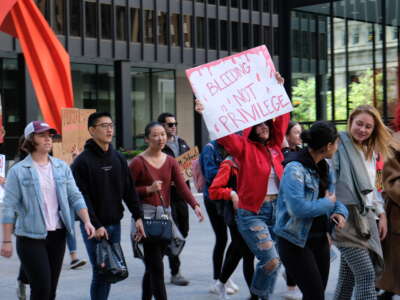
Golden’s defense team thinks they have a strong case that could convince a judge. Vanessa Sanders, another Black criminalized survivor, was found not guilty of murdering her abuser earlier this year in the same court Golden’s case is in. (The prosecutor’s office said it evaluates whether to pursue a case on an individual basis.) But going to trial is still risky, so the Free Keshia Golden campaign has continued to advocate for all charges to be dropped. They most recently marched in downtown Chicago on Tuesday.
Even if this final push fails and Golden has to go to trial on Monday, she won’t be alone. Advocates plan to be in the courtroom, decked out in purple to honor domestic violence victims. If the unthinkable happens and Golden is found guilty, the moms supporting her are prepared to petition Illinois Gov. JB Pritzker for a pardon.
Unlike the state, they assert, they won’t abandon her.

An important fundraising appeal: We have until midnight to raise $14,000
Truthout is one of only a few platforms for justice-oriented, grassroots journalism. Today, as political censorship from the right intensifies, we have no choice but to ask for your help.
We are fundraising right now to cover our basic operating expenses. If you can support Truthout with a one-time or monthly donation, you will make a significant impact on our work. Anything you can do makes a difference — we appreciate your support.











+ There are no comments
Add yours