




| Updated:
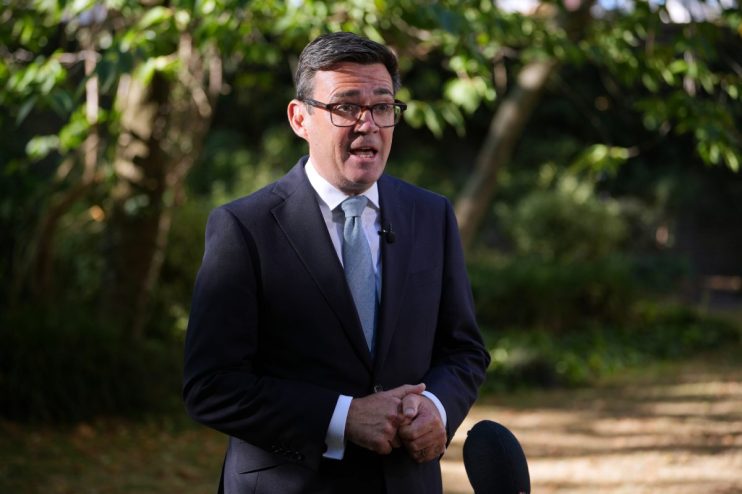
High on the Burnham bounce, calling an early election could be a temption proposition. But the Prime Minister should heed caution, writes Eliot Wilson
The reign of Reform UK at the top of the opinion polls is over. Earlier this month, a survey by YouGov showed the Labour Party in first place with 24 per cent. Reform were second with 22 per cent and the Conservatives a close third on 21 per cent. The last poll conducted when Sir Keir Starmer was Prime Minister had Reform 24 per cent, Labour and the Conservatives 19 per cent.
Andy Burnham will know this and know the question he faces: should he call a general election? Labour’s “Burnham bounce” is modest, a tiny jostling within the electoral peloton, but a month ago most pollsters would probably have predicted Nigel Farage’s teal-accented Estado Novo winning the next election or emerging as the largest party. Now the direction of travel might be changing.
Polling is not an exact science, because it relies on data supplied by humans. As the advertising genius David Ogilvy is supposed to have said, “people don’t think what they feel, they don’t say what they think and they don’t do what they say”. The raw results then have to be interpreted and applied, and this falls to a rare breed of shaman who cannot explain how they do what they do.
Looking at the data, they rely on an eerie kind of fingerspitzengefühl, a fingertip sensitivity which marks out individuals like Philip Gould, Michael Ashcroft, Deborah Mattinson, Stan Greenberg and Frank Luntz. The numbers may be the same, but each expert can arrange them differently to tell a new story. But they remain the best guide we have.
The advantages and risks of an early election
To be clear on one point: Burnham has no obligation, constitutionally, legally or according to precedent, to hold an election. Governing parties can and do change their leaders during the course of a Parliament. Just in the period since the War, it has happened in 1955, 1957,1963, 1976, 1990, 2007, 2016, 2019, 2022 (twice) and now 2026.
It may not be a requirement under the constitution or the law, but there can be advantages to holding an election shortly after you take power. Sir Anthony Eden succeeded Winston Churchill in April 1955, announced an election 10 days later and increased the Conservative majority by 23 seats. He also won the biggest share of the vote for any post-War party, a tantalising 49.7 per cent. No-one saw Suez coming. But he thought he had escaped from the long shadow cast by his predecessor.
If Burnham won a general election with a working majority, he would be able to draw a line, almost to perform damnatio memoriae on Starmer; the new Prime Minister could blaze a trail to “good growth in every postcode and hope in every heart” (yes, he really said that).
The danger is obvious: what if he loses? What if he stakes a working majority of 170 on an unnecessary spin of the wheel, fortified only by a few weeks’ polling data and cheeky Mancunian charm, and fails? He would be skittled out of the Labour leadership and, at 56, he would have to fade away and become one of 10 former Prime Ministers lining up at the Cenotaph every November.
Gordon Brown is a cautionary tale. He finally became Prime Minister in June 2007, and throughout September there was strong speculation that he would seek an early dissolution of Parliament. The speculation intensified when Saatchi and Saatchi unveiled what surely had to be an election slogan: “Not flash, just Gordon”.
On 6 October, Brown announced that there would be no early election. Polling data suggested he would have won. He appeared indecisive, and when he went to the country in May 2010, the voters had changed their minds.
Caution says Burnham should hold tight. He will be mindful of Theresa May’s experience in 2017: she gambled on a snap poll amid double-digit leads over Jeremy Corbyn’s Labour Party. At the beginning of the campaign the Conservatives polled 50 per cent to Labour’s 25 per cent. On election day, May lost the working majority she had inherited and had to rely on the DUP to guarantee winning votes in the Commons.
Is Burnham a gambler?
Burnham’s authority is not under threat in the House of Commons (although he has airily talked about “scrapping” the whipping system), and the current Parliament can run as late as the summer of 2029. But he cannot achieve a legislative programme within weeks. Appealing to jaded and sceptical voters to trust his good intentions on the economy, public services or immigration would be asking a lot.
Is Burnham a gambler? Leaving the shadow cabinet and the Commons for Manchester in 2017 might seem a daring act. But he had failed to become Labour leader twice and the future under Corbyn seemed bleak. It is a measure of how out of place he was that his successor as shadow home secretary was Diane Abbott.
By contrast, Burnham had seen Boris Johnson leave the Opposition front bench in 2007, win election as Mayor of London twice and come back to the Commons as foreign secretary and a credible leadership candidate. But Johnson has a higher tolerance for risk than most.
If anything, the Prime Minister’s earlier career, certainly up until 2017, was marked by a determination not to isolate or expose himself, but to triangulate as much as possible.
The window for choosing an early election is growing smaller, since Parliament returns on 1 September then adjourns two weeks later for the party conferences. Election campaigns do not spring fully formed the head of Zeus, or even of Burnham’s strategy guru Matthew McGregor. If Burnham’s team is not ready to go within the next few weeks, it may already be too late.
The arguments against a snap poll seem to me to weigh more heavily. Burnham could be trying to surf a diminishing wave of optimism with few achievements to his credit yet and a crushing parliamentary majority in the balance. He could hobble his ministry, as Theresa May did, or be ejected from office entirely, making him unique: no other Prime Minister has ever called a snap election, lost it and ended their only stay in Downing Street.
The speculation needs to stop. Gordon Brown could tell him that. As Carmela Soprano reminded Tony – he had for a moment forgotten his Cicero – more is lost by indecision than by the wrong decision. The Prime Minister has to make a call, and hope it’s the right one.
Eliot Wilson is a writer and historian. He is a senior fellow for national security at the Coalition for Global Prosperity and a contributing editor at Defence on the Brink





+ There are no comments
Add yours