





| Updated:
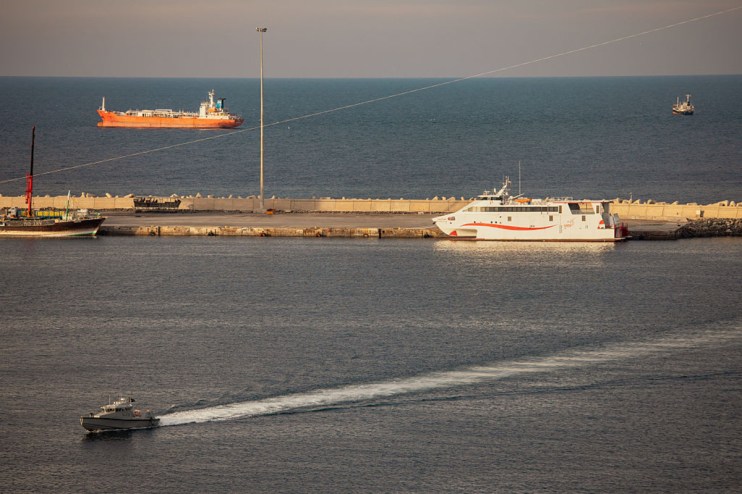
Iran has declared the Strait of Hormuz closed as it trades fresh strikes with the US over the alleged unauthorised passage of a ship through the vital trade route.
The Islamic Revolutionary Guard Corps said on Sunday morning that the waterway, which usually accounts for a quarter of the world’s maritime oil trade, will be shut “until further notice”.
Iran and the US exchanged fire over the weekend after it said it had struck a vessel travelling on an unapproved route through the strait, which lies between Iran and Oman.
“A vessel that had jeopardised maritime security by switching off its systems was struck and brought to a halt,” Iran’s navy command said.
‘Era of one-sided deals over’
The Strait of Hormuz is now closed “until further notice” and at least until “the end of US interference in this region,” Tehran added.
US Central Command (Centcom) said Iran “blatantly attacked” a Cyprus-flagged container ship in the waterway, adding that a civilian crew member was missing.
Shortly after Iran’s strikes on the vessel, the US launched a round of strikes against at least 140 targets in Iran, including missile and drone sites.
Centcom said: “Iran was provided yet another opportunity to demonstrate adherence to the Memorandum of Understanding after being held accountable for earlier attacks on commercial vessels but has again failed.
“In response, the United States is imposing a heavy cost by continuing to degrade Iran’s ability to attack civilian mariners and commercial ships freely transiting the strait.”
In retaliation, Iran reportedly launched missile and drone strikes at a number of neighbouring Gulf states on Sunday morning.
Jordan, Bahrain, Qatar, Oman and the UAE have each said that they have come under attack in recent hours.
Fresh tensions spike borrowing costs
Iran’s chief negotiator issued a warning to the US on Sunday morning, saying that it will have to “pay the price” for allegedly breaking the Memorandum of Understanding (MoU) agreed between the two sides.
Alongside an image of a section of the MoU, Mohammad Bagher Ghalibaf wrote on X: “The era of one-sided deals is over. We told you: keep your word or pay the price. Reality is knocking.”
This latest flare up comes following a week of fresh tensions between the US and Iran, which have sent oil prices soaring to two-week highs.
On Wednesday, US President Donald Trump declared the ceasefire “over,” sending UK borrowing costs surging.
The yield on ten-year gilts – the primary benchmark for how much it costs the government to borrow – stormed 11 basis points higher to 4.96 per cent after the US launched a “series of powerful strikes” on Iran.
Trump launched further verbal assaults on Iran in later days, threatening to “finish the job” and dismissing Tehran’s leadership as “scum”.










+ There are no comments
Add yours