




Truthout is a vital news source and a living history of political struggle. If you think our work is valuable, support us with a donation of any size.
“They never listen to us. They never listen to high schoolers. And if we don’t fight, nobody is going to fight for us,” one French high school student emphatically told the BBC at a recent mass youth protest.
Her frustration reflects a familiar political reality: Politicians routinely dismiss young people’s grievances rather than confront the conditions driving their anger. In 2024, the French newspaper Le Monde described a recurring caricature of French youth as “lazy, resistant to authority and even selfish.” In the United States, Fox News host Jesse Watters dismissed complaints about rising costs from “kids” who, he claimed, had “never had real jobs.” White House press secretary Karoline Leavitt agreed, declaring, “It’s laziness,” and accusing Gen Z of having grown up with “everything handed to them.”
Writing off young people as entitled and incapable of serious political thought is an old political reflex. Yet while those in power accuse young people of laziness and debate what is wrong with them, youth around the globe are hard at work challenging what is wrong with society and changing the world.
On November 20, students and young people in more than 25 European countries will join a coordinated International Youth and Student Strike under the banner “Fight for Our Future, Not Their Wars,” an action emerging from a much wider wave of youth revolt stretching from Mayotte to Morocco, Chile, Argentina, Brazil, and beyond. The strike call links education and housing to austerity, climate breakdown, and militarization.
These revolts led by high school students show how struggles over schools can become struggles over society — and over who has the power to shape it.
“We Can’t Work in Those Conditions”
While the mass protests in Paris have drawn international attention, the high school revolt began weeks earlier in France’s overseas territories. Students and teachers started mobilizing on August 31 at Lycée de la Cité du Nord in Mayotte — an island off East Africa that remains under French rule despite decades of UN resolutions recognizing it as part of the independent nation of Comoros. Thérèse Lebeault, a 10th-grade student at Lycée Younoussa Bamana, described the conditions:
There are too many students in the classrooms … There aren’t enough toilets — there are three when we’re nearly 3,000 students. There are no fans in the classrooms, not enough nurses, not enough buses for transportation. There’s also a shortage of teachers, a shortage of classrooms — everything, really … nothing is right.
On September 7, students at Lycée Félix-Éboué in French Guiana presented 17 demands over deteriorating school conditions. As the revolt spread, students in Martinique, Guadeloupe, and Réunion — all former colonies that remain under French rule — joined the wave, exposing how struggles over education are intertwined with colonial inequality.
In metropolitan France, students were confronting many of the same problems. Mohammed, a 17-year-old student in the Paris suburb of Sevran, described classrooms where “there aren’t enough chairs or desks to go around, so some students have to stand up,” and said some students go “months without teachers when absent staff aren’t replaced.” Fadila, 17, at Lycée Paul Éluard in Saint-Denis, described “cockroaches and rats everywhere in the school,” broken toilets without running water and classrooms reaching 104°F in summer. “We can’t work in those conditions,” she said. In Strasbourg, 17-year-old Raphael described overcrowding, extreme heat, too few toilets, and water leaks: “The building is falling apart.”
These revolts led by high school students show how struggles over schools can become struggles over society — and over who has the power to shape it.
These were not isolated complaints. Across France, students were identifying common grievances and organizing collective demands. The Union Syndicale Lycéenne, France’s main high school student union, pointed to “lack of teachers and staff,” “dilapidated high school buildings,” “overloaded timetables and overcrowded classes,” and “stress caused by Parcoursup,” France’s university admissions system.
These problems were not distributed equally. Students in poorer communities reported greater difficulty getting absent teachers replaced. A fight over missing teachers and leaking ceilings exposed deeper inequalities — raising the question of who gets to decide the conditions of young people’s lives.
In barely two weeks, the uprising had spread across the country. By October 1, more than 1,000 high schools — nearly one in four nationwide — were affected by strikes or protests, including more than 200 blockades. Students piled trash bins, shopping carts, and metal barriers across school entrances; in some cities, barricades burned and clashes erupted with police.
On October 6, the protests spilled far beyond the schools: The Interior Ministry counted 266,000 demonstrators nationwide, while student organizers put the figure at 450,000.
As the uprising spread, the state responded with extraordinary force. Between September 28 and October 5, police made 6,059 arrests, with 5,060 people placed in police custody, 87 percent of them minors. A 15-year-old student in Lens had his hand torn off by a police grenade. A 16-year-old lost the use of one eye, and a 14-year-old suffered a double jaw fracture after being struck at close range by a police grenade launcher. By October 7, France’s police inspectorate had been assigned 18 investigations into allegations of police misconduct.
Teachers and parents mobilized not only in support of the students’ demands, but to protect them. Educators formed human barriers between students and police, marched alongside their pupils, and joined blockades. “I’m here just to provide protection, to form a barrier between the police and the students,” Juliette Estiville, a high school Spanish teacher in Paris, told reporters. “The teachers who come to the blockades are really there to protect our young people.”
By October 1, more than 1,000 high schools — nearly one in four nationwide — were affected by strikes or protests, including more than 200 blockades.
Solidarity soon extended far beyond teachers and parents. High school students were marching alongside university students, workers, farmers, and climate activists. By November, a coalition of unions representing millions of workers across education, transportation, public services, and private industry had joined the mobilization.
What began as a fight over missing teachers and deteriorating classrooms has become a broader confrontation over austerity, inequality, and society’s priorities.
The students may not have been in class studying history, but they were learning something about power, repression, and solidarity — and making history of their own.
“Money for Schools, Not for War”
France is not alone. Across borders, students have begun recognizing their struggles in one another. In Rome, students occupying a high school opened their statement with “like in France.” In Greece, secondary-school students joined university students and teachers demanding better-funded public education, chanting, “From Greece to France, we are fighting for public and free education.”
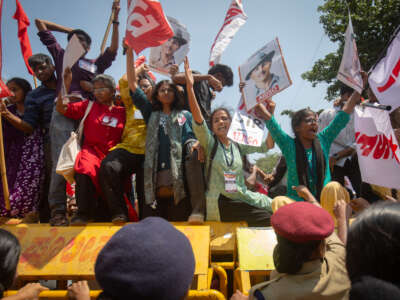
In Chile, high school students have been central to mass protests against education cuts and austerity. In Germany, more than 45,000 students in over 100 cities, primarily high schoolers, walked out on September 25 against compulsory military service and militarization. In Spain, young people have also been central to mass protests over the housing crisis — including in Valencia where roughly 30,000 teachers, students, and family members marched after a two-week education strike demanding smaller classes, more staff, and better school infrastructure. In the United Kingdom, school students have connected their organizing to the French revolt and are preparing November 20 walkouts as part of the wider international strike. In Argentina, secondary students occupied schools in protest against President Javier Milei’s education cuts. In India, the Cockroach movement grew from university graduates and job seekers to include teenagers furious over exam leaks and a lack of government accountability. Seventeen-year-old Saurav Kushwaha traveled overnight from Madhya Pradesh to join its first major Delhi protest. “I followed them on Instagram for fun,” he told Al Jazeera. “But there is a chance that we can actually get the minister to resign.” Seven weeks later, on July 25, India’s education minister, Dharmendra Pradhan, resigned following weeks of youth-led protests. High school students in the United States have likewise moved into struggles beyond the classroom. During Operation Metro Surge in Minnesota, hundreds of Twin Cities students walked out against ICE and federal immigration enforcement. At Roosevelt High School, Border Patrol agents entered school grounds, detained a staff member, and used chemical weapons on a crowd that included students. Days later, hundreds walked out. “We’re fighting for our neighbors who can’t be out here,” 17-year-old Genevieve Neerland said.
As in France, student resistance soon converged with organized labor. Minneapolis and St. Paul teachers joined other unions in backing a January 23 call for “no work, no school and no shopping,” helping produce an economic shutdown that echoed Minneapolis’s historic 1934 general strike. A week later, students walked out nationwide.
Across these movements, young people begin with what they encounter directly — a teacher shortage, a dilapidated school, a rigged examination, federal agents invading their campus — and begin asking larger questions about who receives resources, whose communities are targeted, and who gets to decide their future. They earn an advanced degree in social studies when repression teaches them that the state is not simply a neutral referee, but an apparatus of power organized to defend the existing social order and its hierarchies.
One slogan from Italian high school protests distilled that widening analysis: “Money for schools, not for war.” In France, the defense budget rose from roughly €32 billion in 2017 to €57 billion in 2026, an increase of 77 percent. In the United States, Congress appropriated roughly $839 billion for the Pentagon in fiscal year 2026.
Those priorities become especially stark in the context of the genocide in Gaza. France has continued authorizing military exports to Israel, while the United States provided Israel approximately $21.7 billion in military aid during the first two years after October 7, 2023, according to Brown University’s Costs of War project. By June 2024 alone, the United States had sent Israel at least 14,000 2,000-pound bombs, 6,500 500-pound bombs, and thousands of other munitions. By April 2026, UNICEF reported that nearly 98 percent of Gaza’s school buildings had been damaged, with around 81 percent struck directly during Israel’s military assault.
That helps explain why Palestinian flags and keffiyehs have appeared throughout youth demonstrations. Organizers of the November 20 International Youth and Student Strike explicitly link austerity to militarization and war. Their manifesto declares: “Our future will not be given to us.”
A History of High School Students Making History
France has seen these contradictions erupt into rebellion before. In the months leading up to May 1968, French high school students organized Comités d’action lycéens, or High School Action Committees, challenging authoritarian school structures, educational selection, and the Vietnam War. During the May uprising, students occupied schools and organized discussions about exams, school governance, the Vietnam War, and workers’ struggles. May 1968 is often remembered as a revolt of university students and workers, but high school students helped push educational struggles toward larger questions about power and society.
That pattern extends around the world. High school students helped initiate South Korea’s 1960 April Revolution, which grew into a nationwide uprising that toppled U.S.-backed dictator Syngman Rhee on April 26, ending his 12-year authoritarian rule; Black secondary students in the Soweto uprising challenged apartheid education in 1976, sparking nationwide resistance that helped reinvigorate the anti-apartheid movement; and Chilean high school students occupied schools during the 2006 “Penguin Revolution,” forcing increased education funding and reforms to the market-driven school system inherited from Pinochet’s dictatorship. The United States has its own deep history of high school revolt. In 1951, 16-year-old Barbara Johns organized a walkout against segregated and dilapidated conditions at her Virginia high school; the resulting lawsuit became part of Brown v. Board of Education. Jon N. Hale, a historian of student movements, told me that Johns showed young people were prepared “not only to join but lead and inspire elders in the movement.”
During the 1960s, young people helped propel the Civil Rights, Chicano, and antiwar movements. Thousands joined Birmingham’s Children’s Crusade; about 15,000 Mexican American students participated in the 1968 East Los Angeles walkouts; and historian Aaron G. Fountain Jr. told me that the late 1960s and early 1970s saw “over a thousand Black or Latino student uprisings.” In Des Moines, 13-year-old Mary Beth Tinker’s Vietnam War protest produced the landmark Tinker decision protecting student speech. Looking back, Tinker told me, “It was so clear to us that it was all connected, the anti-war and peace movement, and the fight for civil rights.” But student movements have rarely developed entirely in isolation. In another interview, historian Jarvis Givens described teachers as “essential to the shaping of the political imaginations of the people we often hold up.” He pointed to Martin Luther King Jr.’s high school English teacher, Sarah Grace Bradley, who helped the 15-year-old King develop a Black history speech and accompanied him to an oratorical competition.
Teachers do not manufacture movements; students already know when their classroom is overcrowded, their teacher is missing, or their building is falling apart. But learning history can reveal that inequality is neither natural nor inevitable. When young people learn how injustice has been created, resisted, and transformed, they can see that the world they inherited was made by people — and can be remade by them.
That helps explain why battles over history have become so fierce. UCLA researchers found that nearly half of public high school principals reported attempts to limit teaching about race and racism during the 2021-2022 school year, while the American Library Association reported 4,235 unique titles challenged for censorship in 2025.
These fights are not only about which facts students encounter. They are also about what students can imagine. A student who learns about Barbara Johns, East LA, or Soweto learns something larger: People their age have changed history before.
That knowledge changes what seems possible.
Historian Aaron Fountain, author of High School Students Unite!, told me that high school students constitute an oppressed group and that “you cannot truly reform society unless you first reform the high schools.”
From confronting segregation and apartheid to overthrowing dictatorships, they have demonstrated that the struggle to transform schools can become a struggle to transform society itself. High school students may begin by protesting dress codes, demanding repairs to crumbling school buildings, or fighting for the right to protest at school at all. But these struggles and their collective victories can grow into larger movements against segregation and apartheid — and even bring down dictatorships.
The Students Are Teaching
Time and again, when high school students go into struggle, they draw much of society with them. Part of the reason lies in the contradictions built into education itself.
Capitalist societies need schools to produce workers who can read, calculate, communicate, and think. Yet teaching youth those skills can be a risky gambit. It is difficult to teach history without inviting students to identify with people who rebelled, or to teach how to analyze a text or an argument while guaranteeing they will never use their power of analysis to question the institutions around them.
James Baldwin captured the contradiction of schooling in his 1963 “Talk To Teachers” — that “as one begins to become conscious one begins to examine the society in which he is being educated.”
On November 20, students will skip class — and teach the rest of us how history gets made.
Another contradiction built into capitalist schooling is that schools often train students to understand success as an individual competition — for grades, test scores, college admission, and eventually jobs. Yet schools also bring many young people together every day, creating opportunities for students to recognize that what appears to be an individual problem is actually collective, opening the door to collaboration and solidarity. Teachers — beset by the same conditions of underfunding and austerity — have also often developed a political consciousness through their experience, aid young people in investigating those contradictions, supporting them when they organize, and helping them ask critical questions about society that can connect their immediate experiences to the larger structures shaping their lives. As one French teacher put it in an interview with BT during a mass protest, the revolt is “still about high schools and students and young people and French youth. But it’s also about, basically, capitalism.”
Struggle then becomes another kind of education. Rayyan Seriket of the Fédération Syndicale Étudiante told Democracy Now! that the protests grew beyond high school students because they raised “the whole question not only of our living conditions, but also of who we are governed by and what interests they have.”
Once students begin asking those questions, they rarely stay confined to the schoolhouse. Parents, teachers, and workers can recognize their own struggles in the students’ demands. That is why struggles over education so often become struggles over society itself.
And they become more powerful when they cross borders. One slogan from the French protests captured that horizon: “Capitalism exploits us / The far right divides us / Anger brings us together.”
That is why November 20 matters. The planned international student strike represents an opportunity to turn scattered struggles over education, inequality, and war into a coordinated movement that challenges the systems producing these crises.
On November 20, students will skip class — and teach the rest of us how history gets made.
An important fundraising appeal: 24 Hours to raise $19,000
Donations are down for Truthout at a time when media is under immense pressure. Google’s AI search has driven our traffic down by 15 percent, Trump is arresting journalists, and many independent media organizations face heartbreaking cutbacks and closures.
At the same time, movement media is vital in the fight against Trump’s authoritarian reign. Our mandate to tell the truth, share strategies for resistance, and speak against fascism is ever more urgent in this deluge of political censorship and misinformation. Yet, we are struggling to meet our publishing costs when our work is so urgently needed.
We are fundraising right now for those basic operating expenses — we need $19,000 in the next 24 hours. If you can support Truthout with a one-time or monthly donation, you will make a significant impact on our work. Anything you can do makes a difference.



+ There are no comments
Add yours