







Part of the Series
Fighting for Our Lives: The Movement for Medicare for All
Honest, paywall-free news is rare. Please support our boldly independent journalism with a donation of any size.
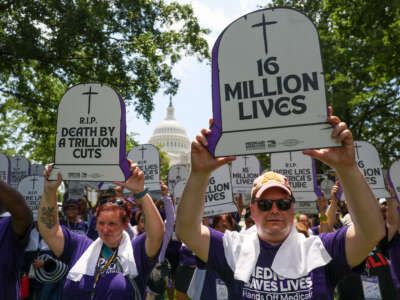
Millions of people in the U.S. are currently in danger of losing their health care as a result of Donald Trump’s so-called “One Big Beautiful Bill,” which was passed in 2025 with Trump in the White House and Republican majorities in both the Senate and the House.
The new bill tilted the economy evermore in favor of the wealthy, rolling back hundreds of billions of dollars of taxes and clawing back a portion of the lost revenue through extreme cuts to social safety net programs.
The biggest loser in the bill was Medicaid, which was coming off of more than a decade of expansion under provisions of the Affordable Care Act that allowed states to broaden eligibility for the program. Onerous new workfare requirements — requiring able-bodied recipients to prove 80 hours a month of work or community service — paired with more frequent eligibility checks, were crafted specifically to drive down the numbers enrolled in the health care program. Estimates of the impact range widely, but there is general agreement that somewhere between just under 5 million and just over 10 million people stand to lose their health care as a result of this bill.
Add in the millions being driven off of Affordable Care Act (ACA) plans by Congress’s refusal to extend tax credits as well as by rising premium costs, and there’s a real chance that, in coming years, America will revert to pre-ACA-era numbers of uninsured.
During the 2026 enrollment period, as deductibles and premium costs soared, the number of Americans in ACA-subsidized insurance plans dropped by more than one-fifth compared to the previous year; and, for those who stayed enrolled, many opted for far less comprehensive “bronze” plans rather than the increasingly unaffordable “silver” options that had previously attracted the most enrollees.
Astoundingly, according to the Commonwealth Fund, as of late 2026 nearly half of American adults under the age of 65 either have no health insurance, have experienced health coverage gaps at some point in the previous year, or are currently significantly under-insured.
Somehow the GOP thought it could dodge the issue by crafting the cuts to health care in a way that meant the worst impacts wouldn’t be felt until after the 2026 elections. Given the pain that people in the U.S. were already feeling around health care, it was a strategy doomed to failure.
In the run-up to the midterm elections, polls suggested that the U.S. public was deeply worried about access to health care. Economic issues, including the high costs associated with health care, topped voters’ anxiety lists — with democracy and corruption issues coming in next. Kaiser Family Foundation data indicates that 6 in 10 voters were “very concerned” about the cost of health care; and by a 20-point spread those voters believed that Democrats were more likely than Republicans to address this challenge.
The Kaiser Family Foundation analysis suggests that in swing states where health care was of most concern to residents, by a two-to-one margin voters worried about health care costs voted Democrat over Republican. In states such as Maine and Michigan, where Democratic candidates won on platforms that included a promise to push for Medicare for All, large majorities of the electorate told the pollsters that they wanted the government to play a larger role in securing access to affordable medical coverage for residents. In newly blue Texas, where more than 5 million residents currently lack health coverage, Democratic lawmakers have been lining up to propose legislation to expand Medicaid access in the state — almost daring the Republican majority in the state senate to block them and to then try to justify that action to voters.
Three-quarters of people in the U.S. now live in states with Democratic governors, many of them also with both state legislative bodies blue, meaning that state-level health care reforms will likely complement congressional efforts to bring more people under health coverage umbrellas.
Come January, Democrats have a once-in-a-generation opportunity to reshape the health care landscape in the United States — or, at the very least, to lay out a set of policy reforms that they would enact were they able to get beyond a Trump veto, or were they to win the White House in 2028.
Incoming congressional leaders, with backing from the party’s Cost-of-Living Healthcare Working Group, have already made it clear that they will seek to reverse the cuts to Medicaid and to restore the ACA tax credits. The working group has also been pushing for a commitment to expand Medicare as a move toward universal health care coverage.
Many proposals, including restoring Medicaid and ACA to their pre-2025 status, have been test-run during the current Congress. While they didn’t pass, bills such as representative Adam Gray’s Protecting Healthcare and Lowering Costs Act are ready to be dusted off and reintroduced now that Democrats have congressional majorities. The incoming majority has pledged to introduce legislation to roll back these cuts, as well as to protect access to vaccines, within the first 100 hours of the new Congress.
Beyond that, for the past few years Democrats have been developing a longer-term strategy to ratchet up pressure on the Trump administration to negotiate ways to expand Medicare eligibility, lower drug prices, and cap the percentage of household income that families spend on health care in any given year.
When the scale of the Republicans’ defeat became clear on election night, Trump announced that he was ready to become “Mr. Veto.” But it’s hard to see how the Republicans will stand united in blocking overwhelmingly popular health care reforms for the next two years. A window has opened up to create a better, more functional health care system. It will likely start with the Democrats reversing the Medicaid cuts; but that should be seen as the starting point, rather than the final goal, for a broader series of changes to how the country delivers health care to residents.
Fundraising Deadline: Missed
Donations are down for Truthout at a time when media is under immense pressure. Google’s AI search has driven our traffic down by 15 percent, Trump is arresting journalists, and many independent media organizations face heartbreaking cutbacks and closures.
At the same time, movement media is vital in the fight against Trump’s authoritarian reign. Our mandate to tell the truth, share strategies for resistance, and speak against fascism is ever more urgent in this deluge of political censorship and misinformation. Yet, we are struggling to meet our publishing costs when our work is so urgently needed.
Our fundraiser ended last night, but there’s still time for us to meet those basic operating expenses — we need only $10,000. If you can support Truthout with a one-time or monthly donation, you will make a significant impact on our work. Anything you can do makes a difference.










+ There are no comments
Add yours