







Climate Change, Economy & Trade, Environment, Featured, Global, Global Governance, Headlines, Human Rights, International Justice, IPS UN: Inside the Glasshouse, TerraViva United Nations
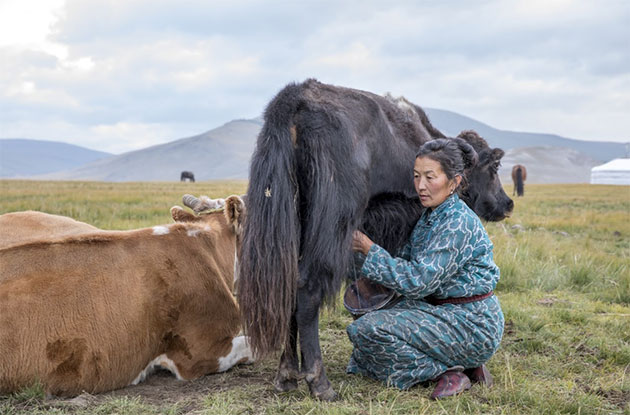
Woman milks a cow in northern Mongolia. Credit by Katiekk, Shutterstock
– This is supposed to be the year the world finally sees and recognizes pastoralists. The United Nations has designated 2026 as the International Year of Rangelands and Pastoralists, bringing long-overdue attention to communities who have sustained some of the world’s most fragile and important landscapes for generations.
Yet right now, the world is on fire… quite literally. All eyes are on the wildfires in France, Spain, and Canada. California is coming up on wildfire season. And scientists are predicting the strongest El Niño in history.
As climate-fueled disasters become more frequent and severe, now is an important moment to learn from pastoralists, whose traditional knowledge, adaptive land management practices, and deep understanding of living with climate variability have helped sustain people and landscapes through centuries of environmental change.
In August, governments will gather in Mongolia for COP17 of the United Nations Convention to Combat Desertification (UNCCD COP17), where rangelands, land degradation and climate resilience will be central to the global agenda.
This will be the first UNCCD COP since the e.stablishment of the Caucus of Indigenous Peoples and the Caucus of Local Communities—hard-won victories at COP16—with “Land and People Day and tenure rights included formally on the COP17 agenda.

Dr. Solange Bandiaky-Badji is Coordinator and President of the Rights and Resources Initiative (RRI)
Yet the scale of what is at stake is enormous. Rangelands cover more of the Earth’s surface than any other land use type, and up to 500 million people directly rely on pastoralism for their livelihoods. These lands are central to food security, biodiversity, climate resilience, and the survival of communities across Africa, Asia, Latin America and beyond. Yet pastoralists remain among the least protected and understood land stewards in the world.
This year of recognition must become more than a symbolic milestone. Unless governments and institutions use this moment to move from visibility to rights, pastoralists will continue to be praised in speeches while being pushed further to the margins in law, policy and investment.
Resilience Is Not Invulnerability
Pastoralists are incredibly resilient. Across drylands, savannahs, mountains and rangelands, they have adapted to shifting seasons, scarce water, and fragile ecosystems through sophisticated systems of mobility, customary governance, and ecological knowledge. Their way of life is one of the world’s most climate-adapted livelihood systems. But resilience should not be confused with invulnerability.
At a New York Climate Week event last year focused on Indigenous pastoralist knowledge and nature-based solutions, pastoralist leaders described the reality their communities face every day. One speaker from the Sahel spoke of droughts, severe flooding and wildfires that continue to destroy livelihoods and cost lives. She recalled stories from her grandmother about struggling to find even a grain to eat in order to survive and warned that extreme weather is threatening their lives.
While Climate change is intensifying the pressures on lands and livelihoods that were already under strain, it is only part of the story. Pastoralists are also being squeezed by policies and development models that misunderstand and overlook how their systems work and focus on a narrative that pastoralists are a threat to ecosystems. Their livelihoods depend on mobility, but many legal frameworks are built around fixed land ownership and permanent settlement. Their governance systems are collective and customary, but many governments recognize only formal administrative structures. Their territories include grazing corridors, water points and seasonal routes, but these are rarely treated as essential infrastructure. Even where policies exist focusing on pastoralism, they often do so from restrictive approaches that only center pastoralists as part of a chain of production or tourism exploitation.
The Gap Between Recognition and Rights
A recent analysis by the Rights and Resources Initiative across Kenya, Niger, Tanzania, Mongolia, Nepal, Bolivia and Peru found a persistent gap between recognition on paper and protection in practice. While governments may acknowledge pastoralist land access in some form, mobility—the foundation of pastoralist livelihoods—is rarely protected in law. Among the countries studied, Niger stands out as the lone exception explicitly recognizing mobility as a fundamental right. The legal gap among the rest of the countries has real consequences.
Across regions, rangelands are being fragmented by agricultural expansion, infrastructure projects, extractive industries, conservation restrictions, carbon initiatives and green energy projects. These pressures are often presented as development or climate solutions. But when they are imposed without pastoralists’ full participation and consent, they deepen inequality, fuel conflict and weaken the very systems that have protected rangelands for generations.
Invisible in Data, Invisible in Policy
That exclusion is also statistical. Pastoralists are too often missing from the data systems that shape national priorities, development financing and climate policy. When governments do not accurately count pastoralist communities, map their mobility routes, measure their economic contributions, or document the pressures they face, their needs and contributions remain invisible. When communities are invisible in the data, they are often invisible in budgets, laws and global commitments.
This is especially alarming given the scale of pastoralists’ contributions. In Africa, pastoralists produce much of the continent’s milk and a significant share of its meat. They sustain local markets, support rural economies, manage vast rangelands and carry knowledge that is essential to climate resilience and biodiversity protection. Yet their contributions are rarely matched by legal protection, public investment or meaningful political representation.
Women face even greater barriers. Pastoralist women are central to livestock economies, food systems, households and community resilience. But they are often excluded from land ownership, mobility rights, leadership and formal decision-making. Any serious effort to strengthen pastoralist systems must address women’s rights directly, not as an afterthought.
Tenure Redefined
At COP17, land tenure returns to the agenda as a standing policy item, carried forward from previous sessions alongside rangelands and pastoralists. That is progress. But tenure conceived as titles, boundaries and fixed parcels cannot secure people whose security depends on movement. The United Nations Declaration on the Rights of Peasants (UNDROP) already names transhumant, nomadic and semi-nomadic communities as rights holders and requires states to protect their land rights, an obligation that cannot be met by extending sedentary tenure models to mobile peoples. Pastoralist tenure must be redefined: adaptive, embedding mobility, recognizing shared use, seasonal occupation and overlapping claims and anchored in customary governance. For pastoralists, secure tenure is flexible tenure.
The Solutions Are Clear
The good news is that pastoralists are not waiting for the world to act on their behalf. They are organizing. There is a growing movement across Africa, Asia and Latin America. They may be communities separated by continents and colonial borders, but they are connected by shared histories, livelihoods and struggles.
First, governments must recognize pastoral mobility as a legal right. Movement is not a weakness of pastoralist systems; it is what allows communities to manage climate variability, protect ecosystems and sustain livestock in changing conditions.
Second, states must protect the physical infrastructure of pastoralism, including grazing corridors, water points, dry season reserves and seasonal migration routes. These are as essential to pastoral economies as roads and ports are to national economies.
Third, customary governance systems must be legally recognized and supported. Pastoralist communities have long managed land, water and conflict through local institutions that are adapted to their realities. Replacing these systems with rigid, top-down frameworks weaken both rights and resilience.
Fourth, pastoralist women must have equal rights to land, mobility, resources and leadership. Climate resilience cannot be built while half the community is excluded from decisions that affect them and shape our collective future.
Finally, climate finance, conservation funding and development investments must reach pastoralist communities directly and respect their rights. Projects that restrict access to land without consent or compensation undermine both livelihoods and global environmental goals.
COP17 in Mongolia is an opportunity to turn this year of recognition into a year of action. Governments should arrive prepared not only to discuss rangelands, but to listen to the people who know them best. Pastoralists must be at the table as rightsholders, experts and partners.
The world cannot meet its goals on climate resilience, food security, biodiversity or land restoration while ignoring the communities already holding these systems together.
This is the year of pastoralists. Now it must become the year the world finally recognizes their rights.
Dr. Solange Bandiaky-Badji, is President and Coordinator, Rights and Resources Initiative
IPS UN Bureau










+ There are no comments
Add yours