







Did you know that Truthout is a nonprofit and independently funded by readers like you? If you value what we do, please support our work with a donation.
Germany is now facing the same systemic crisis that its leaders once diagnosed in other European countries, such as Greece, Portugal, and Spain, in the early 2010s. Economic woes and anti-immigrant sentiment have given rise to anti-establishment politics, which in turn is reshaping the country’s political landscape. Indeed, after the Alternative for Germany (AfD) party achieved a historic result in the Saxony-Anhalt state in eastern Germany, the fascists have just won another state election in Mecklenburg-Western Pomerania and also made significant gains in the election held in the city-state of Berlin. But it was the radical left Die Linke (the Left), the successor to the ruling Socialist Unity Party (SED) of the former German Democratic Republic, that won the most votes in Berlin.
In the state of Mecklenburg-Western Pomerania, a largely rural state in Germany’s former communist east where unemployment stands at nearly 8 percent, well above the national average, the AfD took first place by winning 38.2 percent of the vote on September 20, while the center-left Social Democratic Party (SPD) came second with 35.5 percent. Chancellor Merz’s center-right Christian Democratic Union (CDU) got routed as it failed to cross the 5 percent threshold, thus not winning a single seat in the state parliament for the first time anywhere in Germany. Merz described the result as “a disaster” for his party but vowed to stay in office and press ahead with his unpopular reforms to the German economy, which consist of imposing austerity measures and do not touch the rich. The Sahra Wagenknecht Alliance (BSW) also failed to clear the 5 percent threshold, while Die Linke took just 6.5 percent and the Greens took 5.7 percent.
The state election in Mecklenburg-Western Pomerania was another resounding victory for the AfD and represented something of a rebuke of the SPD-Die Linke coalition that has governed in the state capital of Schwerin for the past five years. Indeed, what is most unexpected about the result in this German state election is that, unlike Saxony-Anhalt, Mecklenburg-Western Pomerania was not considered an AfD stronghold. Mecklenburg-Western Pomerania has the lowest proportion of immigrants among all of Germany’s 16 federal states.
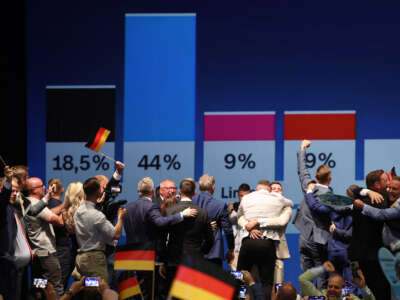
In the Berlin state election, Die Linke finished first with 25.3 percent of the vote, ahead of the CDU which got 19 percent, while the AfD won 16 percent, up 6.9 points from the last election.
Die Linke more than doubled the vote percentage it received in the previous Berlin state election in 2023, when it won 12.2 percent of the vote. The party cannot form a government alone, but is clearly in a position to lead a coalition government with the Social Democrats and the Greens and could see its mayoral candidate Elif Eralp become the first leftist mayor of Berlin.
Housing was at the center of the Berlin election and is undoubtedly the key factor behind Die Linke’s surge in popularity. Led by the charismatic 45-year-old Eralp — the daughter of Turkish exiles and a human rights advocate who has served in the Berlin House of Representatives since 2021 and is often called “Berlin’s Mamdani” — Die Linke focused its campaign on rent controls and more social housing, including support for implementing Berlin’s 2021 housing referendum, in which nearly 60 percent of voters backed a legal process to expropriate properties from big landlords. In Berlin, major housing and financial corporations own hundreds of thousands of apartments and thus have major influence over rents in the neighborhoods in which they own properties.
Bringing large private housing stocks under public ownership is a truly radical solution to the housing problem facing Berlin. The 2021 referendum is not legally binding but has nonetheless found massive support among the young people of Berlin in particular, who voted overwhelmingly for Die Linke. Yet, it could potentially become law if the parties in control of the Berlin Senate choose to make it so, although such a move would face various judicial challenges. A far less radical measure, a Berlin rent cap law, was declared unlawful by the German Federal Constitutional Court.
Aside from Die Linke, only the Greens support the implementation of the housing referendum. It remains to be seen whether a coalition government led by Die Linke can reach an agreement regarding the expropriation of large real estate companies. However, the party’s program on housing, which it views as a human right and not a commodity to be manipulated for private profit, is not confined to expropriations. It also includes regulating rents, building thousands of social housing units each year, and requiring landlords with at least 50 housing properties to allocate a portion of their apartments to low-and middle-income renters.
Die Linke’s humanitarian agenda extends to numerous other areas, including initiatives to increase employment and protect the climate, provide free education and free public transport, and protect immigrants from deportation. The party has called for a solidarity-based “immigration society” in which all people enjoy the same political, legal, and cultural rights. But as the results in Saxony-Anhalt and Mecklenburg-Western Pomerania indicate, this is a vision for German society that many voters reject. Even in cosmopolitan Berlin, the anti-immigrant AfD made significant gains, although it will remain in the opposition not only in Berlin but most likely also in Mecklenburg-Western Pomerania.
Still, there can be no denying that it is Die Linke’s approach on affordable housing that is responsible for the party’s historic victory in Berlin. And, as already indicated, it is young people in particular who are attracted to the party’s left-wing economics. But there is an irony here. Die Linke’s left-wing economics resonate mainly with the west German youth, while people in east Germany, a region where the country’s economic woes are far more pronounced, have turned to the far right.
The central question now is whether Die Linke’s historic victory in Berlin can translate into a broad national breakthrough, especially with its internal conflicts having largely subsided since the departure of the party’s former co-chair Sarah Wagenknecht, who went on to form her own party, dubbed the Sarah Wagenknecht Alliance (BSW). Wagenknecht’s leadership used to confuse voters about the party’s stances, considering her hardline approach to immigration and overall social conservatism combined with leftist economic policy. Now, the party has a consistent policy on immigration and offers a real alternative to the present economic model of Germany, which has become increasingly unsustainable. Die Linke has already won over the young and has shed its image as merely an anti-capitalist protest party. As its campaign in Berlin showed, bringing attention to pressing economic and social issues can further sharpen Die Linke’s political profile. Die Linke was considered dead just a few years ago. But the party seems to have learned from its past mistakes. Not only has it been revitalized, but it now has the potential to become a major player in German politics. The growing appeal of its humane vision for the future of German society may be one of the only bulwarks preventing a further surge of the AfD.
25 Years of Truthout: An important fundraising appeal
This September, Truthout is celebrating 25 years of publication. For over two decades, we have been a trusted source for fiercely independent journalism thanks to readers like you.
As we look to the next 25 years, we have launched a special fundraising campaign. Looking to a sustainable future for our publication, we have a fundraising goal of $52,000 in the next 72 hours.
We are asking for your support at this juncture because we face greater threats than ever before in our organizational history. Trump and his MAGA allies are determined to control the information ecosystem, and movement-based organizations are subject to dangerous censorship and scrutiny.
If you can support Truthout with a one-time or monthly donation, you will make a significant impact on our work and our legacy. Anything you can do makes a difference!










+ There are no comments
Add yours