


Truthout is a vital news source and a living history of political struggle. If you think our work is valuable, support us with a donation of any size.
Facing the growing loss of its unquestioned hegemony in the world system — that unipolar world that took shape after the end of the Second World War and was consolidated with the collapse of the Soviet bloc — conservative sectors have been arguing for several decades that the window of opportunity to prevent China’s power from equaling or surpassing that of the United States is closing. They argue that it is necessary to use all possible means, including military force, to halt China before it is too late.
This characterization of what is at stake has become one of the primary determinants of the Trump administration’s foreign policy. This is expressed in the aggressive application of tariffs against both enemies and allies; its attempts to prevent China from obtaining the most advanced chips required to compete in the field of artificial intelligence; and its efforts to restrict China’s access to and control of indispensable energy and mineral resources. It is expressed in the content of the new national security doctrine released at the end of 2025, in the threats against Canada, Greenland, and Cuba, and in the successive military actions that have been carried out. Equally, it is seen in the demand made to Congress to increase the military budget by 50 percent for the coming year, despite the fact that the current budget is already higher than the sum of the military spending of the ten countries that follow it.
The high probability that the Republican Party will lose control of the House of Representatives, or even the possibility of losing both chambers in the midterm elections, creates an additional urgency for Trump that makes him increasingly dangerous. The unchecked power with which he has governed until now would be limited in some way, which is why he is accelerating the implementation of his agenda, even if it implies the violation of the United States Constitution and international law, as well as defying the opinion of the majority of the population, including many of his own supporters.
First Gaza, then Venezuela, and now Iran (in a year which also included smaller-scale bombings of Somalia, Yemen, Nigeria and elsewhere) — it is the unfolding before our eyes of a new world order in which global legal norms (which were always of limited efficacy) are being openly replaced by the law of the strongest. This is happening to all of us, and recognizing it is important. This is expressed, for example, in the demand that the U.S. makes of Spain, for example, to reduce expenditures on health, education, environmental protection, and social security in order to increase its military budget from 2 percent to 5 percent of its gross domestic product.
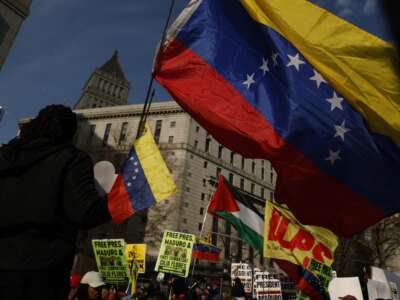
After months of deploying an extraordinary naval operation off the Venezuelan coast resulting in the murder of scores of fishermen, in the early hours of January 3, the United States armed forces carried out a military operation in which they destroyed civilian and military installations, murdered more than one hundred people, and kidnapped Nicolás Maduro and his wife, congresswoman Cilia Flores.
From that moment on, Venezuela became a United States protectorate. Trump recognized Delcy Rodríguez, the vice president under Maduro, as interim president. We do not know if this appointment had been previously negotiated. Since that day, these two heads of state have exchanged successive messages of friendship. Trump has repeatedly declared himself very satisfied with Delcy Rodríguez, stating that she is “behaving very well.”
The objectives proposed by the United States government for Venezuela have been announced by Marco Rubio in terms of three phases: first, stabilization; second, recovery; and third, transition. This means that, in the first place, it is a matter of initiating a set of institutional transformations — especially in regulations and laws regarding hydrocarbons and mining — based on the interests of the United States, under conditions that are as non-confrontational as possible (Trump: “To the victor go the spoils”). Secondly, based on this new institutional framework, the goal is to advance in economic recovery and, subsequently, in an undefined future, carry out what would properly be the political transition and the possibility of elections. The timing and pace would be defined by the State Department.
Instead of attempting a deep regime change that would have required troops on the ground and, surely, would have generated resistance and instability, the choice was made to carry out these transformations while preserving the fundamentals of the Maduro government’s structure. This has operated, so far, as a masterstroke. This explains why something that many analysts have questioned, has in fact happened. Why, instead of placing opposition leader and Trump sycophant María Corina Machado as head of state after imposing U.S. control over Venezuela, did Trump choose to preserve the fundamentals of the Maduro government’s structure and at the top, Maduro-adjacent personnel?
With Delcy Rodríguez as interim president, the desired changes are being carried out, avoiding what could have been a situation of great tension, violence, and instability. The pre-existing structure of Venezuela has been preserved, but it is now totally subordinated to the service of other — U.S. — interests. In this new order of a colonial protectorate, even though the characters are, in essence, the same—they have had their “ideological chip” changed—the policies are no longer “revolutionary,” but are defined from Washington. Although there is widespread unease among popular sectors identified with Chavismo, they have not found ways to express it. And, fundamentally, the profound changes that the Delcy Rodríguez government is implementing, fulfilling the task it has been assigned, operate in a currently demobilized society with little possibility of resistance, and with a limited capacity to understand what is happening and what its consequences could be for the future of the country.
A few days after January 3, high-ranking officials from the Trump administration began arriving with successive demands. First, to change legislation on hydrocarbons. Immediately, with only two debates, the National Assembly approved a reform to the law that, violating Venezuela’s Bolivarian Constitution, limits the state’s role in the regulation and exploitation of hydrocarbons and grants full control over this industry to Washington. The imperial power now decides which companies can operate in Venezuela and to which countries Venezuela’s oil cannot be sold. In the new legislation, priority is given to the rights of transnational corporations. They will operate in accordance with United States, not Venezuelan law, and disagreements will be settled in U.S. courts. Currently, revenues are managed by Washington, which — based on budgets presented monthly by the Venezuelan government — decides which expenses to fund and which not, and the corresponding amounts.
Next, similarly radical modifications were demanded in mining legislation. Again, with a unanimous vote, obeying the voice of the new master, the National Assembly approved the requested deregulatory opening.
In geopolitical terms, Trump has imposed a radical reorientation of Venezuela’s international place within the global world order, displacing its relationships with China, Russia, Cuba, Iran, Turkey, and perhaps more, in favor of full subordination to the dictates of Washington, starting with the total cut-off of oil supplies to Cuba.
In these new conditions of a protectorate, the internal situation has changed little. There have been limited changes of government ministers and in the military high command, with Delcy Rodríguez replacing some of the officials most identified with Maduro with people of her own choosing. The expectations of broad sectors of the population that their living conditions might improve have been diminished. Some economic sanctions have been lifted, oil production has begun to rise (slightly), and Venezuela has been readmitted to the International Monetary Fund, but nothing has changed in the daily life of the vast majority of the population.
There is a limited moderation in the control of the media and in the repression of street mobilizations. Although an amnesty law was approved, the government has handled it at its own convenience, to the point that Delcy Rodríguez declared that it was no longer in force. According to the Foro Penal, by mid-April, there were still 477 political prisoners.
Until the end of last year, two options appeared possible for the immediate future of the country: either the continuity of Maduro’s repressive authoritarian regime or the loss of national sovereignty in the face of a United States intervention. We did not imagine that these were not mutually exclusive futures. Today we have the continuity, with very few alterations, of the authoritarian regime, but now without Venezuelan sovereignty, in the form of a U.S. protectorate in which all the major decisions about the present and future of the country are not made in Caracas, but in Washington. Both the government led by Delcy Rodríguez and the opposition led by María Corina Machado are now, in fact, under Washington’s tutelage. This has severe consequences for the country because neither democracy nor elections are priorities for Trump.
One cannot understand what happened on January 3, 2026, when Venezuela lost national sovereignty, without going back to July 28, 2024, when, after the extraordinary electoral fraud committed by the government of Nicolás Maduro and his United Socialist Party (PSUV), Venezuela lost popular sovereignty. Violent repression was unleashed against the spontaneous protests that took place in at least 20 of the country’s 23 states, resulting in 25 deaths and more than 2,200 prisoners. The alleged peace that was imposed was sustained by repression, press censorship, and the massive violation of constitutional rights.
At that point Venezuela, more than disunited and polarized — broken and dilapidated — had reached a level of desperation in the face of what was felt to be a corrupt and criminal dictatorship. As a result, a significant sector of the population came to believe that anything was better than its continuity. For them, speeches that appealed to national sovereignty sounded like abstract categories that had nothing to do with their daily lives.
Democratic and left-wing sectors in Venezuela, such as the Communist Party of Venezuela and Comunes, reject both the historical betrayal of Nicolás Maduro and the PSUV against the Constitution of the Bolivarian Republic of Venezuela, and the shameful surrender of our country at the feet of Donald Trump, carried out by María Corina Machado with her successive calls for military intervention. Damage is done by those on the international left who, far from acknowledging the dramatic situation of systematic human rights violations, resulting in the severe levels of childhood malnutrition, a monthly minimum wage that is today less than one dollar, the collapse of public education and health, the disappearance of social security, and the closure of all electoral options, have prioritized support for the authoritarian government over solidarity with the Venezuelan people. This prolonged humanitarian crisis has been the result both of the severe economic sanctions imposed by the United States and the inefficiency and systematic corruption that have characterized Venezuelan governments in recent decades. The rejection of the imperial project for Venezuela can in no way imply support for a government that is rejected by a huge majority of the population.
The lack of capacity for self-critical reflection on one’s own experiences and the limited possibility of learning from them has historically been a problem on the left, both in Venezuela and globally. If the authoritarian, repressive, extractivist, and corrupt government of Nicolás Maduro is presented as the model to follow, and as an example of what the left and socialism offer as the alternative to imperialist domination, it is actively contributing to the shifts toward the right and far-right that are occurring all over the world.
An important fundraising appeal: 72 Hours to raise $27,000
Thank you for reading Truthout today. We have a brief message before you go.
Unfortunately, donations are down for Truthout at a time when media faces immense pressure. Yet, grassroots media is vital in the fight against Trump’s authoritarian reign. Our mandate to tell the truth, share strategies for resistance, and speak against fascism grows more urgent each day. We must appeal for your support.
If you can support Truthout with a one-time or monthly donation, you will make a significant impact on our work. Please donate during our fundraiser.



+ There are no comments
Add yours