





Honest, paywall-free news is rare. Please support our boldly independent journalism with a donation of any size.
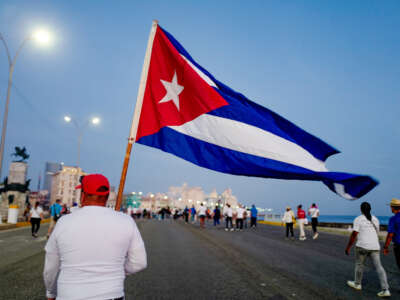
In recent months, President Donald Trump’s blockade against Cuba has generated blackouts and hunger, stretching society to its breaking point. Exploiting the crisis, Cuban American reactionaries across Florida are pressing for regime change. Decked in MAGA swag, they frequently gather along the palm tree-lined streets of Miami to excoriate socialism, promote escalation, and sport signs declaring “Make Cuba Great Again.” Since the war against Iran began, their demand has been simple: “Cuba next.”
While lobbying for intervention, community leaders have drafted detailed agreements for dividing the political spoils and implanting unfettered capitalism on the island. From Guantánamo Bay, Secretary of Defense Pete Hegseth recently primed activists’ expectations by declaring that Trump is “taking back our hemisphere,” insinuating the imminent use of force.
Cuban American conservatives and U.S. officials claim to champion Cuban democracy. Yet the intensified sanctions and pro-war demonstrations lay bare the violence of U.S. policy, while revealing a horrific tolerance for human suffering. Far from defending Cuban sovereignty, Washington and its reactionary allies have long attempted to thwart the island’s aspirations for self-determination. For over a century, U.S. officials have regarded Cuba as a plantation to exploit, rival to defeat, or dissenting voice to silence, never shedding their colonial outlook. The current crisis mirrors this troubled history, as policymakers and right-wing extremists revive siege warfare in the Caribbean.
The Blood-Stained Facade
The latest string of U.S. sanctions and promises to liberate the island resound with bitter irony. In 1898, Washington justified intervening in Cuba’s war for independence against Spain by citing mass starvation among civilians. Leading the charge, Sen. George Hoar declared that Madrid “deliberately [plotted] to starve them to death.” After invading, President William McKinley proclaimed Cuba’s liberation, yet refused to cede power to local revolutionaries, excluding them from negotiations with Spain.
Instead, his administration turned the island into a U.S. protectorate, while claiming that its large population of color made self-rule dangerous. Echoing this sentiment, The New York Times warned against “an irresponsible government of half-breeds,” and the San Antonio Express argued that foreign control was necessary to “save the Cubans from themselves.” For four years, U.S. military authorities attempted to disenfranchise Black citizens, established the Rural Guard to squash dissent, and oversaw a land grab by foreign businessmen, who displaced thousands of farmers.
In 1901, Washington linked independence to acceptance of the Platt Amendment, which granted the United States “the right to intervene” to protect strategic interests. Sen. Orville Platt argued that it was essential for stability, since local politicians were as “irresponsible as children.” The statute allowed U.S. officials to establish a naval base in Guantánamo Bay, before again invading the island in 1906, 1912, and 1917. U.S. leaders mocked Cuba’s sovereignty. Deploying U.S. soldiers in 1906, President Theodore Roosevelt derided “that infernal little Cuban Republic,” claiming that he wanted to “wipe its people off the face of the earth.”
In large part, tensions remained high because of economic exploitation. Following the War of 1898, U.S. businessmen manipulated the widespread destruction of legal records to seize Cuban land. Between 1905 and 1911, the number of farms in Guantánamo alone fell from 1,154 to 419, as foreign investors consolidated massive sugar plantations. The sociologist Lowry Nelson observed that property disputes were “one-sided affairs,” since U.S. corporations employed high-powered lawyers and “corrupt[ed] the officials … with bribes.” Poverty spread across the island, and male unemployment rates surpassed 20 percent by 1907.
Popular outrage finally exploded in 1912, when the Independent Party of Color organized mass protests against racial and economic exclusion. In response, Secretary of State Philander Knox pressured Cuban officials to stifle the uprising by threatening another invasion. Historian Louis Pérez, Jr. emphasizes that U.S. Marines blitzed from the local naval base to protect U.S. property, freeing Cuban soldiers to undertake a cruel campaign of repression. “They have lopped off the heads of probably some six thousand negroes in this province,” a U.S. citizen in Guantánamo claimed. One Afro-Cuban resident recalled that soldiers “killed everything that was Black” and set fire to piles of bodies.
The massacre of 1912 not only showcased the racist fury of Cuba’s ruling class. It also revealed the persistence of colonial control, as the threat of further U.S. intervention supercharged the violence. For decades, Washington portrayed such policies as a form of benign paternalism that guaranteed Cuba’s sovereignty. Yet the Platt Amendment’s shadow encouraged Cuban leaders to prioritize the rights of foreign investors over demands for social justice, prompting former U.S. Ambassador Sumner Welles to conclude in 1934 that Cuba’s government was “merely a facade” for “American interests.”
Unwanted Guests
Before the Cuban Revolution, U.S. businessmen oversaw the island’s economy, while backing President Fulgencio Batista, who tortured dissidents and received suitcases of bribes each week. Historian Van Gosse explains that Batista cemented Havana’s status as a hotbed of vice and colonial desire, where tourists like future President John F. Kennedy drank, gambled, and watched live sex shows in segregated luxury. Overseeing a tropical tax haven, Cuban authorities allowed U.S. investors to remit profits, while controlling entire industrial sectors and 40 percent of sugar fields.
In 1956, Fidel Castro returned from exile to lead a popular uprising that aimed to dismantle the semi-colonial order. President Dwight D. Eisenhower mobilized to help Batista quell the insurrection. A CIA officer recalled that agents “penetrated all institutions” of Cuban life, and U.S. diplomats pursued “all means short of outright intervention” to block Castro from power. While providing military aid, the Pentagon also allowed Batista to launch air strikes from its Guantánamo naval base, razing hamlets with B-26 bombers. In a theatrical twist, rebels then seized U.S. Marines as hostages, forcing Eisenhower to downgrade cooperation.
After their victory in 1959, revolutionaries strove to overcome the legacy of colonialism, successfully eliminating malnutrition and racial segregation. Rebel leader Raúl Castro announced that Cubans had finally “finish[ed] the War of Independence.”
Yet again, Washington conspired to stifle the revolution, fearing that it would undercut U.S. imperial authority and inspire leftists worldwide. In 1960, the State Department contemplated “every possible means” to “weaken the economic life of Cuba,” paving the way for a decades-long blockade. U.S. authorities even impounded Fidel Castro’s airplane, when he visited the United Nations that year. While tensions grew, Under Secretary of State Chester Bowles lamented the Kennedy administration’s “lack of moral integrity,” as officials sponsored assassination plots and terrorist attacks against Cuba. Asked about invasion plans, presidential advisor Adolf Berle exclaimed, “Let ’er rip.”
After the U.S.-backed incursion failed, Castro stationed Soviet missiles on the island in self-defense. Furious, Kennedy risked nuclear war to remove them. Revealingly, he worried that the missiles made Cubans “look like they’re coequal with us.”
More than anything, the U.S. government’s refusal to leave Guantánamo illustrated its colonial mindset. For decades, policymakers exploited the enclave to promote subversion. Island scholars claim that the base became “an important footbridge” for counterrevolutionaries. One Cuban American operative recalled that he simply “jumped the fence,” after the Bay of Pigs invasion failed. Repeatedly, U.S. soldiers shot Cuba’s sentries, killed local civilians, and hurled stones and insults. In 1964 alone, the revolutionary Ernesto “Che” Guevara reported 1,323 provocations at the border, including “acts of sexual exhibitionism.”
Before the Berlin Wall fell in 1989, U.S. officials portrayed Cuba as an unrestrained aggressor. But the truth was the reverse: U.S. policymakers opposed the revolution because it targeted the legacy of the Platt Amendment and crushing exploitation.
Colonizing the Opposition
After the Soviet Union collapsed, the State Department revamped the blockade and stimulated Cuban dissent, hoping to erase what remained of global socialism. Between 1996 and 2011, authorities allocated $205 million for regime change on the island.
In particular, Washington financed media outlets to stir discontent and orient government critics. The National Endowment for Democracy, USAID, and other institutions funded dissident newspapers such as CubaNet, ADN Cuba, El Estornudo, El Toque, and Diario de Cuba. In 2010, policymakers also debuted the social media platform, ZunZuneo, to organize “smart mobs,” and later, spread anti-government hashtags in a failed “Bay of Tweets” in 2021. A former senior U.S. intelligence analyst, Fulton Armstrong, stressed that the policy put Cuba in an impossible bind: “We win if the opposition media gain a foothold, and we win if they provoke government repression,” which would further legitimize U.S.-backed dissent.
This cynical logic equally applied to support for human rights activists. Most notably, Washington helped turn the Ladies in White into international icons of resistance. Cuban women established the group in 2003 after authorities imprisoned their relatives, who allegedly received U.S. financing for political subversion. Ironically, the Ladies then used foreign funds to promote the release of “political prisoners” and intensifying economic sanctions.
Leaked cables reveal that U.S. diplomats often collaborated with the group, while requesting covert financial aid from Washington. Chief of Mission Michael Parmly reported that he met with “[l]eading members” to coordinate tactics. At one session, co-founder Berta Soler lamented the challenge of smuggling money “from a private organization in the United States.”
U.S. officials also cultivated charismatic opposition leaders such as Oswaldo Payá, who became the leading anti-government critic in Cuba. In 2012, Payá died in a car accident. The driver, Ángel Carromero, was a far-right activist from Spain illegally funneling cash to him. Notorious for speeding, Carromero had received 42 traffic tickets from the Spanish government. Nonetheless, Washington and the Payá family claimed that Cuban authorities assassinated Oswaldo by forcing his car off the road.
Relying on Carromero’s testimony, the Inter-American Commission on Human Rights blamed Cuba for the crash in 2023, while U.S. leaders venerated the deceased activist as a martyr. Afterward, the Trump administration strong-armed members of the Organization of American States into placing Oswaldo’s daughter, Rosa María Payá, onto the commission. Human rights experts feared “conflicts of interest,” since her anti-government activism would tarnish the body’s “appearance of independence.” In response, the State Department secured her nomination by threatening aid cuts to states that opposed it. Payá now exploits the position and her U.S.-sponsored nonprofit organization to promote regime change against progressive governments across the hemisphere, citing the violent 2019 coup in Bolivia as a model.
In short, U.S. officials have fostered political division in Cuba for decades. Rather than strengthen democracy, they chose to colonize the opposition. In turn, prominent government critics pursued counterrevolution over reform, as they competed for foreign support. Projecting an imperial forcefield, U.S. power remained discreet yet suffocating. Policymakers were too weak to uproot socialism, but strong enough to keep Cuba frozen in an unending Cold War.
The Politics of Hunger
Since 2017, the United States has drastically tightened the blockade against Cuba, asserting extraterritorial sovereignty over the island. Both Republicans and Democrats backed sanctions to court the votes of Cuban Americans in Florida, as many drifted into the MAGA camp. Celebrating this shift, the Ladies in White dubbed Trump the “Achilles heel” of socialism.
A high-tech form of siege warfare, the blockade prevents Cuba from accessing financial markets, oil, agricultural supplies, and more. During the COVID-19 pandemic, U.S. officials literally tried to asphyxiate the island, blocking the export of oxygen and ventilators. Since 1992, the United Nations has passed 33 resolutions denouncing the blockade, which it says inflicts incalculable losses running into the trillions of dollars.
This year, Trump justified escalating sanctions by citing the Monroe Doctrine, which U.S. leaders invoked to invade Cuba in 1898. Ironically, he portrayed Cuban socialism as undemocratic, while interfering in elections in Argentina, Honduras, and Colombia to advance the far-right realignment of the region. He also pardoned the former Honduran president, Juan Orlando Hernández, for cocaine trafficking, so he could help isolate Cuba and other leftist governments. In leaked audio files, Hernández and his colleagues boast about plans to “eradicate the cancer of the left,” as well as a “new North American base” in Honduras “for conflicts… [with] Cuba.”
More than anyone, Cuban American extremists propel the latest wave of aggression. Despite espousing democracy, their leaders exemplify the strident conservativism and vulgar corruption of the Batista dictatorship, while pushing Cuba toward humanitarian collapse. Secretary of State Marco Rubio’s main political backers, the Fanjul brothers, run a sugar plantation that employs forced labor. Likewise, Trump’s principal adviser on Cuba, Mauricio Claver-Carone, is notorious for sexual and financial misconduct. More broadly, the Cuban American National Foundation, Cuban Democratic Directorate, and other pillars of the Cuban American lobby have misused federal funds, violently assaulted critics, or organized terrorist attacks against the island.
Leveraging her human rights credentials, Payá now leads Pasos de Cambio, a coalition of counterrevolutionary groups, and has signed a “Liberation Agreement” advocating regime change. Island residents call the blockade “genocide,” reporting skyrocketing infant mortality rates and starvation. By contrast, Payá’s colleague Orlando Gutiérrez-Boronat of the Assembly of the Cuban Resistance dubs it “a great achievement by Cuban exiles,” claiming that it grants them the legitimacy to govern Cuba.
Pandering to supporters, Trump recently celebrated the 1898 invasion, before implying that a new era of colonialism has begun: “Cuba … is coming our way.” Afterward, Payá praised the president, recognizing “the historical parallels” and insisting his government is “the best ally of the Cuban people.”
As war drums sound, Rubio demands that UN members “refrain from delivering any remarks” critical of U.S. policy or face retaliation. The Pentagon is considering plans for an aerial invasion of Cuba. And U.S. legislators who visited the island this July warn that sanctions are turning it into a “silent Gaza,” systematically strangling Cuban society.
Ultimately, Cuba’s humanitarian crisis is the latest episode in a 128-year struggle for control over the island. The Platt Amendment and Monroe Doctrine have morphed into the “Donroe Doctrine,” making unprovoked aggression a strategic principle. Legally speaking, the blockade is colonialism in all but name: an extraterritorial assertion of sovereignty that aims to starve Cubans, capsize their economy, and bring them to their knees. As Trump and his allies target Cuba, island residents continue a tradition of unbending resistance against U.S. colonialism and the headwinds of history.
Media that fights fascism
Truthout is funded almost entirely by readers — that’s why we can speak truth to power and cut against the mainstream narrative. But independent journalists at Truthout face mounting political repression under Trump.
We rely on your support to survive McCarthyist censorship. Please make a tax-deductible one-time or monthly donation.
+ There are no comments
Add yours