







Truthout is a vital news source and a living history of political struggle. If you think our work is valuable, support us with a donation of any size.
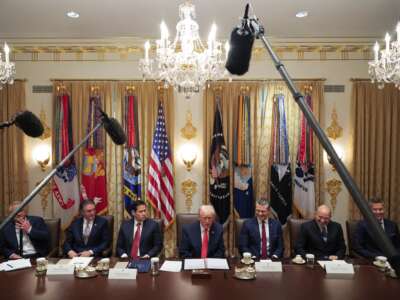
The New York Times recently analyzed public meetings of President Donald Trump’s cabinet, seeking insight into how members of his administration speak to him. That analysis found that flattery plays a major role — in fact, at least one in every six sentences either flattered the president or criticized his political opponents.
It is not unusual for cabinet meetings to feature officials promoting the policy or objectives of presidents. But the analysis — conducted by The New York Times through observation of over a dozen hours of cabinet meeting footage — indicates that his current cabinet is taking it to levels that are typical in authoritarian governments.
It’s also notable how cabinet officials are praising him. Often, these officials are describing the president as being the only person possible to achieve the goals he’s purportedly achieved, including accomplishments he hasn’t yet realized.
For example, Secretary of State Marco Rubio described Trump in glowing terms when it came to his actions on the Russia-Ukraine conflict. “You’re the only leader in the planet that can bring the two sides together to bring an end” to the war, Rubio said at one cabinet meeting.
Notably, the war remains ongoing, and the administration does not appear to be mediating any agreements between the two sides. A meeting between Trump and Ukraine President Volodymyr Zelenskyy also made international headlines after the U.S. president behaved brashly toward his counterpart in a White House meeting last year.
“There are anecdotes that we can point to other presidents who expressed displeasure with dissent in those kinds of settings, but I cannot recall any presidency that has been marked by this much … fawning,” said Jacob Neiheisel, an associate professor in the Department of Political Science at the University at Buffalo, speaking to HuffPost about the matter.
Historically, cabinet officials are meant to provide advice to presidents, informing them of the realities of situations they face or the repercussions of taking certain actions. But the Times’s analysis appears to show that Trump’s cabinet is more focused on promoting his ideas, whether based on sound policy or not.
Trump’s cabinet is indeed far different than those of past presidents, including revered ones like President Abraham Lincoln’s “team of rivals,” which featured officials who had previously opposed Lincoln and would regularly challenge his opinion.
Conversely, historians view Trump’s cabinets — both his first and second terms — as being among the worst ever in U.S. history, noting that his appointees have lacked relevant experience for the roles they serve, have had high turnover rates, have been based on loyalty, and have had low approval ratings among the American public.
Several polls show low approval and favorability ratings for Trump’s team of advisers.
Former Director of National Intelligence Tulsi Gabbard, for example, received a -12 point favorability rating in the latest Economist/YouGov poll, published earlier this week. Robert F. Kennedy Jr., who serves as Secretary of Health and Human Services, also received a -14 point favorability rating.
Meanwhile, in a Quinnipiac University poll published last month, Secretary of Defense Pete Hegseth received a -21 point approval rating. Even Secretary of State Marco Rubio, viewed perhaps as the most “popular” of Trump’s cabinet officials and as a possible 2028 presidential frontrunner, received an approval rating of -6 points.
Contrary to the praise he receives from these officials, Trump’s own approval rating among the U.S. public is dismally low. According to the RealClearPolling aggregate of data from multiple surveys, as of Friday, Trump receives a 40.4 percent approval rating, on average, while 57.1 percent of Americans disapprove of how he’s handling the presidency.
Press freedom is under attack
As Trump cracks down on political speech, independent media is increasingly necessary.
Truthout produces reporting you won’t see in the mainstream: journalism from the frontlines of global conflict, interviews with grassroots movement leaders, high-quality legal analysis and more.
Our work is possible thanks to reader support. Help Truthout catalyze change and social justice — make a tax-deductible monthly or one-time donation today.









+ There are no comments
Add yours