







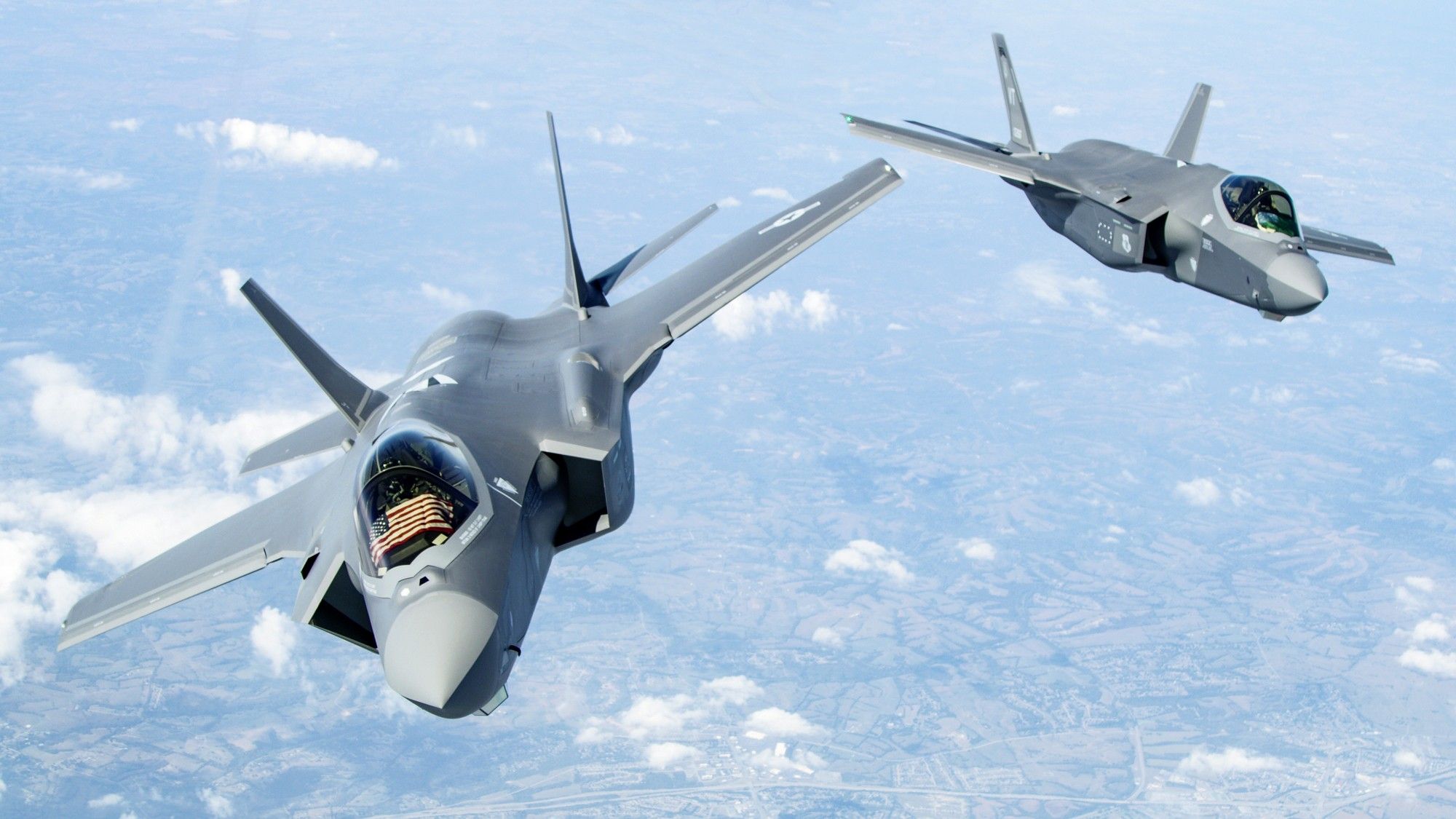
The U.S.’ most expensive military program to date, has fielded a fighter jet that simply doesn’t work most of the time.
A Government Accountability Office (GAO) report released last week found the military’s F-35 fighter jets are only fully mission capable — meaning they can perform all assigned missions — about 25% of the time. That is a steep drop from 2021, when the jets were fully mission capable about 38% of the time.
The F-35’s mission capable rate, which measures how often the jet can accomplish one of its assigned missions, likewise fell from 67% to 44% in the same time frame.
As Dan Grazier, who directs the Stimson Center’s National Security reform program, tells RS: “No one should really be shocked to learn that the program’s readiness rates have decreased. That has become a pattern with the F-35.”
Indeed, the aircraft’s paltry mission capable rates underscore the program’s debilitating sustainment issues. These include a lack of spare parts, software problems, excessive repair backlogs, and unmitigated issues with corrosion on some jets.
In response, the F-35 program has launched an updated sustainment strategy which aims for an 80% mission capable rate, and a 65% full mission capable rate, for the fighter jet by 2030. But it will cost nearly $14 billion — on top of the F-35’s already $2 trillion lifetime price tag.
As Grazier tells RS, more money won’t save the program.
“Program officials have devised a number of similar gimmicks designed to improve outcomes like the C2D2 [Continuous Capability Development and Delivery] effort nearly a decade ago,” Grazier said. He referred to an F-35 software upgrade initiative which aimed to modernize the fighter jet, but ultimately led to programming delays and software problems.
The program’s “costs have more than doubled already,” Grazier said. “After 25 years of development, it should be obvious to everyone that the F-35 is simply a flawed concept.”
As Gabe Murphy, a policy analyst at Taxpayers for Common Sense, tells RS: “If you bought a new car and it only worked 25% of the time, you’d go yell at your dealer until they fixed it or covered the cost of a new one; you wouldn’t go back and buy another new car.”
“Congress shouldn’t pay for a single new F-35 until the Pentagon and its contractors have figured out how to make the planes we’ve already bought work,” Murphy said.
Rather than hit the brakes, the DoD wants to double down. The Pentagon requested over $21 billion for 85 F-35s and adjacent expenses for FY 2027 — nearly double its previous request for 47 F-35s for FY 2026.
From Your Site Articles
Related Articles Around the Web









+ There are no comments
Add yours