





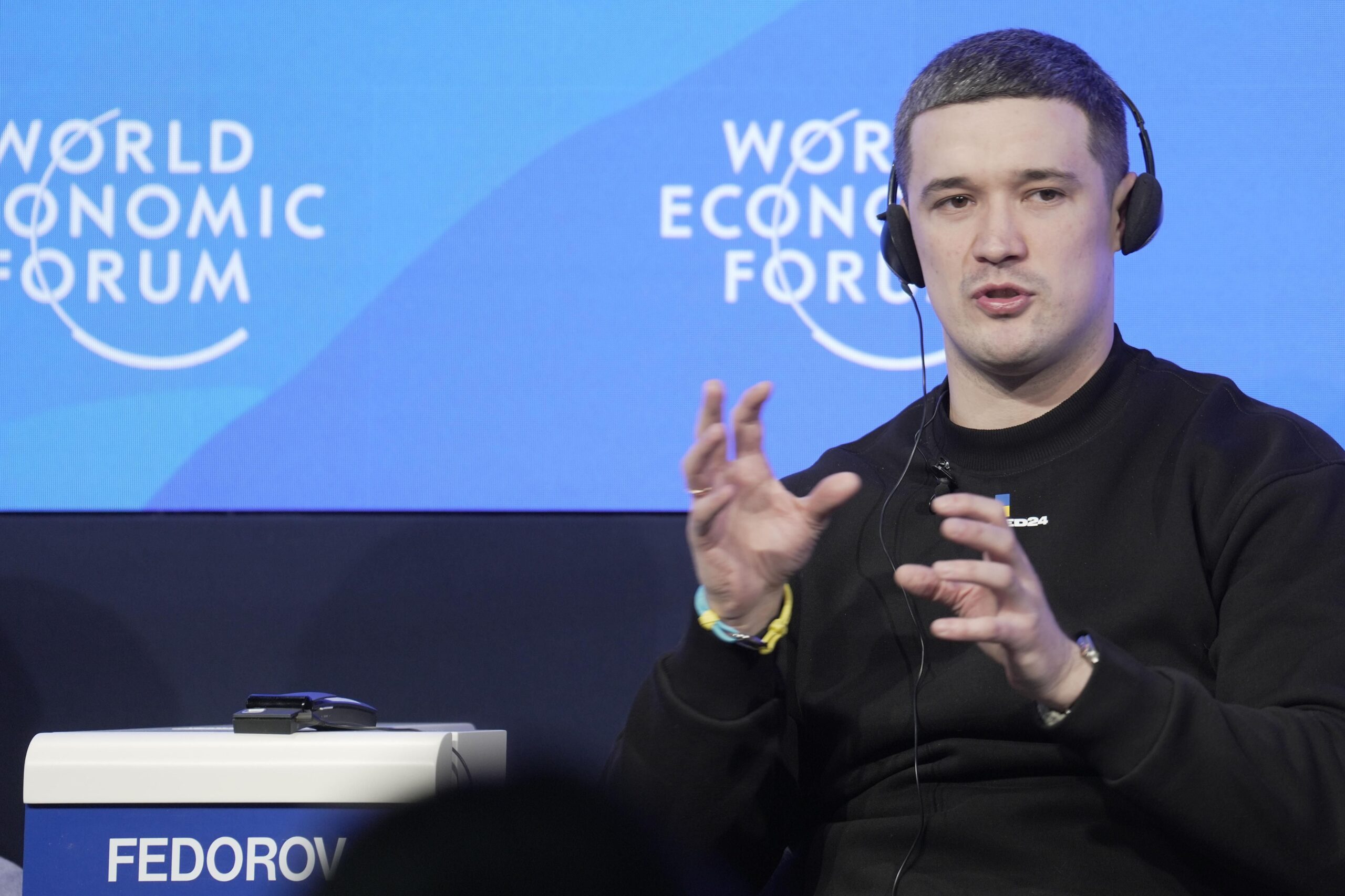
Ukrainian President Volodymyr Zelensky has fired Defense Minister Mykhailo Fedorov as part of a larger government shakeup, setting the stage for an ugly political fight from which Zelensky will likely emerge victorious but not unbruised.
Of all the things that have been labeled — for the most part, inaccurately — by Western observers as a “gift to Russia,” Fedorov’s ouster is one that actually meets the mark. Fedorov, unlike much of Ukraine’s top military and political leadership, grasped the extent of Ukraine’s colossal structural disadvantages vis-a-vis Russia and worked toward a strategy that put Kyiv in the best possible position to maneuver within them.
Whereas a prominent strain of senior Ukrainian leadership found solace in gauging battlefield success by some variation of General Westmoreland’s infamous Vietnam-era bodycount metric, Fedorov understood that Ukraine cannot prevail in a war of attrition against its much larger, better-resourced foe. Ukraine’s erstwhile defense minister sought instead to leverage his country’s comparative advantages in drone innovation and automation in service of a “middle strike” strategy that shifts the locus of the war from the frontlines in Ukraine’s east and southeast to Russia’s rear.
The ensuing Ukrainian strike campaign on targets inside Russia exacted an economic, political, and psychological toll on Moscow that, though it doesn’t change the underlying dynamics of a conflict in which Russia maintains an overall edge in manpower and firepower, has given Ukraine a degree of breathing room and provides a vector for pressuring Moscow.
Zelensky has already tapped the acting head of the Security Service of Ukraine, Yevhenii Khmara, to serve in Fedorov’s stead. Yet it appears unlikely that the middle strike strategy can be sustained without Fedorov, who not only masterminded it but was willing to accept the political sacrifices necessary to make it work.
Executing a strike program along these lines requires prodigious investments and a recalibration of Ukrainian logistics structures, which is where Fedorov ran into trouble. Fedorov understood that he cannot hit the procurement and sustainment targets needed for a middle strike strategy without rolling back the graft, embezzlement, and cronyism that has become endemic to Ukraine’s war effort.
This meant, in practice, cutting out politically well-connected suppliers with profit margins well outside what can be achieved under normal market conditions and enforcing a system of competitive tenders designed to aggressively drive down per unit prices of munitions and other equipment. “We acted harshly as a state by breaking some companies’ business strategies. But how can I justify buying shells we already have in surplus when we have shortages of other types of ammunition?” Fedorov said.
This procurement mentality, coupled with Fedorov’s efforts to reform the AFU’s bloated and overstretched corps system, did not make him many friends in Ukraine’s powerful defense-industrial sector and military bureaucracy. Fedorov reportedly sought the dismissal of the AFU’s Commander-in-Chief, Oleksandr Syrskyi, whom he saw as emblematic of a Soviet-era mindset standing athwart the deep structural changes needed to keep Ukraine’s war effort alive.
But the much more experienced Syrskyi has proven himself a deft political operator — then again, it may not have taken much convincing to align the numerous elites that stand to lose from Fedorov’s reforms into a bloc against him. Meanwhile, Fedorov evidently had not succeeded in shaping a countervailing coalition of stakeholders willing to expend capital on shielding him from political attacks.
These forces came to a head with Zelensky’s decision earlier this week to remove Fedorov, a move so unpopular so as to draw rebuke even from his own state media apparatus. There are protest actions planned across Ukraine that may reach the scale of last year’s demonstrations over Zelensky’s moves to gut the National Anti-Corruption Bureau of Ukraine, or NABU.
As with the protests last year, which were also brought by the ides of July, the demonstrations over Fedorov’s ouster will provide Ukrainians with a rare outlet to express public disapproval with the government’s handling of the war effort.
How will this scandal reflect on Zelensky? It is often said, not without some justification, that Russian President Vladimir Putin enjoys a level of authority and control that offers him substantial, even if not absolute, decisionmaking power. It’s not fully appreciated in Western commentary that Zelensky, though he presides over a very different system, maintains a degree of influence over key Ukrainian institutions, patronage networks, and stakeholder relationships that allows him to weather even the harshest political tides.
The events of the past year speak to his remarkable political resilience. Zelensky backtracked on his NABU legislation and managed to emerge from last year’s protests largely unscathed. Some months later, he fired Andriy Yermak —a close ally who was widely seen as the second most powerful man in Ukraine — on the heels of serious corruption allegations. Though it was widely believed that the two are joined at the hip, Zelensky managed to decouple himself from Yermak and went on with the business of governing.
The reasons for this are fairly straightforward. Zelensky continues to benefit from the near total backing of European leaders who have increasingly assumed the primary burden of supporting Ukraine. The Trump administration, though it has been far more willing to criticize Zelensky than the Europeans, concluded in the aftermath of the pugilistic February 2025 Oval Office confrontation that replacing Zelensky would not necessarily resolve the structural issues holding up a Russia-Ukraine peace deal.
There is no reason to assume Fedorov’s firing, unpopular as it is, will go over any differently — at least not in the short term. Zelensky’s recent challenges, though nowhere near politically fatal in isolation, have had the cumulative effect of dispelling the sheen of near-inviolability that he enjoyed from 2022 through the Biden period.
Zelensky is now running on a surplus of political goodwill — ironically, generated in large part by the successes of the man he has just fired — that insulates him against immediate consequences. But if the past five years of the Russia-Ukraine war have shown anything, it’s that hot streaks tend to be short-lived.
While no one can predict when exactly the cup of Zelensky’s political fortunes will run over, there is little question that Fedorov’s ouster further wounds his standing as a wartime leader.
From Your Site Articles
Related Articles Around the Web



+ There are no comments
Add yours