



Author
Ahmed Barakat
Author

Share

Fact Checked by
CryptoNews Editorial Team
Author
US Midterms Polymarket odds currently price a Democratic sweep of Congress at 66.5% on October 5, with $17.81M in event volume and $7.55M in liquidity. That is a market-implied probability, not a poll or election result, and it does not mean any crypto bill has a 66.5% chance of becoming law.
The market remains open and is scheduled to close on November 4, 2026. Its relevance for crypto traders is therefore conditional: a possible change in congressional control could alter expectations around crypto regulation, but the figures do not show that crypto markets have reacted.
These odds dropped as Bitcoin sits at $86,000, up nearly +1% over the past 24 hours, as the broader crypto market spiked +0.5% overnight, taking the total crypto market cap back above $3 trillion.
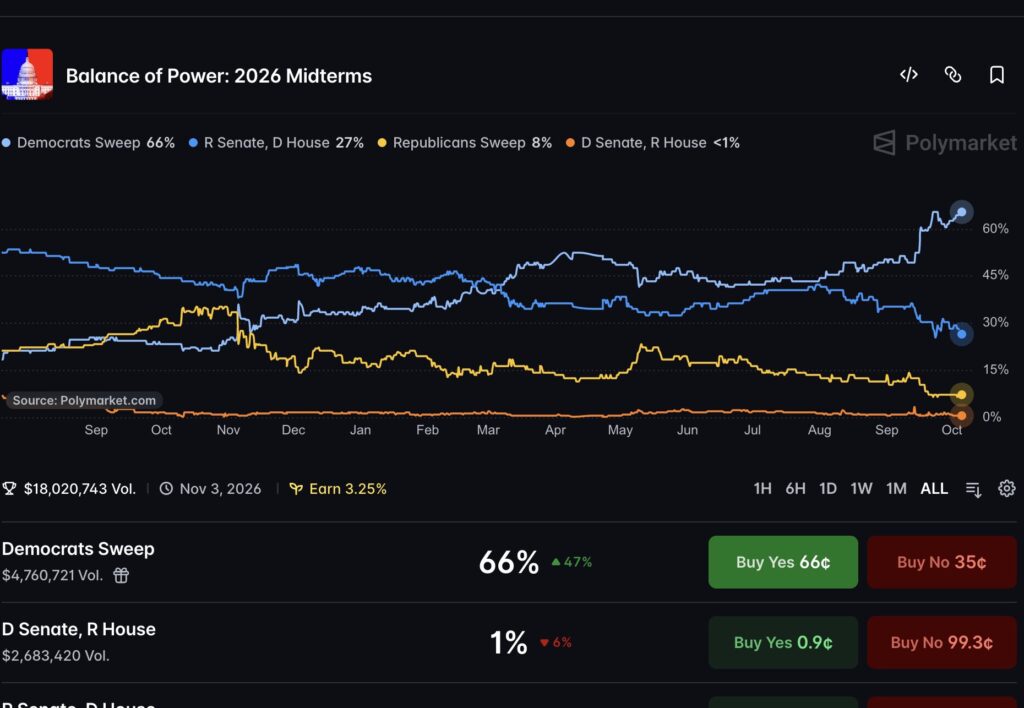
US Midterms Polymarket Odds: What Does the Current Democrat Sweep Price Actually Show?
The headline figure should be read as the market’s current price for one defined outcome, not as certainty. Polymarket’s rules determine control based on the results of relevant House and Senate elections, with provisions for complications such as runoffs and independent members’ party caucuses; close races or post-election control questions can affect how the contract resolves.
That distinction matters when political probabilities enter trading discussions. US political developments can influence market expectations through several channels, including fiscal policy and regulation, but the relationship between Washington policy and Bitcoin’s direction does not turn an election contract into a crypto-price signal. The Polymarket snapshot confirms the odds and trading activity, not a direct cause of price action.
Earn $50 and Enter $300K Prize Draw on EdgeX
How Could a Democratic Sweep Change Crypto-Policy Expectations?
A Democratic sweep could impact expectations for stablecoin legislation, digital-asset market structure, and regulatory priorities, but it wouldn’t directly enact laws or dictate regulatory application.
Proposed stablecoin legislation might clarify reserve assets, redemption rights, and supervision, potentially benefiting compliant issuers but raising costs for some offshore models.
Market-structure discussions include dividing responsibilities between the SEC and CFTC, token classifications, and regulations for exchanges and brokers, with decentralized finance treatment as a potential issue.
Changes in congressional control could influence expectations for these issues, without guaranteeing specific outcomes or enforcement changes.
For traders, this difference is between potential policy shifts and actual market impacts. A Democratic sweep might lead to reassessment of new rules, but the real effects on tokens, exchanges, or stablecoin liquidity depend on the specifics of any legislation.
Regulatory clarity could help compliant US operators, while stricter requirements might complicate compliance. Overall, stablecoin and market-structure debates are relevant but do not show a direct effect from the US election market.
Supercharge Your Trading in 2026 With BloFin AI Trading Bots