







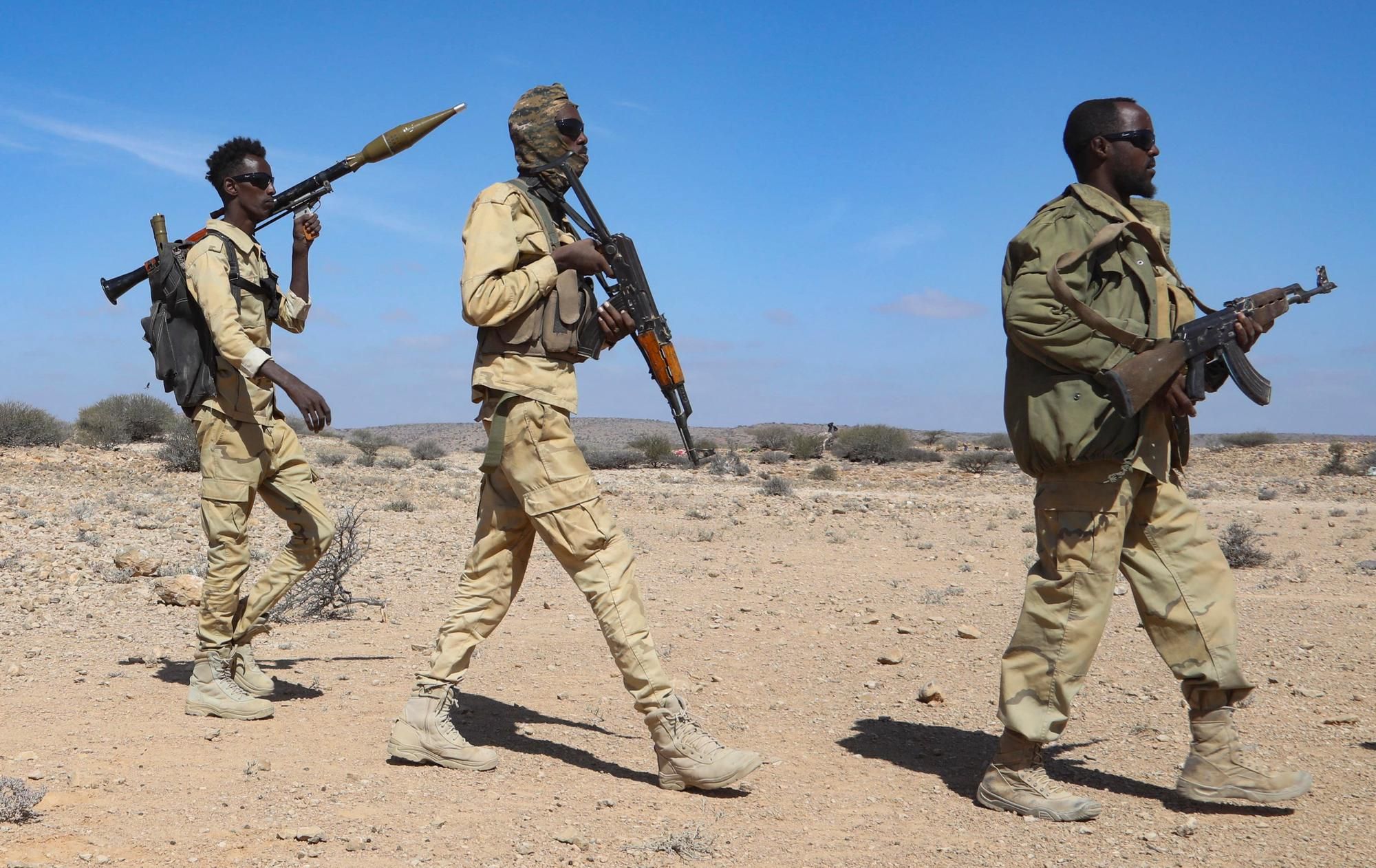
In early August, the top U.S. special operations commander for Africa signed a security agreement with the president of Puntland — a semi-autonomous region in northeastern Somalia — to expand the American military installation there.
The deal surfaced through a short statement from the Puntland government.
“Under the agreement, the United States will expand its military base in Bosaso to improve operations against terrorism and to help protect maritime security,” the Puntland Government of Somalia wrote in a statement. “The Puntland state remains committed to fighting terrorism and any threat that could harm the security, stability, and development of Puntland, Somalia, and the Horn of Africa.”
There are few details regarding the arrangement, which has no public text and has not yet been confirmed by the U.S. Africa Command (AFRICOM) or anybody in Washington.
“The informality is really important,” said Samar Al-Bulushi, associate professor of anthropology at University of California, Irvine, and a non-resident fellow at the Quincy Institute. “If the U.S. wants to be able to stand by its claim — that seems to be a claim only — that it respects the sovereignty of the Somali government, then, in theory, it wouldn’t be negotiating formal agreements with these semi-autonomous regions.”
The deal was reportedly negotiated without input from the central government in Mogadishu — whose authority the government in Puntland does not recognize — marking a notable shift toward treating Somalia’s federal peripheral states as sovereign negotiating partners in their own right.
Though the agreement itself is vague, it signals a potential new direction in the Trump administration’s Horn of Africa policy. Experts say the driving force is the expansion of the Iran war into the Red Sea, not a reaction to events inside Somalia itself. But the move also risks deepening a rift between Mogadishu and the federal states it has long struggled to hold together.
American engagement with these states is not entirely new. Cameron Hudson, an analyst who previously served as director for African affairs at the National Security Council, told RS that the U.S. has used Puntland as a staging ground for operations inside Somalia for years, largely via an Emirati-run base in the port city of Bosaso.
“The United States probably now sees a longer term need to have a kind of wholly owned, wholly operated U.S. base in the region,” Hudson said, a move that likely indicates either an increase in military strikes within Somalia or part of a larger effort to combat growing threats in the wider region.
Washington has for years maintained what is known as a dual-track posture in Somalia, in which it supports Somalia’s internationally recognized central government while simultaneously building direct relationships with regional and local authorities outside Mogadishu, such as Puntland or Somaliland. AFRICOM says that it has no plans to build a military base in Somaliland, though some Republicans in Congress have called on Trump to recognize the state’s independence. The U.S. was also recently the only member of the United Nations Security Council that did not condemn Israeli recognition of Somaliland.
That engagement with Somalia’s peripheral states has taken on new strategic significance as the Iran war has spilled into the Red Sea. Since Yemen’s Houthis announced on July 20 that they would impose a maritime blockade against Saudi Arabia in the Red Sea in what they say is a response to renewed attacks from Riyadh, Washington and its allies have been looking for ways to to prevent the blockade from further destabilizing the global supply chain. A base in Bosaso would position U.S. forces closer to that front in the war.
“The Trump administration might be reconsidering its engagement in Somalia,” Ahmed Ibrahim, a socio-cultural anthropologist who has written extensively about the Horn of Africa, told RS. For the past year and a half, the Trump administration has largely eschewed expanding its presence on the ground in East Africa, Ibrahim said, instead focusing on drone strikes to combat threats from terrorist groups like al-Shabaab. Trump launched a record 124 airstrikes in Somalia last year and has added an additional 78 so far in 2026, a massive increase from the 51 total strikes during President Joe Biden’s term.
Although the move may reflect a shifting approach toward Somalia, the war in Iran and its aftershocks are the key accelerants, says Michael Woldemariam, an associate professor at the University of Maryland and non-resident senior fellow at the Atlantic Council.
“It’s really only understandable in terms of the Red Sea question,” he told RS. “I find it hard to understand what the logic would be independent of increased focus on the Red Sea, Gulf and maritime security questions.”
That logic could help explain why Puntland, rather than Djibouti, which borders Somalia’s northwest, has become one of Washington’s preferred partners for expanding access near the Bab al-Mandab Strait — the body of water that connects the Red Sea to the Gulf of Aden, and through which 10-12% of global shipping travels —according to al-Bulushi. Djibouti hosts Camp Lemonnier, the U.S.’s largest permanent base on the continent, but its government has drawn a line since the start of Israel’s war in Gaza and the subsequent attacks in the Red Sea, telling Washington that it could not strike the Houthis from the naval base in their country because of concerns that this would bring drag them into the conflict. The base in Puntland could offer AFRICOM that level of operational flexibility.
Al-Bulushi described the nascent arrangement as reflecting a “military-to-military style” of engagement that appears to largely leave out elected representation, diplomats, or political appointees on both sides.
“This traces back to the first Trump administration and then the Biden administration, who maintained far greater leeway for the U.S. military, and AFRICOM specifically, to not only engage in negotiations and reach agreements but to engage in operations on the ground without consultation within the U.S. government,” she told RS.
Hudson says the Puntland base expansion could be part of a broader effort for the combatant command to try to “justify its existence,” noting that AFRICOM was reportedly on the chopping block early in Trump’s term but has since found renewed purpose across the continent.
AFRICOM officials also met with leadership in Jubaland, another federal member state that does not recognize Mogadishu’s authority, in the days before the Puntland government announced the deal. These efforts could reinforce a pattern that risks deepening the divisions the U.S. says it wants to see resolved.
“We create this self-fulfilling prophecy,” Hudson told RS.“If we complain about the weakness and division and then we suspend our support [for the central government] and we strengthen the peripheral states, then we are going to accelerate the thing about which we are complaining the most.”
Woldemariam argues that Somalia’s politics were already trending unstable well before this deal, pointing to unresolved disputes over constitutional changes that have frozen cooperation between Mogadishu and the breakaway states. “I’m not sure security cooperation with Puntland or Somaliland really makes it any worse. I think we’re already at a pretty alarming stage,” he says.
But he nonetheless warns about the trajectory of U.S. regional policy after the Puntland military base expansion. “There’s a lot of smoke here,” Woldemariam said. “I think we’re headed in the direction of a scaled-up U.S. presence across the Horn’s Red Sea littoral. Ultimately the form it takes remains to be seen.”
From Your Site Articles
Related Articles Around the Web








+ There are no comments
Add yours