

Honest, paywall-free news is rare. Please support our boldly independent journalism with a donation of any size.
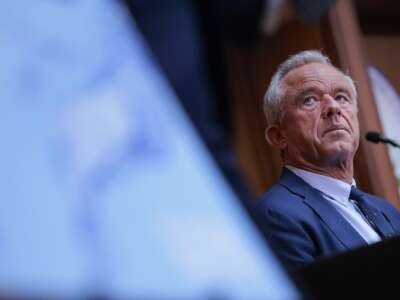
In an extraordinary public display of administration infighting, Secretary of State Marco Rubio told the Senate foreign relations committee on June 2 that he was wresting back control of U.S. contributions to an international vaccine consortium — Gavi, the Vaccine Alliance — from Health and Human Services Secretary Robert Kennedy Jr. and his anti-vaxxer entourage. It was time, Rubio announced brusquely, to “re-engage” with Gavi, which was established in 2000 and takes the lead in vaccinating roughly 60 percent of the world’s children.
Across the public health world, there was a collective sigh of relief. “I hope it is a reset,” Professor Gavin Yamey, director of the Center for Policy Impact in Global Health at Duke University, told Truthout. “I hope it is a sign of support. Traditionally global health has been a remarkably bipartisan concern.” Yamey hopes that Rubio’s announcement will turn the page on the “aberration” of the U.S.’s recent “unprecedented” disengagement with international public health needs.
Gavi is a private organization that is funded by a combination of contributions from governments around the world and from private philanthropy. While the U.S. contributions, which make up about one-seventh of the organization’s total funding, are authorized by Congress and have traditionally been administered by the State Department, RFK Jr. essentially demanded control over the process when he came into office. And, in 2025, the State Department, preoccupied as it was with the administration’s stampede away from multilateralism and overseas aid, acquiesced.
Kennedy has long been a vaccine skeptic, and he has been particularly outspoken in his opposition to the use of a mercury-containing compound named thimerosal as a preservative in multi-dose vaccines. Wealthy countries, which generally use single-dose vaccines, have generally phased out the compound’s usage in vaccines; but in poorer countries, where aid agencies and medical systems have long relied on multi-dose vaccines — which are easier to transport, to store, and to distribute to large numbers of patients at speed — it is still vital to use the preservative in some vaccines so as to prevent contamination of batches.
RFK Jr. has long argued that thimerosal is a neurotoxin that can cause autism. Numerous scientific studies disagree with this — and the scientific consensus is that this type of mercury compound is harmless when used in vaccines. But Kennedy has rarely let science stand in the way of his anti-vaccine ideology, and by June of last year, the Health and Human Services secretary was ordering a cessation of payments to Gavi until the vaccine consortium phased out its usage. “No causal connection has been found,” Sarah Despres, who was counsellor to Health and Human Services secretary Xavier Becerra during the Biden administration and now consults with nonprofits on immunization policy, said of Kennedy’s beliefs about thimerosal triggering autism. “But Secretary Kennedy just doesn’t believe any of that.”
Despite the fact that Congress had authorized $300 million in spending for 2025 — and despite the fact that, according to Gavi, only 14 percent of the vaccines that it distributes contain the compound — Kennedy decided to hold up distribution of all the money to Gavi. In 2026, Congress authorized the same amount again, and, once more, RFK Jr. refused to release it, meaning that $600 million of agreed-upon U.S. contributions to the organization were not paid out. Until last week, Rubio’s State Department had sat by quietly and simply watched as Gavi struggled to meet its vaccination goals absent U.S. support.
“RFK took the mantle and stopped all funding to Gavi,” says Switzerland-based Dr. Seth Berkley, who was CEO of Gavi for 12 years and is now a senior adviser to the Pandemic Center at Brown University.
The vaccine consortium has calculated that because of Kennedy’s short-sighted decision, “600,000 children will ultimately die from not receiving vaccines.”
Berkley told Truthout that the vaccine consortium has calculated that because of Kennedy’s short-sighted decision, “600,000 children will ultimately die from not receiving vaccines.” (Originally, they had estimated the excess deaths would reach 1.2 million, but through some creative rearrangement of its vaccine regimens they have managed to get out more vaccines than they had initially thought possible, even without U.S. funding.)
The huge increase in child deaths expected in the wake of RFK’s action is in addition to the staggering global death toll associated with the administration’s decision to use DOGE to kill off USAID in early 2025. Brooke Nichols, an infectious disease mathematical modeler at Boston University, calculated last July that in the first months following USAID’s demise, 330,000 people died who would likely not have died had USAID programs remained in place. By November, that number had topped 600,000 — and two-thirds of these victims were children. In Ituri Province, in the Democratic Republic of the Congo, CDC monitoring offices have been shuttered; Ituri is now the epicenter of an uncontrolled Ebola outbreak.
In 1990, around the world 12.6 million children under the age of 5 died. Every year from then until 2025, that number declined. In 2024 it was down to 4.6 million. But last year, with Gavi funding cut and USAID destroyed, the number rose again, for the first time this century, reaching 4.8 million. Those excess deaths are the direct consequences of the U.S.’s stampede away from public health interventions on the international stage.
Kennedy’s action has forced Gavi to cut back on its global emergency stockpiles of vaccines for cholera, meningitis, Mpox, yellow fever, and Ebola.
Historically, the U.S. has provided roughly 15 percent of Gavi’s funding. Even though, in recent years, it has been outspent by the U.K., with other large donors being Germany, the EU, Japan, and the Gates Foundation, its contributions remain hugely important. Take away hundreds of millions of dollars, and, explains Berkley, it forces impoverished countries to pony up co-pays for vaccines that used to be distributed free of charge; in consequence, those countries are forced to choose which vaccines to pay for and which to forego. More generally, says Berkley, Kennedy’s action has forced Gavi to cut back on its global emergency stockpiles of vaccines for cholera, meningitis, Mpox, yellow fever, and Ebola. As these stockpiles — which Gavi lets impacted countries access free of charge during epidemics — dwindle, the risk of significant outbreaks rises.
For Yamey, Kennedy’s actions are equivalent to “holding vulnerable children in low and middle income countries to ransom.” Kennedy’s demands for Gavi to summarily stop using thimerosal, Yamey told Truthout, were calculated to cause “massive upheaval and enormous changes to the entire vaccine pipeline.”
Like so much else about the Trump administration’s withdrawal from the U.S.’s international obligations, in the long run the anti-Gavi action orchestrated by Kennedy has been hugely counterproductive. “For every one dollar you invest in vaccines, you get a 54-dollar return,” argues Berkley. “It’s an amazing public health tool.”
Hence, for Berkley and others who have followed this trainwreck, the administration’s apparent U-turn on Gavi funding, coming in the midst of a multi-country Ebola outbreak and with diseases such as polio once more increasing in prevalence, is long overdue. “If the State Department retakes over the relationship,” Berkley says, “it should become more rational and more based on science. If that’s true, it’s a good thing for the world.”
Please support nonprofit journalism
Independent media is a pillar of democracy and a powerful force for justice. Please make a tax-deductible one-time or monthly donation to Truthout if you can.

+ There are no comments
Add yours